Companion planting is one of those gardening topics where useful ideas and garden folklore have become so mixed together that it can be difficult to know what to believe. Search for almost any vegetable online, and you can find long charts declaring that one plant is a “good companion,” another is an “enemy,” and a third supposedly protects the entire garden simply because of its smell. Real gardens are more complicated.
Plants growing beside one another interact through light, water, root space, nutrients, canopy size, flowering time, insects, and the gardener’s management. Sometimes two crops genuinely work well together because they occupy different parts of the available space. A tall crop can provide useful afternoon shade for a cool-season vegetable. A quick radish crop can be harvested before a slower tomato plant fills the bed. A climbing crop can use vertical space while something shorter grows beneath it.
In other cases, the advantage comes from insects rather than physical spacing. Flowering herbs can provide nectar or pollen for predators and parasitoids that attack vegetable pests. Research has also found specific examples in which interplanting herbs or flowers can interfere with pest-finding or egg-laying behavior. However, that is very different from saying a single basil plant beside a tomato makes the tomato “pest-proof.”
University Extension guidance reflects this distinction. Oregon State University describes companion cropping partly as a way to stagger harvests and make better use of limited garden space, while Penn State and the University of Minnesota summarize research showing that some herb-and-vegetable combinations can influence particular pest populations or attract beneficial insects. They also caution, directly or indirectly, against treating every traditional companion-planting claim as fact.
That is the approach used here. Some of these eleven combinations have research behind a specific biological benefit. Others simply make excellent horticultural sense because their growth habits, seasons, or space requirements complement one another. Neither type needs to be magical to be useful.
1. Tomatoes and Basil
Tomatoes and basil are probably the most famous companion-planting combination, but there is a better reason to grow them together than the usual claim that basil somehow repels everything that might attack a tomato. From a practical perspective, they fit the same summer garden well. Both appreciate warm conditions, abundant sun, and reasonably consistent moisture. Tomatoes occupy the upper part of the bed while basil remains much shorter, allowing you to use some of the open soil around widely spaced tomato plants without introducing another large competing vegetable.
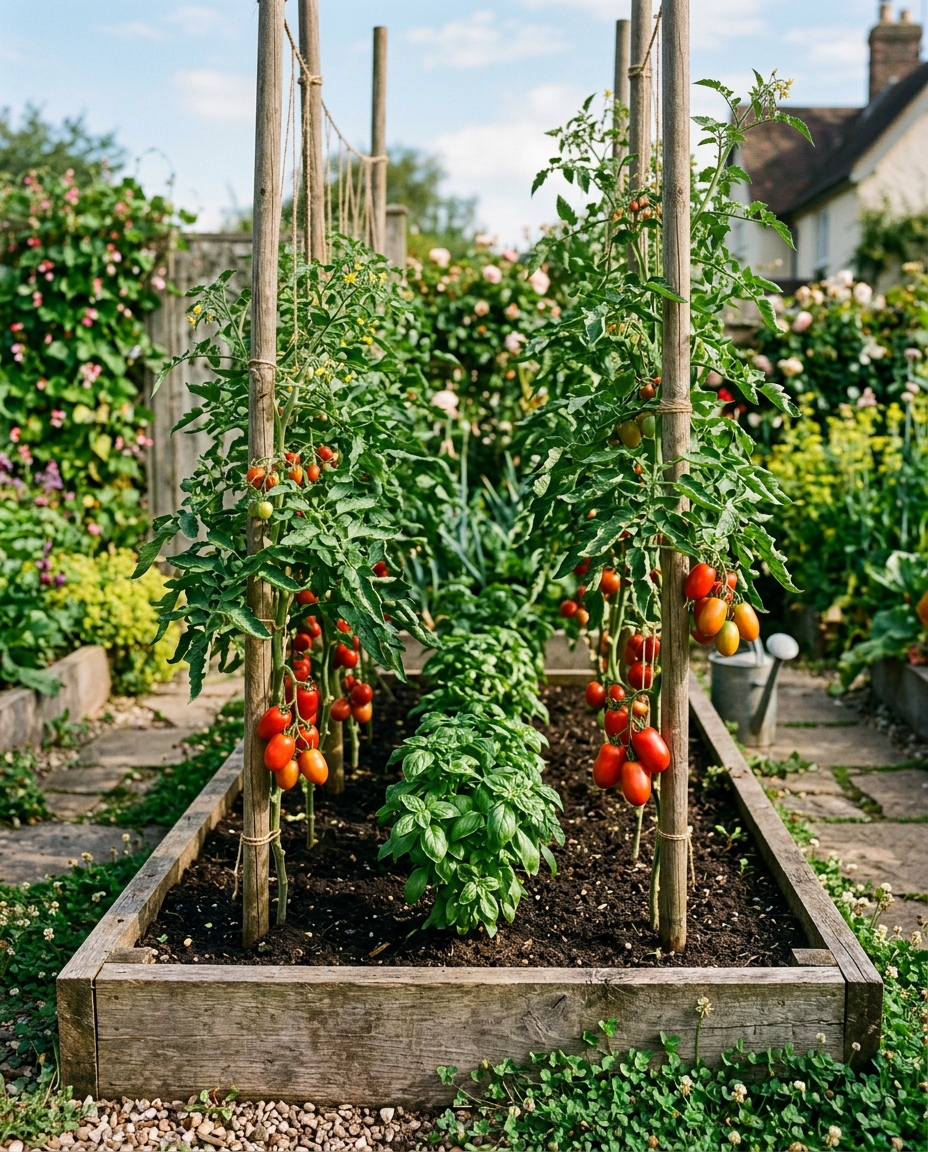
There is also research behind at least some of the pest-related claims. Penn State Extension reports evidence that basil interplanted with tomatoes can interfere with thrips finding tomato plants and can reduce egg-laying behavior by tomato hornworm moths. University of Minnesota Extension similarly notes studies in which basil reduced thrips populations in tomatoes. That should not be interpreted as complete pest control, but it gives this traditional combination more support than many companion-planting pairings found on garden charts.
Spacing still matters. Do not create a dense ring of basil around the tomato stem. Tomatoes need airflow, access for pruning or harvesting, and enough open soil for irrigation. Place basil where it can receive adequate light without creating a humid mass of foliage around the base of the tomato. The combination becomes especially useful in a small kitchen garden because both crops are harvested repeatedly and are often used in the same summer meals. Even without any pest benefit, that alone makes the planting efficient.
Why This Combination Makes Sense
| Tomato | Basil | Shared Advantage |
|---|---|---|
| Tall crop | Short crop | Uses different canopy levels |
| Warm-season | Warm-season | Compatible planting season |
| Needs strong sun | Prefers strong sun | Similar site conditions |
| Long production period | Repeat harvest | Productive summer pairing |
2. Tomatoes and Leaf Lettuce
Tomatoes and lettuce make sense together for a completely different reason: timing and shade. Leaf lettuce is a cool-season crop that tends to struggle as temperatures rise, while tomatoes begin relatively small and eventually become large warm-season plants. Early in the season, lettuce can use the open soil around young tomato transplants before the tomato canopy expands significantly. As the tomatoes grow, some of that developing shade may help protect lettuce from intense sunlight and heat for a little longer.
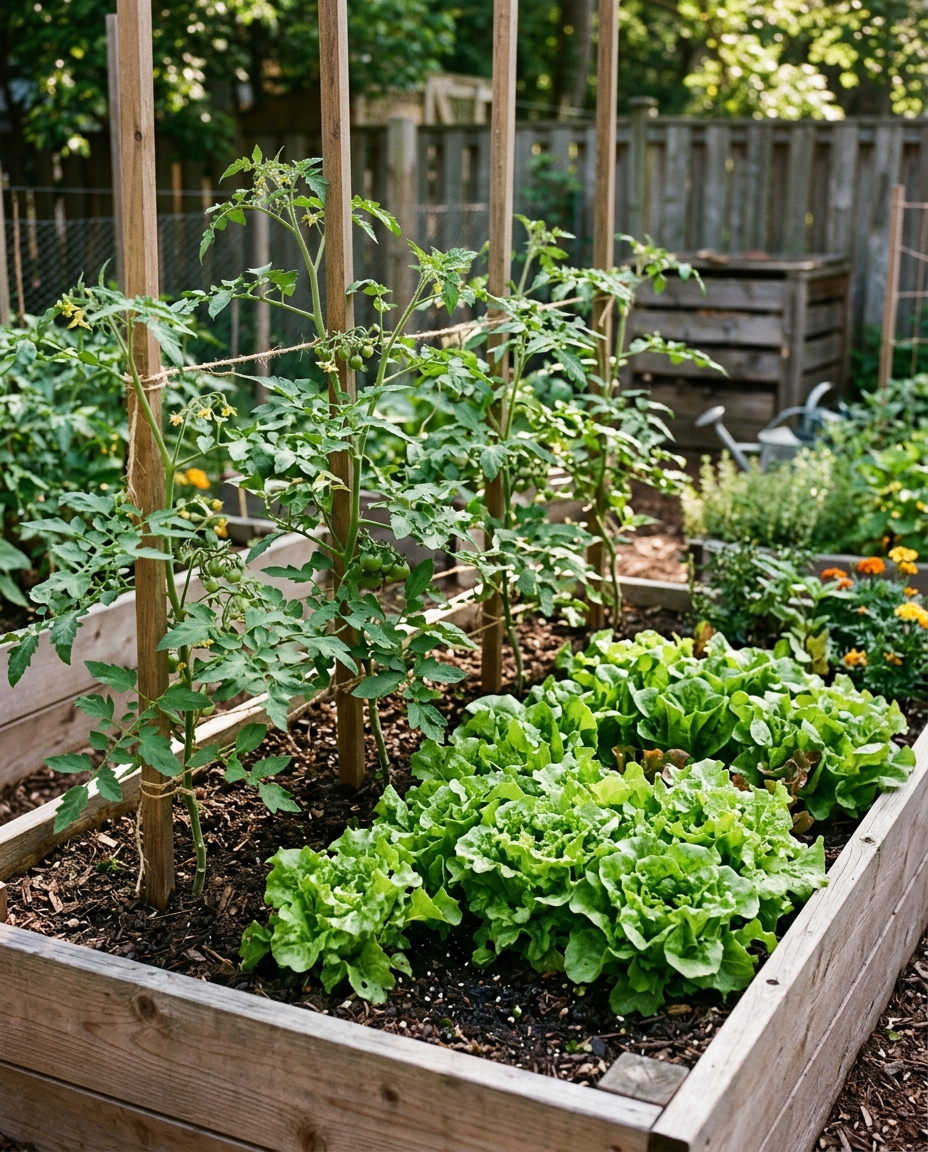
Oregon State University specifically includes lettuce with tomatoes as a useful companion example, noting the value of taller crops providing shade as conditions warm. This does not mean lettuce will happily produce beneath tomatoes throughout the hottest part of summer in every climate. Once temperatures become too high, many lettuce varieties will bolt regardless of shade. The useful part of the combination is the transition between seasons.
Instead of leaving a large circle of bare soil around small spring tomato transplants, grow lettuce in that temporary space. Harvest the lettuce as the tomatoes expand. By the time the tomato plants need their full mature footprint, much of the lettuce should already have been removed.
That is companion planting through timing rather than permanent coexistence.
Best Use
Plant lettuce toward the front or sunnier edge of the tomato bed early in the season. Avoid placing it directly against tomato stems, and allow enough access for watering and tomato maintenance.
3. Tomatoes and Radishes
Tomatoes and radishes are another good example of companion planting based on timing rather than mysterious chemical effects between plants. Radishes grow quickly. Tomatoes do not.
When tomato transplants first enter the garden, a large amount of the eventual tomato-growing area remains temporarily open because the plants are still small. Radishes can occupy some of that space for several weeks and be harvested before the tomato roots and canopy dominate the bed. Oregon State University specifically uses radishes and tomatoes as an example of companion cropping for gardeners with limited space, while emphasizing that the larger crop should not eventually inhibit the smaller one.
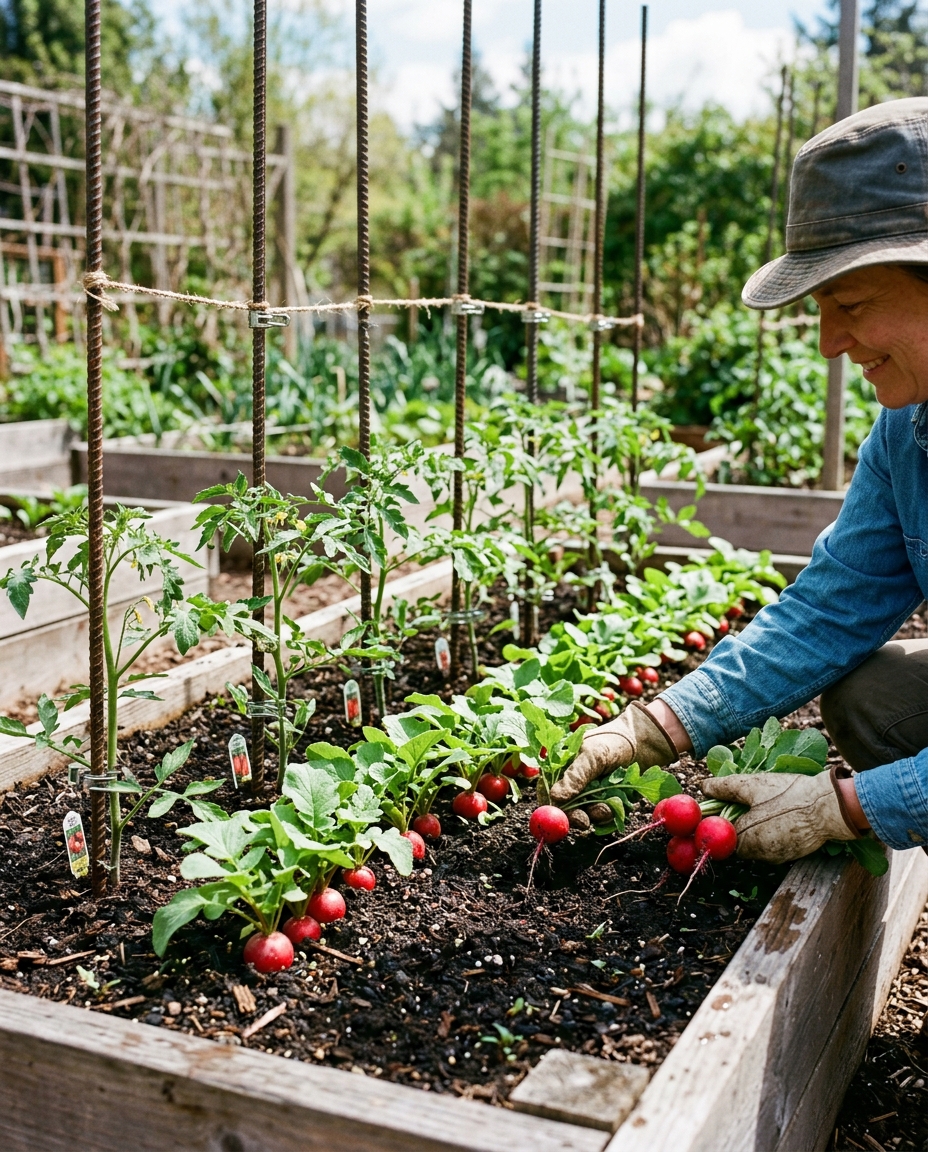
This is an important companion-planting principle: two vegetables do not necessarily need to spend their entire lives together. Sometimes the most efficient pairing is one in which the first crop disappears exactly when the second begins needing more space.
Sow a modest amount of radish seed rather than filling every gap densely. The tomatoes still need access to water and nutrients, and the radishes should be harvested promptly once they mature. The result is essentially two harvests from overlapping garden space instead of leaving valuable spring soil empty while waiting for the tomatoes to become large.
Best For
Raised beds, small vegetable gardens, gardeners using intensive succession planting, and anyone who wants an early harvest before summer crops reach full size.
4. Carrots and Tomatoes
Carrots and tomatoes can share a bed effectively when spacing and timing are handled carefully. Tomatoes create most of their visible growth above ground, while carrots concentrate the crop below the soil surface. That difference makes it possible to use garden space more efficiently than pairing two enormous leafy vegetables.
Oregon State University includes carrots with tomatoes as a companion combination and notes that shade from mature tomatoes can help carrots during warmer weather.
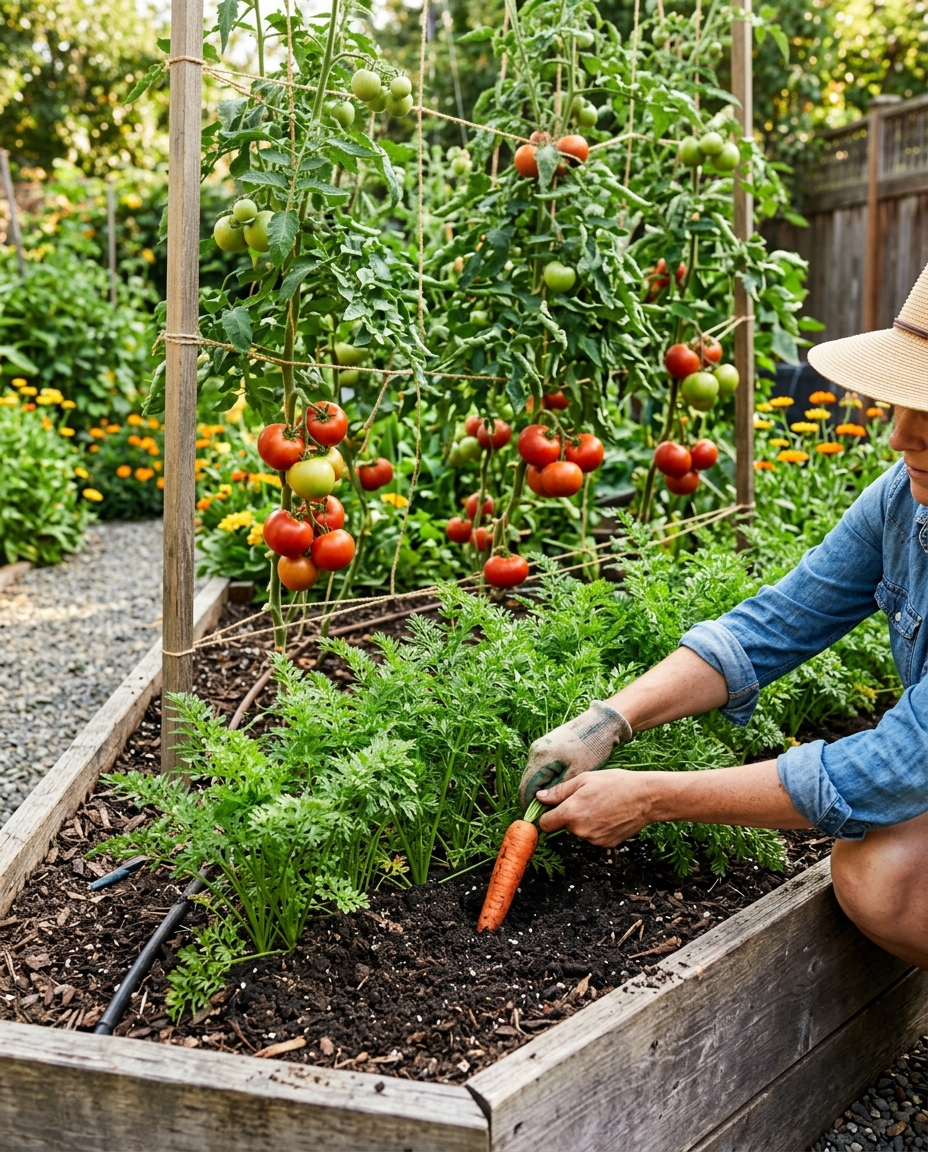
The combination is easiest when carrots are planted early. They can develop while tomato plants are still small, and by the time the tomato canopy becomes substantial, the carrots are already well established. Some protection from intense afternoon sun can be useful during warm periods, although the carrots still need adequate light.
Do not sow carrots in a dense circle directly around the tomato stem. Tomato roots occupy a large volume of soil, and both crops still need sufficient water and nutrients. Place the carrots toward the accessible edge of the bed where they can be thinned and harvested without damaging tomato roots or supports.
Soil structure also needs to favor the carrots. Loose, stone-free soil is more important to carrot quality than the identity of its neighbor.
5. Pole Beans and Corn
Beans and corn are a classic combination that makes sense because they use space differently. Corn grows vertically as an upright stalk, while pole beans naturally climb. In some systems, established corn can provide part of the support that climbing beans need, reducing the amount of separate trellis infrastructure required.
Oregon State University lists corn and beans among useful companion combinations, noting differences in root depth and the ability of climbing beans to use corn as support. There are important practical limitations, however. Corn stalks should be established and sturdy before aggressive pole beans begin climbing them. If both are planted at the same stage and the beans grow faster, vines can overwhelm young corn.
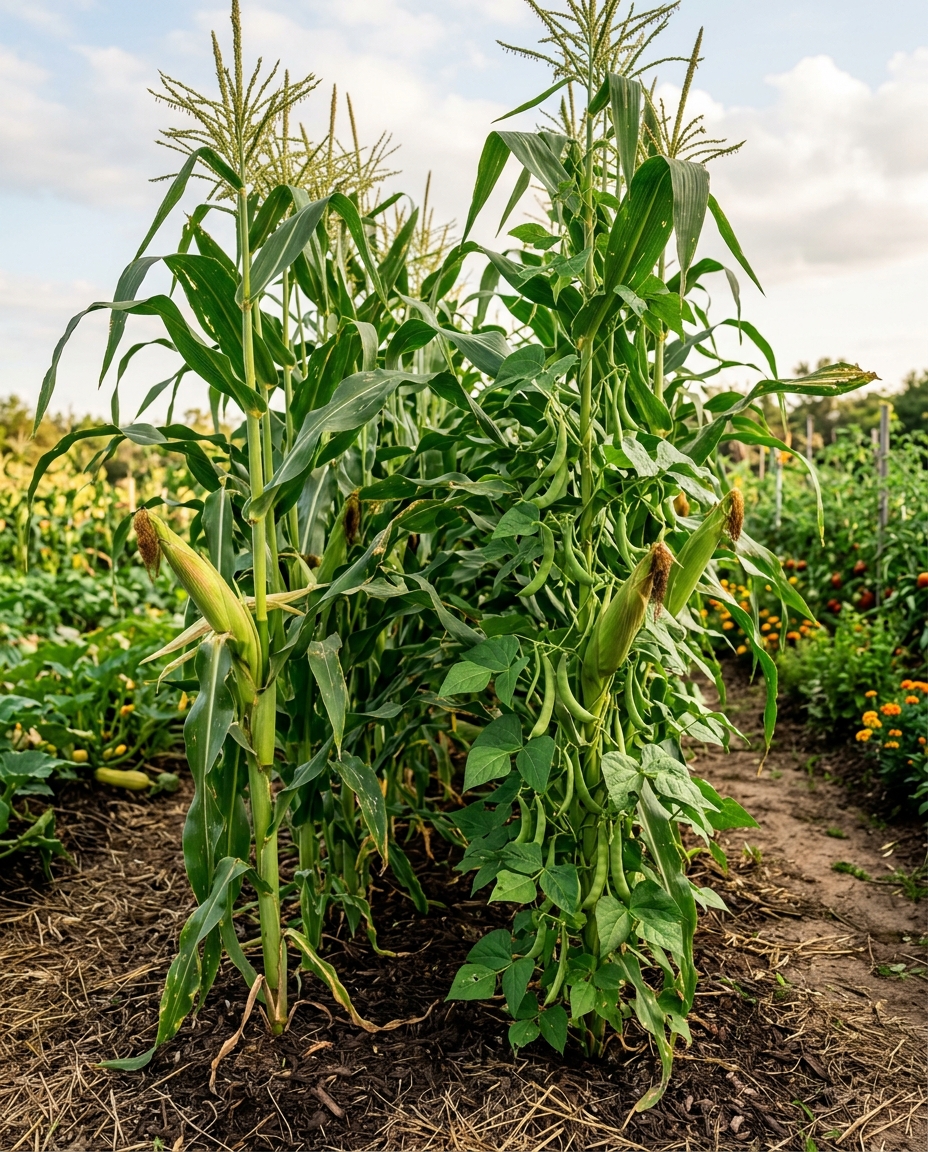
Corn also needs appropriate spacing for reliable wind pollination. A few isolated stalks in a single line generally pollinate less effectively than corn planted in a block. Companion planting should not override the crop’s basic growing requirements.
Another common misunderstanding involves nitrogen. Beans host nitrogen-fixing bacteria in root nodules, but this does not mean a bean plant immediately fertilizes neighboring corn throughout the season. Much of that nitrogen remains within the plant system and becomes more available after residues and roots decompose. OSU explicitly notes that legumes need to remain and decompose for that nitrogen benefit to become available over time.
The strongest reason for the pairing in a home garden is therefore space efficiency, not free instant fertilizer.
6. Peas and Leafy Greens
Peas and leafy greens such as lettuce or spinach make an excellent practical combination because they prefer similar cool-season growing periods while occupying different vertical spaces. Peas climb upward on a trellis, leaving much of the soil surface available around the base. Lettuce or spinach remains low and can fill part of that lower zone without interfering with pea vines when adequate spacing is maintained.
The timing also works well. Both crops are commonly grown during cooler weather, which means you are not trying to force one plant through summer heat while keeping its neighbor comfortable.
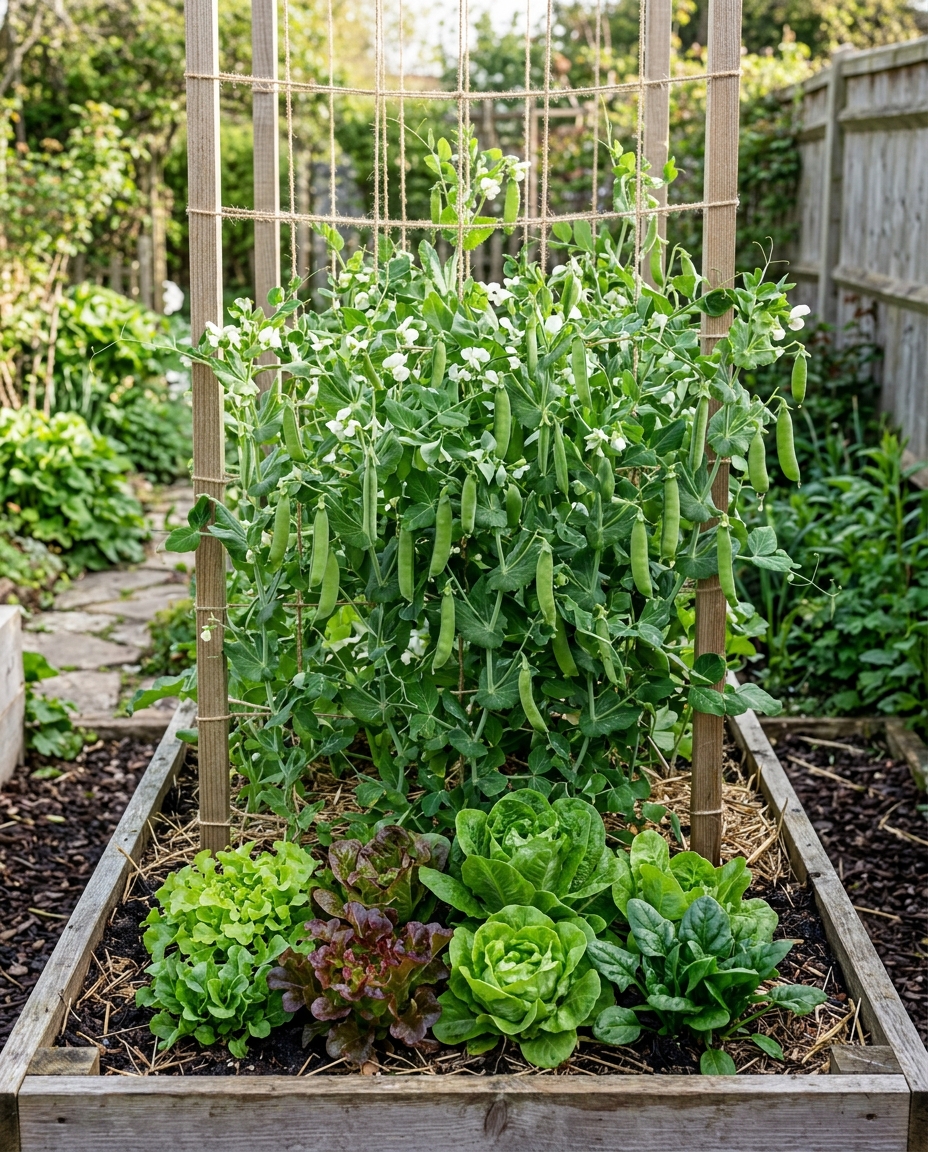
As temperatures rise, the pea trellis may provide some light shade to nearby greens. That will not prevent heat-induced bolting indefinitely, but it can make the planting arrangement more efficient during the transition toward warmer conditions.
Position leafy greens on the side of the trellis where they will receive the amount of light appropriate to your climate. In cool spring weather, excessive shade is unnecessary, while in warmer conditions some afternoon protection can become useful. Once peas finish producing, remove the vines and reuse the vertical support for a warm-season crop such as cucumbers or beans if your growing season allows. This turns one small garden section into a sequence of productive plantings.
7. Brassicas and Thyme
Broccoli, cabbage, kale, Brussels sprouts, and other brassicas commonly attract cabbageworms and related caterpillar pests. This is one area where companion planting has research behind some specific herb combinations.
Penn State Extension reports research in which thyme reduced egg-laying behavior by adult cabbageworms and cabbage loopers around cole crops. University of Minnesota Extension also summarizes research showing that thyme, along with some other companion plants, reduced populations or damage from certain brassica pests.
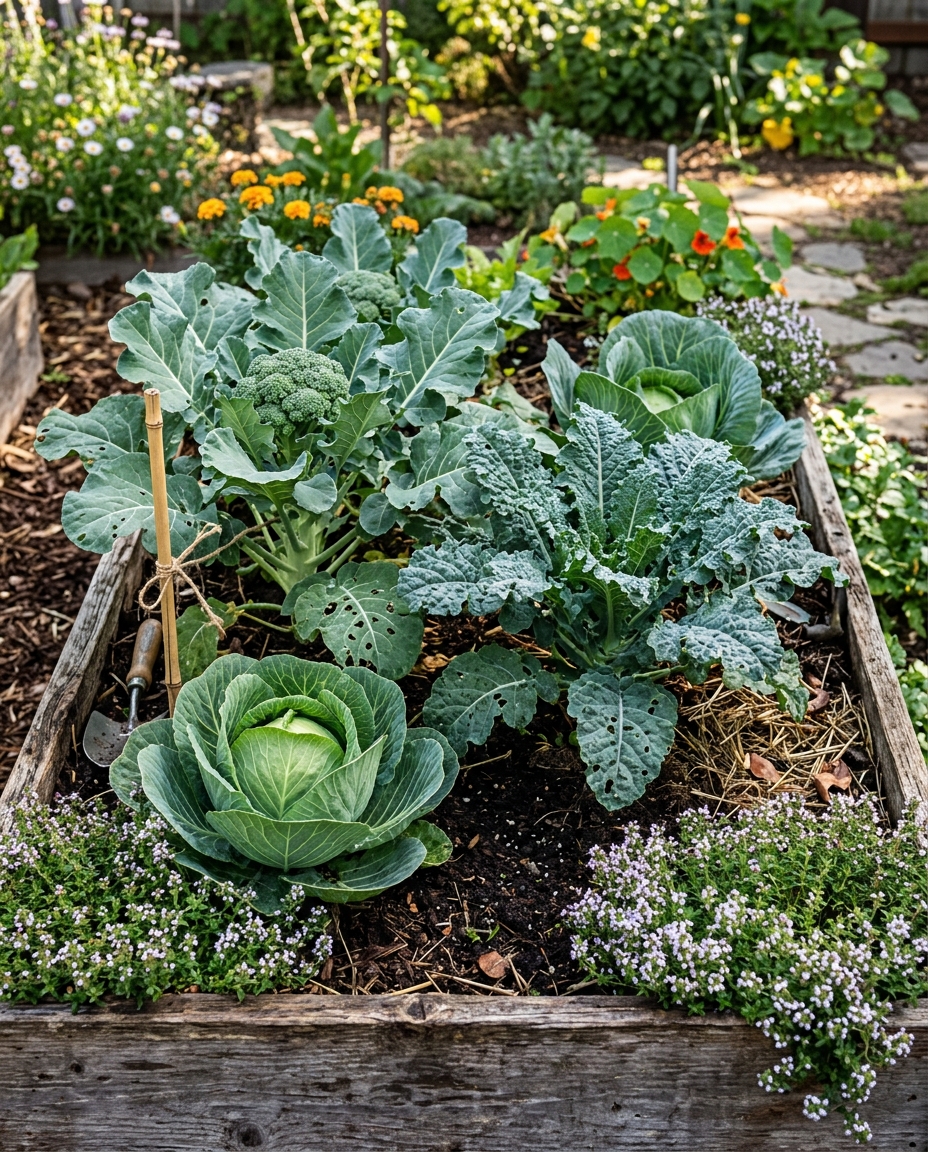
That does not mean thyme replaces row covers, monitoring, hand-picking, biological controls, or other pest-management strategies. The effect is better understood as one additional layer within a diversified garden. Thyme is particularly useful because it remains relatively low compared with mature broccoli or kale. It can occupy an edge or corner of the bed without creating a tall canopy that competes strongly for light.
Established thyme also prefers reasonably well-drained conditions, so avoid planting it in the wettest portion of an intensively irrigated brassica bed. Keeping the herb near the bed edge can make moisture management easier. For gardeners who already use thyme in the kitchen, this combination has another advantage: the companion plant provides a useful crop even if its insect-related benefit is modest in your particular garden.
8. Lettuce and Flowering Cilantro or Dill
Letting a small amount of cilantro or dill flower can turn an ordinary herb planting into useful habitat for beneficial insects. Penn State Extension specifically identifies cilantro, dill, and fennel near lettuce and other greens as plants that can help attract beneficial predators associated with aphid control. It also notes more broadly that several flowering herbs support parasitic wasps that attack caterpillar pests.
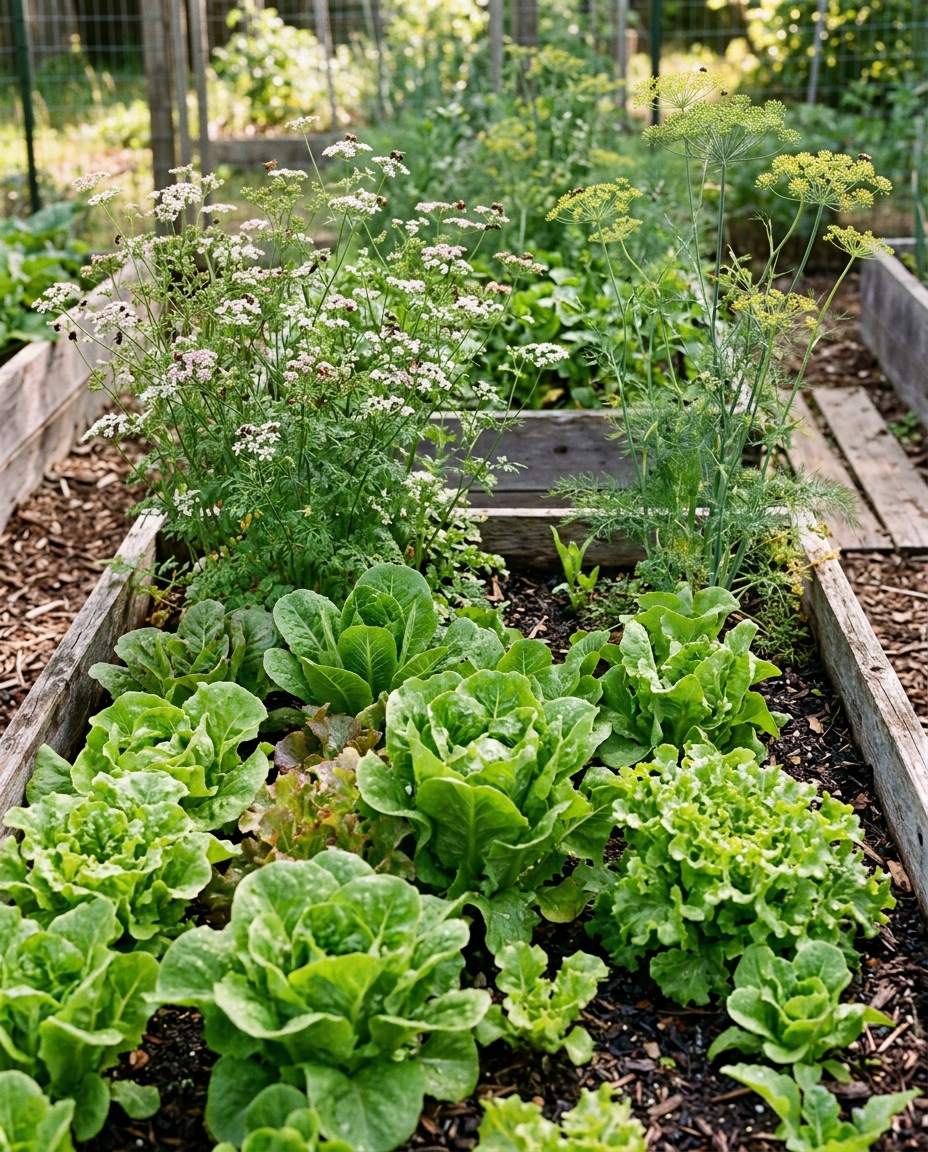
The key word is flowering. The beneficial-insect value is not simply created by having a few leaves of dill somewhere in the garden. Many predatory or parasitic insects use the small flowers as sources of nectar or pollen.
This makes the combination particularly useful when herbs begin to bolt. Gardeners often remove cilantro immediately when it flowers because the leaves become less useful for cooking. Leaving one or two plants in bloom can instead provide ecological value while the remaining plants are harvested normally.
Do not allow a forest of mature dill to shade the lettuce. Dill can become tall, so position flowering plants toward the rear or outside edge of the bed. The combination is less about one plant defending another and more about creating a garden that supports the insects that naturally prey on pests.
9. Eggplant With Cilantro or Dill
Eggplant and flowering herbs provide another example where companion planting can be based on beneficial-insect habitat rather than the idea that a strong-smelling herb simply repels pests.
Penn State Extension reports that cilantro and dill planted with eggplant can increase beneficial predator insects associated with control of Colorado potato beetles, which can also feed on eggplant because both eggplant and potato belong to the nightshade family.
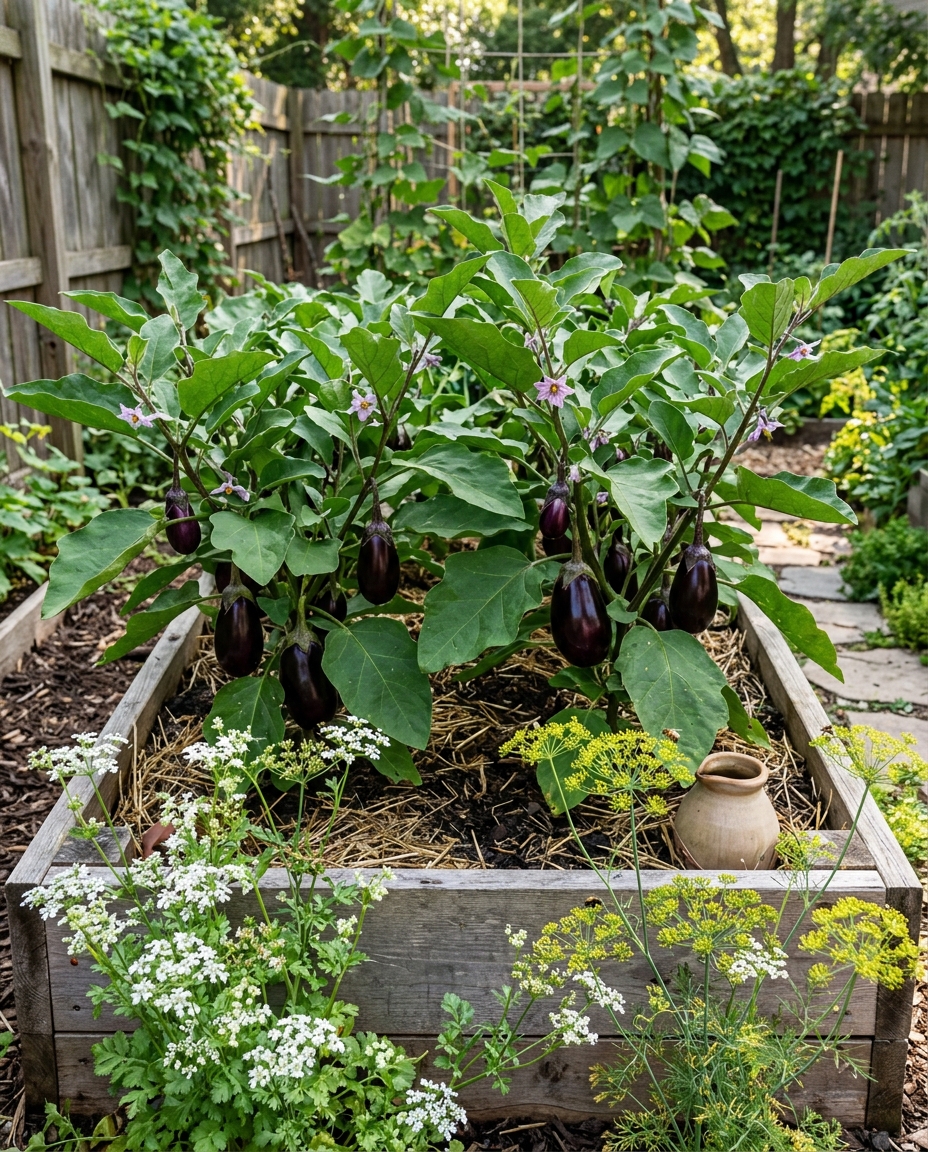
For a home gardener, the layout should still prioritize the eggplant’s needs. Eggplants become broad, sun-loving plants, so they should not be buried among large amounts of competing herb growth. A few flowering dill or cilantro plants around the edge of the growing area are enough to add diversity without creating unnecessary crowding.
Cilantro is particularly useful early in the season because it prefers cooler conditions and often begins flowering as warmer weather arrives. That natural transition can coincide with eggplant becoming larger and more established.
As with other beneficial-insect combinations, results will vary. Local insect populations, surrounding habitat, pesticide use, and the overall diversity of the garden all influence whether predators or parasitoids appear. The broader lesson is useful beyond eggplant: a vegetable garden containing some flowering plants often provides more resources for beneficial insects than a garden made entirely of vegetables harvested before they bloom.
10. Squash and Nasturtiums
Nasturtiums are commonly recommended beside nearly every vegetable online, often with vague claims that they repel anything undesirable. The evidence is more specific than that, but there is some support for planting them near squash.
University of Minnesota Extension summarizes research in which nasturtiums helped reduce squash bug populations, and another study found reductions in damage from squash bugs and cucumber beetles when nasturtiums or marigolds were incorporated into squash plantings.
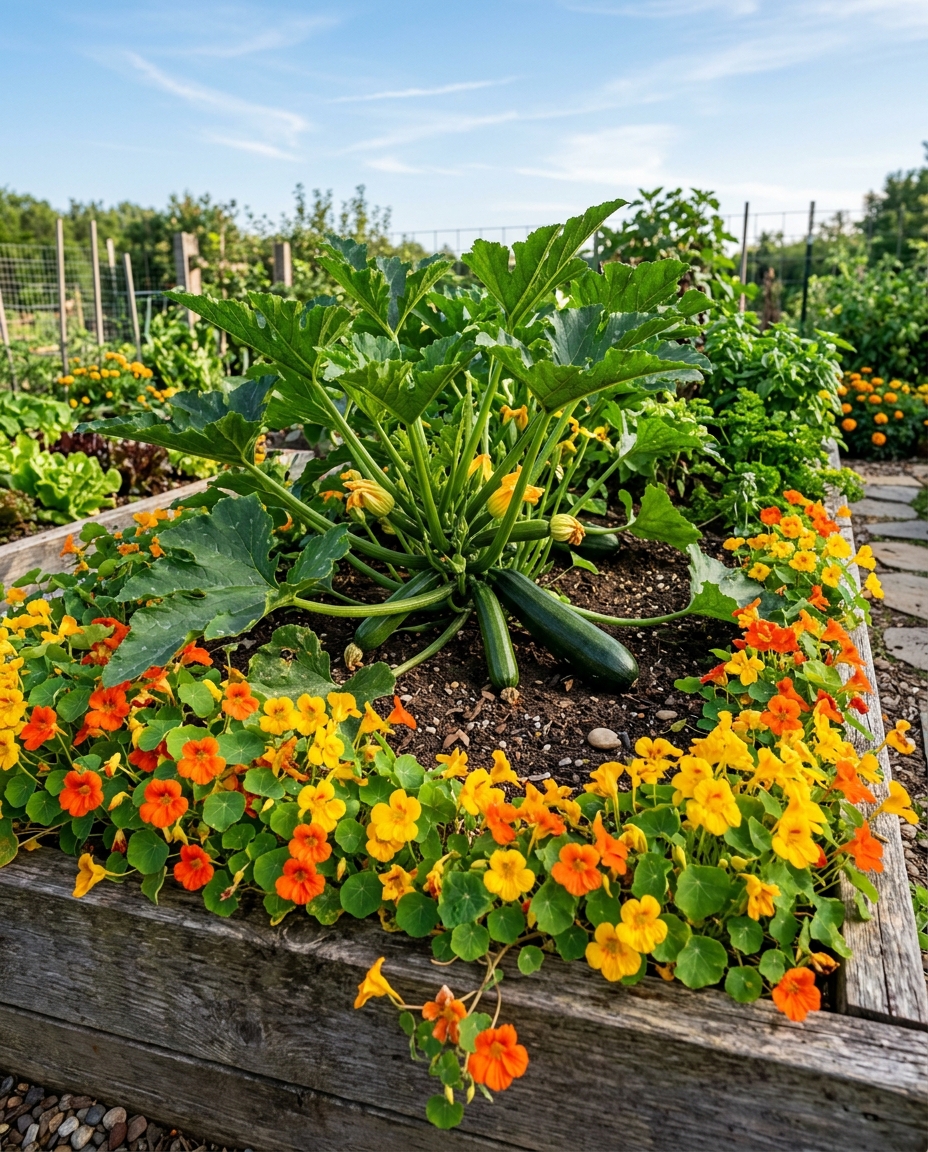
This makes nasturtium and squash a more defensible pairing than many traditional companion charts suggest. The challenge is space. Squash plants are already enormous, and nasturtiums can spread considerably depending on variety. Planting everything tightly around the squash crown can reduce airflow and make harvesting difficult.
A better design places nasturtiums around the outer edge of the squash area where they can flower and spread without disappearing beneath the squash canopy. Compact nasturtium varieties may be particularly useful in small raised beds.
Flowers also contribute another useful function: increasing floral resources in a garden where squash depends on insect pollination. A broader supply of flowers can support pollinator activity, although planting nasturtiums does not guarantee perfect squash pollination on its own. UMN emphasizes the value of consistent flowering habitat for pollinators around squash and pumpkins.
11. Squash and Sweet Alyssum
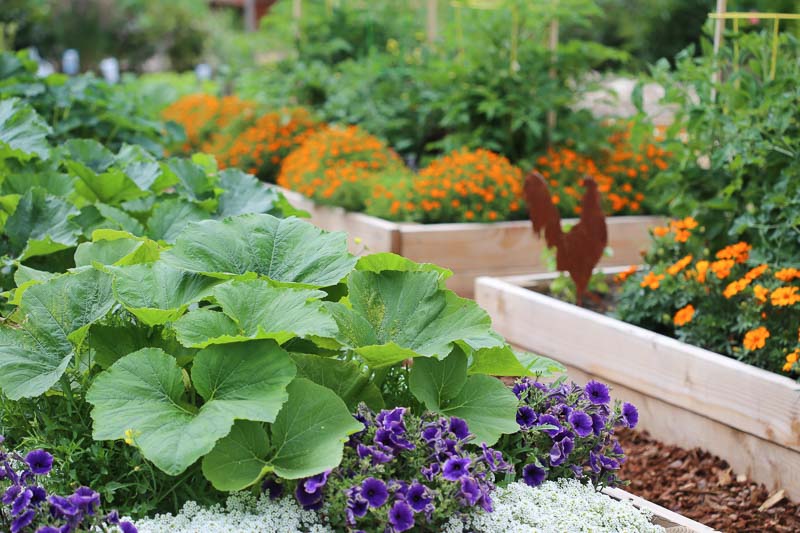
Sweet alyssum is an excellent example of companion planting that focuses on beneficial insects rather than direct repellent effects. The plant remains low, produces many small flowers, and can bloom for an extended period under suitable conditions. Those flowers provide accessible resources for small beneficial insects that may otherwise find very little food in a vegetable-only garden.
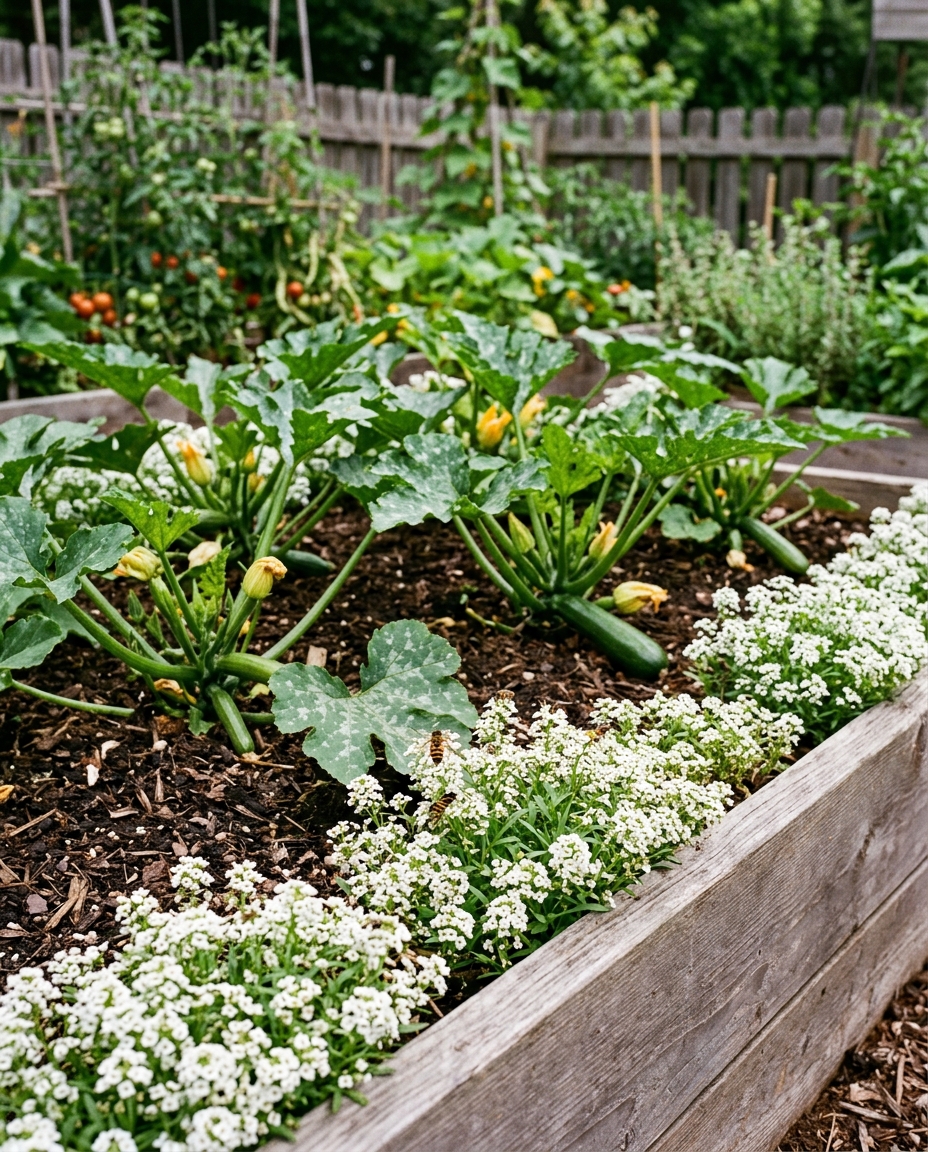
University of Minnesota Extension cites a Florida study where African marigolds and sweet alyssum planted with squash increased populations of natural enemies of aphids and produced a slightly positive effect on yield. That makes sweet alyssum particularly useful along bed edges. Its low growth means it can provide flowers without becoming another large competitor in a space already dominated by broad squash leaves.
Do not plant it so densely that the soil becomes completely covered immediately around squash stems. Leave room for irrigation, inspection, airflow, and ordinary garden maintenance.
Sweet alyssum also works beyond squash plantings as a general insectary flower. Oregon State University includes alyssum among plants gardeners can use to attract beneficial insects. The pairing demonstrates one of the strongest ways to think about companion planting: rather than asking which flower magically protects a vegetable, ask which plants make the garden more supportive of ecological processes you already want.
What Companion Planting Can Realistically Do
Companion planting becomes much more useful once expectations are realistic. One genuine advantage is space efficiency. Crops can occupy different vertical layers or mature at different times. OSU’s vegetable gardening guidance specifically recommends companion cropping of early and late vegetables for limited spaces, while warning gardeners to prevent vigorous plants from overwhelming smaller crops.
Another advantage is microclimate modification. A tall crop can provide some shade to a vegetable that dislikes intense summer heat, as in the tomato-and-lettuce example. This has nothing mystical about it; one canopy simply changes the amount of sunlight reaching the soil below.
Companion planting can also provide insect habitat. Flowering herbs and flowers can provide food to predators and parasitoids that use pests as prey or hosts. Penn State’s review of herb-and-vegetable pairings gives several research-supported examples of this process.
Finally, some interplanting combinations can interfere with the ability of pests to find, feed on, or lay eggs on a target crop. Research involving basil with tomatoes and thyme with brassicas provides examples. None of these mechanisms means companion planting eliminates the need for adequate spacing, good soil, crop rotation, irrigation, pest identification, or appropriate disease management.
What Companion Planting Probably Cannot Do
The weakest companion-planting advice usually assigns almost supernatural properties to individual plants. A marigold does not create a protective force field around a vegetable bed, and planting onions beside carrots should not be treated as a replacement for actual pest management simply because a chart says the plants “protect each other.”
Some traditional recommendations fail when tested. University of Minnesota Extension specifically points out that although marigolds are frequently recommended for Colorado potato beetles, multiple studies have not supported that claim. This is why long companion-planting charts can be misleading. They often mark plants as “friends” or “enemies” without explaining the mechanism, conditions, or evidence.
When evaluating a combination, ask a more useful set of questions. Do the plants need similar growing conditions? Will one shade the other appropriately or excessively? Are their mature sizes compatible? Do they compete heavily for the same space? Does one finish before the other needs more room? Is a pest benefit supported by actual research, or is it being repeated because an old gardening book said so?
If there is no clear answer, the pairing may still work, but it should be treated as an experiment rather than a fact.
Companion Planting vs. Intercropping
The term companion planting is often used broadly in home gardening, while intercropping is a more useful way to think about many of these arrangements. Intercropping simply means growing two or more crops in the same general space. The goal can be better use of land, staggered harvests, pest management, soil coverage, or another practical benefit.
Tomatoes and radishes are essentially a temporal intercropping system. Radishes mature before tomatoes need the space. Corn and pole beans use vertical structure differently. Tomatoes and lettuce create different canopy levels and seasonal timing. Vegetables with flowering herbs add an ecological layer by providing resources for insects. Thinking this way prevents the garden from being reduced to a chart of arbitrary plant friendships.
11 Combinations at a Glance
| Combination | Main Reason It Makes Sense | Type of Benefit |
|---|---|---|
| Tomatoes + basil | Similar conditions + supported pest effects | Space + ecological |
| Tomatoes + lettuce | Temporary shade + seasonal overlap | Microclimate + space |
| Tomatoes + radishes | Radishes finish before tomatoes expand | Succession |
| Tomatoes + carrots | Different growing zones + some shade | Space + microclimate |
| Corn + pole beans | Vertical use + physical support | Space |
| Peas + leafy greens | Same cool season + different heights | Space + timing |
| Brassicas + thyme | Evidence involving pest egg-laying | Ecological |
| Lettuce + flowering cilantro/dill | Supports beneficial predators | Ecological |
| Eggplant + cilantro/dill | Supports beneficial predators | Ecological |
| Squash + nasturtiums | Research-supported pest effects | Ecological |
| Squash + sweet alyssum | Supports natural enemies | Ecological |
How to Design a Companion-Planted Raised Bed
A companion-planted raised bed should still be designed according to mature plant size. Imagine a four-by-eight-foot bed containing tomatoes. The tomatoes are positioned toward the rear on strong vertical supports. Several basil plants sit between the tomatoes but remain far enough away to preserve airflow. Early in spring, radishes and leaf lettuce occupy the open front half of the bed.
As summer approaches, the radishes are harvested first. Lettuce follows as conditions become warmer and tomato plants begin spreading. The basil remains because it tolerates the summer conditions and is harvested repeatedly.
By midsummer, what looked like a densely planted multi-crop bed in spring has naturally transformed into a simpler tomato-and-basil planting with enough room for the mature plants. That is a far more effective use of companion planting than trying to keep five vegetables permanently packed into every square foot.
Do Companion Plants Allow You to Ignore Spacing?
No. Correct spacing remains fundamental even when crops are compatible. Oregon State University’s vegetable gardening guidance notes that plants need enough space to develop adequate leaf area and that excessive crowding can reduce crop quality.
Companion planting should make use of space that is genuinely available, not manufacture space by pretending mature plants remain seedling-sized. This distinction is particularly important with zucchini, squash, tomatoes, cabbage, kale, and other crops that expand dramatically during the growing season.
Use quick crops in temporary spaces. And use trellises to separate vertical growth. Use compact herbs along accessible edges. But preserve enough soil, light, and airflow for each plant to perform normally.
Why Flowers Belong in a Vegetable Garden
Flowers can play a functional role in vegetable production even when they do not directly repel a single pest. Many beneficial insects need more than prey. Adult parasitoid wasps, hoverflies, and other insects may also feed on nectar or pollen. Small flowering plants can therefore provide resources that help maintain beneficial-insect populations in the garden.
Oregon State recommends insectary plants including alyssum, coriander, dill, phacelia, sunflower, yarrow, and others for attracting beneficial insects. The strongest strategy is not planting one flower species and expecting immediate pest control. It is creating a sequence of flowers across the growing season so useful insects have resources available over time.
Keep flowers integrated but controlled. Tall sunflowers can shade vegetables. Aggressive self-seeders may spread farther than intended. Very dense flower borders can compete for water. The same planning principles still apply.
A Better Way to Think About Nitrogen-Fixing Companions
Beans and peas are often described as though they actively feed neighboring vegetables with nitrogen while both plants are growing. That explanation is too simple.
Legumes form relationships with nitrogen-fixing bacteria in root nodules, but much of that nitrogen is incorporated into the legume itself. Oregon State notes that for neighboring crops to benefit substantially over time, legume roots or residues generally need to remain and decompose, releasing nitrogen back into the soil.
This does not make legumes poor companions. Beans and peas can still be extremely useful intercropping plants because of their growth form, seasonal timing, and contribution of organic material. It simply means you should not reduce fertilizer or soil-management decisions solely because a bean plant is growing beside another vegetable.
Companion Planting Should Not Replace Crop Rotation
Interplanting several vegetables does not eliminate the need to think about crop families over multiple seasons. Tomatoes, peppers, eggplants, and potatoes are all members of the nightshade family. Broccoli, kale, cabbage, cauliflower, and radishes are brassicas. Planting several family members together may be useful during one season, but repeatedly planting the same family in the same soil can allow certain soilborne diseases or pests to build up.
Oregon State recommends rotating crop families where practical and specifically warns against repeatedly planting related vegetables in the same location.
Small backyard gardens cannot always perform perfect multi-year rotations, especially when there are only two raised beds. Even modest changes are worthwhile, however. Move tomatoes to the opposite bed, change where brassicas grow, and avoid assuming that companion planting somehow cancels disease cycles.
Common Companion Planting Mistakes
The biggest mistake is treating charts as rules. Two plants being listed as companions does not mean they automatically grow better side by side under every condition.
The second mistake is overcrowding. Gardeners become enthusiastic about biodiversity and place herbs, flowers, vegetables, and roots into every visible patch of soil. By midsummer, the plants are competing severely and airflow has disappeared. Another problem is expecting companion plants to replace pest monitoring. Even research-supported combinations reduce risk or alter pest behavior; they do not guarantee zero pests.
Gardeners also sometimes allow companion plants to become weeds themselves. Mint can spread aggressively, dill can self-seed heavily, and nasturtiums can cover considerable space. A useful companion should remain manageable.
Finally, avoid planting combinations that require completely different management simply because a chart calls them friends. A drought-tolerant Mediterranean herb may not appreciate being constantly saturated just because the neighboring vegetable requires frequent irrigation.
A Practical Companion-Planting Formula
Instead of memorizing hundreds of pairings, evaluate potential combinations using five questions. First, consider season. Do both plants grow comfortably during roughly the same conditions, or will one be finishing as the other begins?
Second, consider height. Will the taller crop create useful shade or harmful shade? Third, consider mature footprint. Can both plants physically occupy the area without serious crowding? Fourth, consider harvest timing. Can a fast crop be removed before a slower crop needs the space?
Finally, consider ecological function. Does one plant produce flowers or habitat that supports beneficial insects, and is there evidence that this matters for the target pest? If a combination makes sense on several of those levels, it is usually much more useful than a pairing chosen simply because it appears next to a heart symbol on an internet chart.
Final Thoughts
Companion planting becomes much more valuable when it stops being treated as garden magic. Tomatoes and radishes work because radishes can leave before tomatoes need the space. Tomatoes and lettuce work because their seasonal timing and canopy development can complement one another. Corn and pole beans use different parts of the garden’s vertical space.
Peas and greens fit the same cool-season window. Flowering dill and cilantro can provide resources for beneficial insects. Basil with tomatoes, thyme with brassicas, and nasturtiums around squash have more specific research behind some of the pest-related benefits traditionally associated with them.
None of these combinations makes good gardening unnecessary. Plants still need enough sunlight. They still need adequate spacing. The soil still needs to support them. Watering still matters. Pests still need to be identified.
Diseases still need to be managed. And one plant should never be expected to solve every problem created by another. The most useful companion garden is therefore not the bed containing the largest number of different species.
It is the garden where each plant has a clear reason for being where it is. That reason might be timing, shade, vertical structure, flowering habitat, or a documented pest interaction. Once you begin thinking in those terms, companion planting becomes far easier to understand—and far more useful.