A small backyard can grow far more food than its size suggests, but the layout matters almost as much as the plants. In a large garden, a poorly placed bed or an overly wide pathway wastes space but may not affect the overall harvest very much. In a compact yard, the same mistake can consume a significant percentage of the usable growing area.
That is why small-space garden planning should begin with movement, sunlight, mature plant size, and access rather than with the number of vegetables you hope to fit into the yard. A bed that is technically large enough for several tomato plants may still perform poorly if the plants block the only path, shade everything behind them, or prevent you from reaching shorter crops in the center.
The most productive compact gardens usually share several traits. Beds are narrow enough to reach without stepping into the soil. Tall plants and trellises are positioned where they will not create unnecessary shade. Paths are wide enough to use but not so oversized that they consume the garden. Vertical structures are used for climbing crops, while frequently harvested herbs and greens are kept close to the house or path.
A good layout also accepts that not every square foot needs to contain a plant. Access is productive space too. If you cannot comfortably water, weed, harvest, inspect pests, or move a basket through the garden, the layout will become frustrating once everything reaches mature size.
The ten layouts below are designed around different backyard shapes and gardening goals. Some work best for narrow yards, others for square spaces, patios, fence lines, or gardeners who rely heavily on raised beds. The right choice depends on how much sunlight you have, whether the yard needs to remain visually open, and how intensively you want to grow.
1. Two Parallel Raised Beds With a Central Path
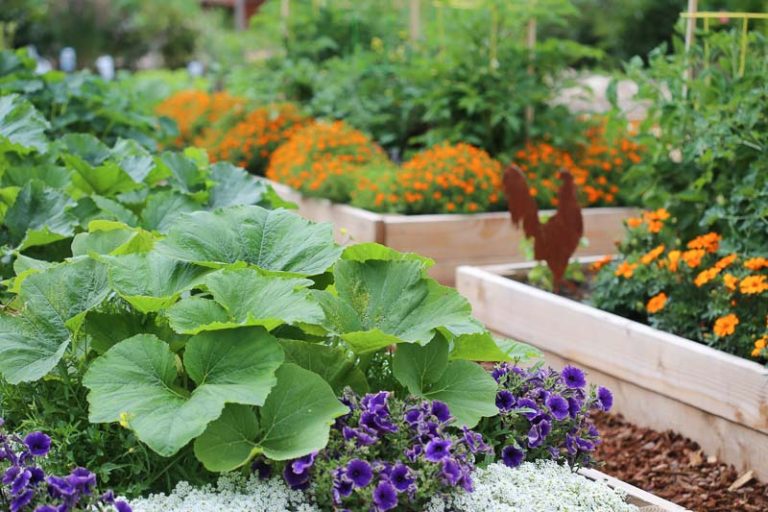
One of the simplest and most efficient layouts for a small rectangular backyard is two long raised beds positioned parallel to one another with a single central path between them. This design creates a clear structure, concentrates growing space, and avoids unnecessary pathways around every side.
The key is keeping the beds narrow enough that you can reach most of the soil from the central path and the outside edges. Beds around three to four feet wide are common because most gardeners can reach toward the center without stepping into the growing area, although the exact width should be based on your own reach and whether both sides remain accessible.
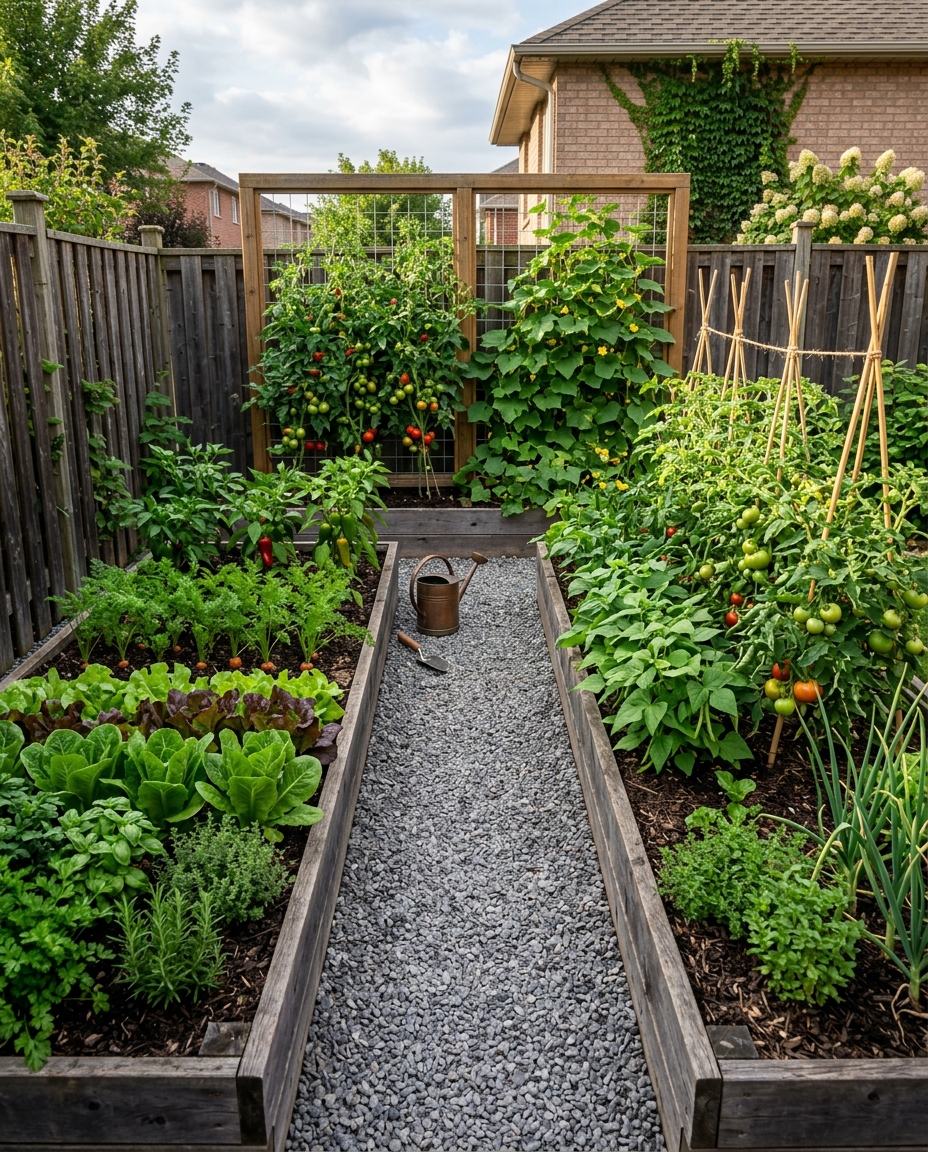
Tall crops can be placed toward the back or outer edges where they will not shade shorter vegetables unnecessarily. Tomatoes, pole beans, cucumbers, and trellised peas can occupy one side, while lettuce, carrots, onions, herbs, and compact peppers fill the lower zones.
The central path should be wide enough to walk through comfortably with a watering can, harvest basket, or wheelbarrow if needed. Extremely narrow paths save a little space on paper but can become almost unusable once tomato branches and cucumber vines begin extending beyond the beds.
This layout is particularly strong for succession planting because each bed can be divided into short sections rather than planted as one continuous crop. Lettuce can occupy one section in spring, beans can replace it later, and another crop can follow depending on the climate.
Best For
Narrow rectangular backyards, beginners, raised-bed gardeners, and anyone who wants a simple layout that is easy to irrigate and maintain.
Example Bed Plan
| Area | Possible Crops |
|---|---|
| Rear of Bed 1 | Trellised cucumbers and pole beans |
| Front of Bed 1 | Lettuce, radishes, herbs |
| Rear of Bed 2 | Tomatoes or peppers |
| Front of Bed 2 | Carrots, onions, basil |
| Bed ends | Flowers or compact herbs |
2. An L-Shaped Garden Around a Patio or Corner
An L-shaped garden makes excellent use of a backyard corner that might otherwise remain ornamental or underused. Instead of placing one rectangular bed in the middle of the yard, two narrow beds follow adjacent boundaries and create a productive growing zone without taking over the center.
This layout is particularly useful when the yard still needs to function as a seating or entertaining space. The raised beds can frame a patio while leaving the central area open, which makes the entire garden feel more integrated into the landscape rather than separated from it.
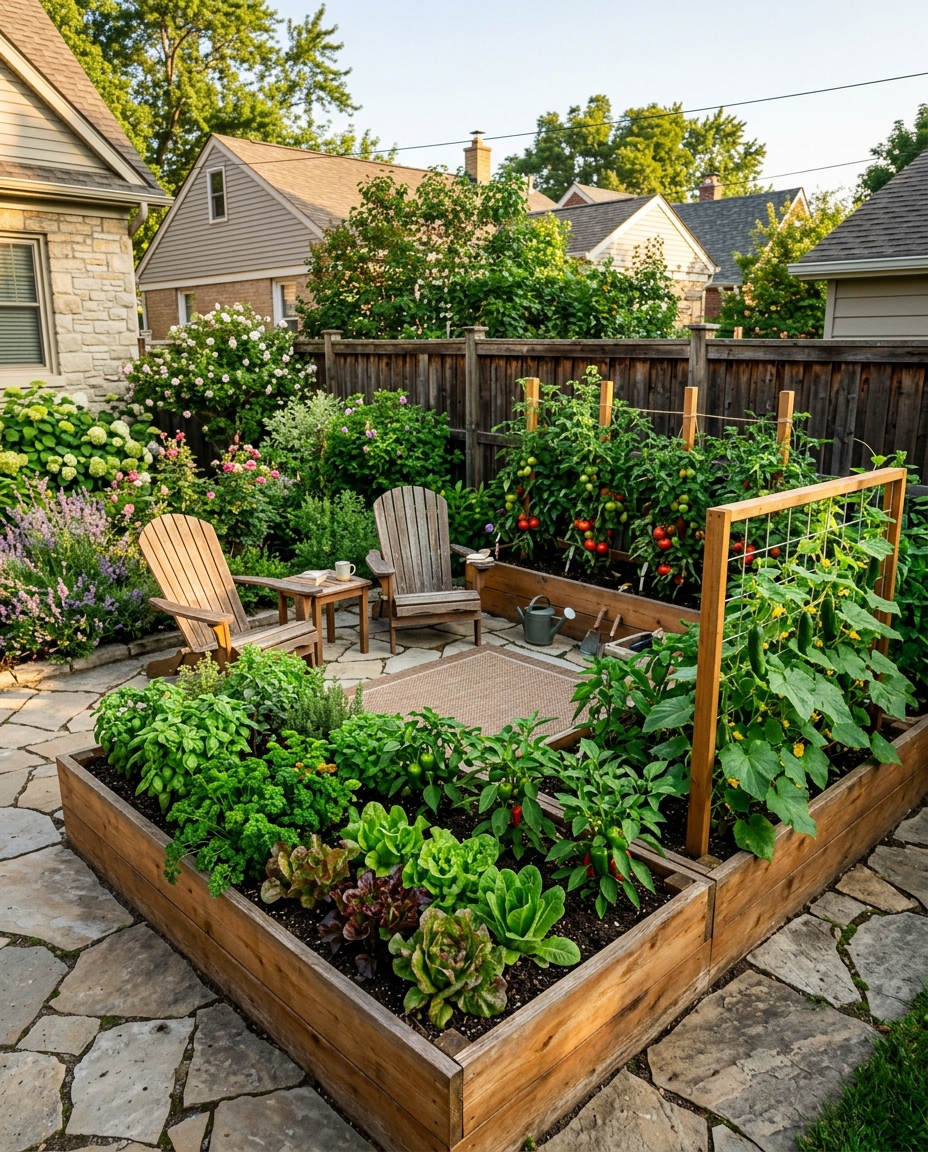
The corner of the L naturally becomes a useful location for a tall crop or vertical feature. A compact trellis, tomato support, or dwarf fruit tree can anchor the junction, while herbs and shorter vegetables continue along the arms of the layout.
Avoid making the inside corner too deep. If the two beds meet in a way that creates a wide square section you cannot reach from either side, that central soil will become difficult to weed and harvest. Narrow, reachable beds are more productive than large inaccessible ones. An L-shaped design also works well for mixed edible landscaping. One arm can function as a kitchen herb bed close to the house, while the other contains vegetables, strawberries, or flowers.
Best For
Patio gardens, corner lots, compact yards that still need open space, and gardeners who want the vegetable garden to look integrated with the landscape.
3. A U-Shaped Raised Bed With an Interior Working Space
A U-shaped raised bed creates a surprisingly large amount of growing edge within a small footprint. Three connected bed sections surround a central working area, allowing the gardener to stand in the middle and reach crops on multiple sides without walking around the entire structure.
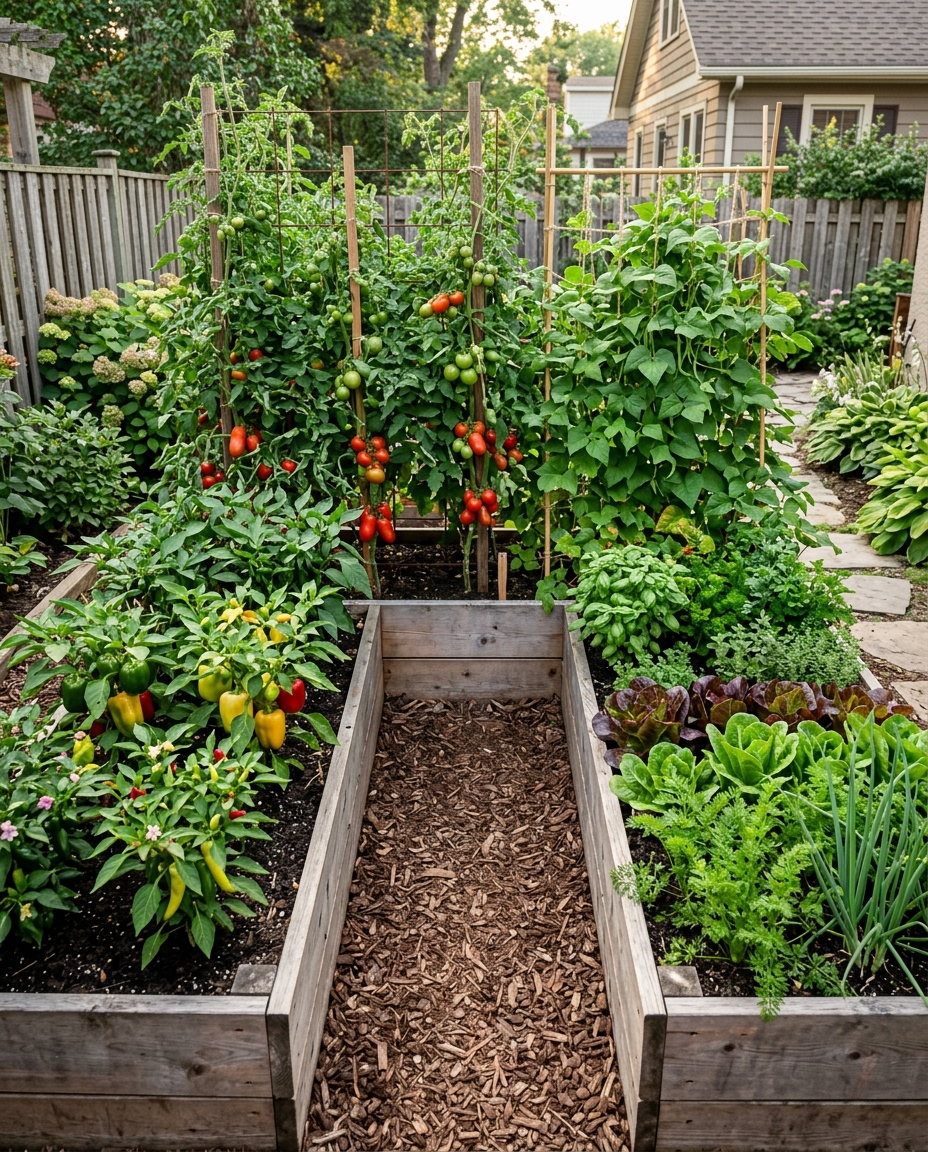
This layout works particularly well in square or nearly square yards where a single large bed would otherwise become too deep to access. The center opening solves that problem by bringing a pathway into the growing area. The dimensions should be planned carefully. The central walkway must remain wide enough to turn around comfortably, carry tools, and bend while harvesting. If the opening is too narrow, mature plants will quickly close it in from both sides.
A U-shape allows crops to be divided according to height and harvest frequency. Tall tomatoes or trellised beans can occupy the rear section, while peppers and eggplants grow along one side and greens, roots, or herbs occupy the other. Because the bed has several interior corners, irrigation should be designed before planting. A drip line can follow the U shape efficiently, reducing the need to drag a hose through a narrow central path.
Best For
Square backyard spaces, gardeners who want maximum raised-bed growing area, and intensive vegetable production.
4. A Fence-Line Garden With Vertical Growing
Many small backyards have valuable growing space along fences that remains unused because gardeners focus only on the center of the yard. A long, narrow bed positioned along a sunny boundary can turn that edge into one of the most productive areas on the property.
Vertical growing makes this layout especially effective. Pole beans, peas, cucumbers, and indeterminate tomatoes can be trained upward instead of spreading across the ground. This keeps most of the central yard open while producing vegetables along a space that may have previously served only as a boundary.
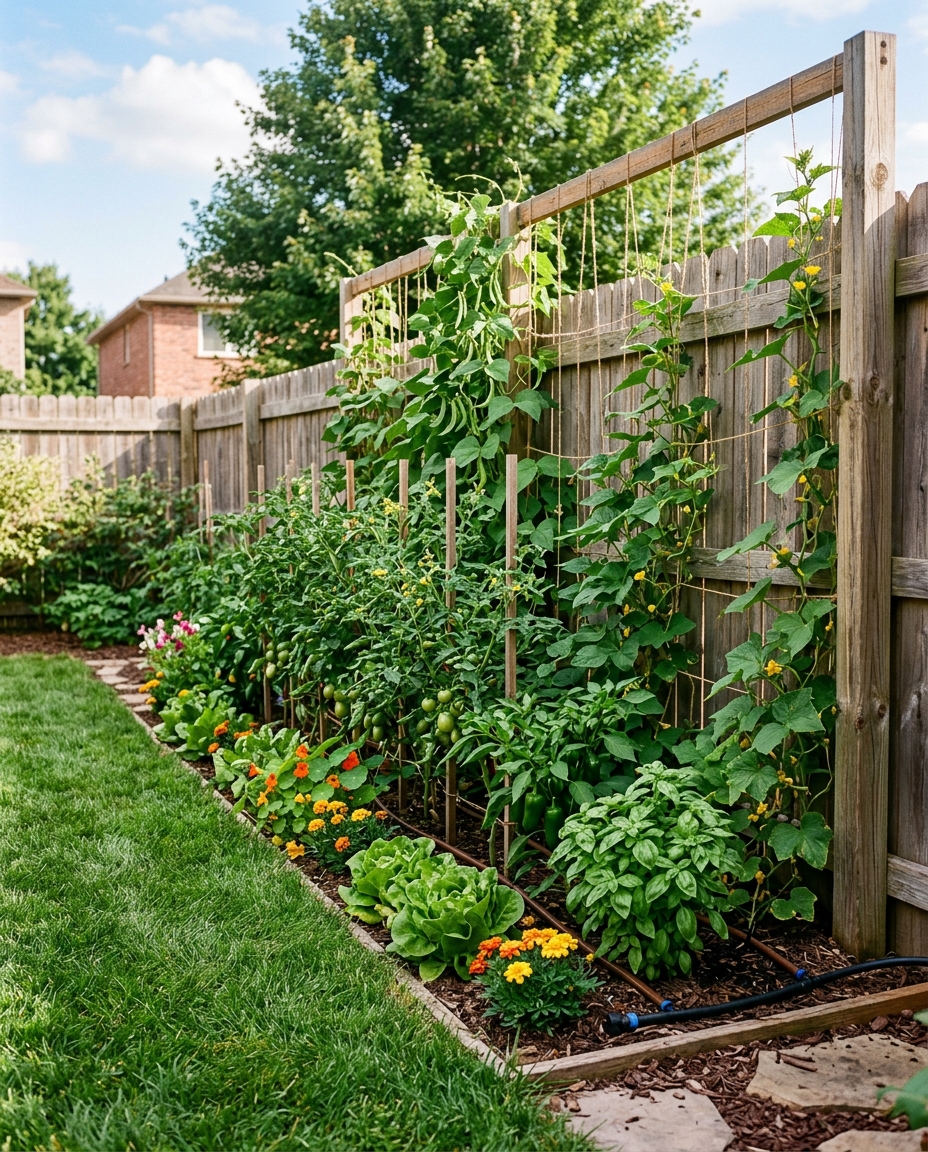
The biggest consideration is sunlight. A fence can create significant shade depending on its orientation and height. Observe the area before committing to sun-loving crops. A sunny fence line may support tomatoes, beans, peppers, and cucumbers, while a partially shaded edge may be better suited to leafy greens, parsley, or other more tolerant crops.
The trellis should be installed before vines become large. It also should not trap moisture directly against wooden fencing or make the fence impossible to maintain. Leaving a small working gap where practical can make repairs and airflow easier. This design can also be visually attractive. A row of climbing vegetables creates a green wall through summer, while herbs, lettuces, or edible flowers fill the lower layer.
Best For
Long narrow yards, small suburban gardens, homeowners who want to preserve the center lawn or patio, and anyone growing climbing vegetables.
5. Four Small Beds in a Grid With Narrow Paths
A four-bed grid creates the feel of a traditional kitchen garden but works surprisingly well in compact yards. Instead of one oversized bed, the growing area is divided into four smaller rectangles or squares with a cross-shaped path between them.
This layout is useful because each bed can serve a different crop group or planting season. One might hold tomatoes and basil, another roots and onions, another greens, and the fourth cucumbers or beans. The divisions make rotation, succession planting, and crop organization easier to understand.
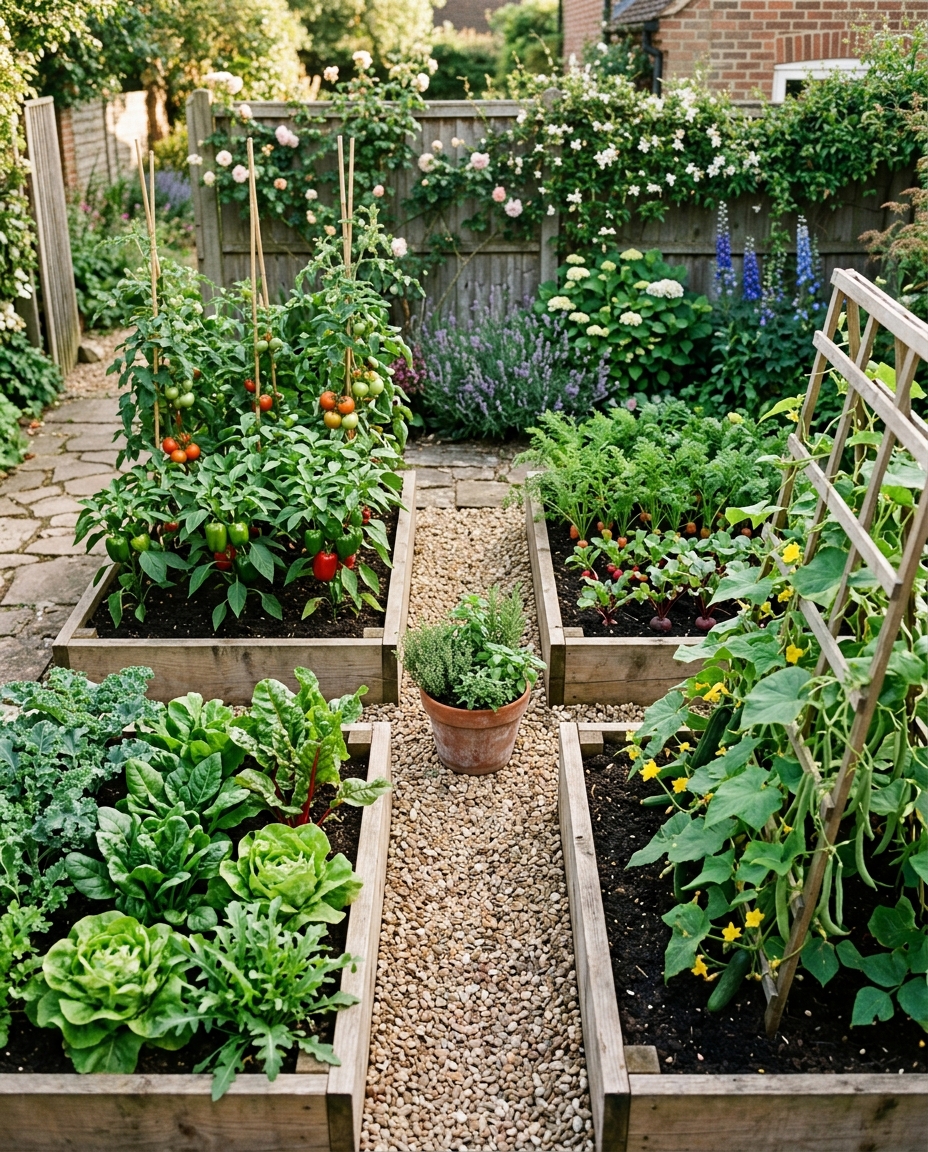
The paths should remain simple and narrow without becoming uncomfortable. Mulch, gravel, stepping stones, or another durable surface helps prevent weeds and keeps the garden accessible after rain. A central feature can make this layout even more attractive. A small herb container, birdbath used purely as an ornamental feature, vertical trellis, or compact obelisk can occupy the center intersection without taking significant growing space.
This layout works best when the beds are small enough to reach from all sides. Oversized square beds create inaccessible centers, which defeats the purpose of dividing the garden.
Best For
Gardeners who like clear organization, crop rotation, symmetrical layouts, and traditional kitchen-garden aesthetics.
Example Four-Bed Plan
| Bed | Crop Group |
|---|---|
| Bed 1 | Tomatoes, peppers, basil |
| Bed 2 | Carrots, onions, beets |
| Bed 3 | Lettuce, spinach, radishes |
| Bed 4 | Cucumbers, beans, peas |
6. A Keyhole Garden for Maximum Reach From One Path
A keyhole garden uses a circular or rounded bed with a narrow path leading into the center, creating a shape that resembles an old-fashioned keyhole when viewed from above. This design is useful because it increases growing edge while keeping most of the bed reachable from one central access point.
In a small backyard, the keyhole shape can make better use of an awkward square or corner space than a conventional rectangle. Instead of walking around several sides, you enter through one path and reach much of the planting area from the central opening.
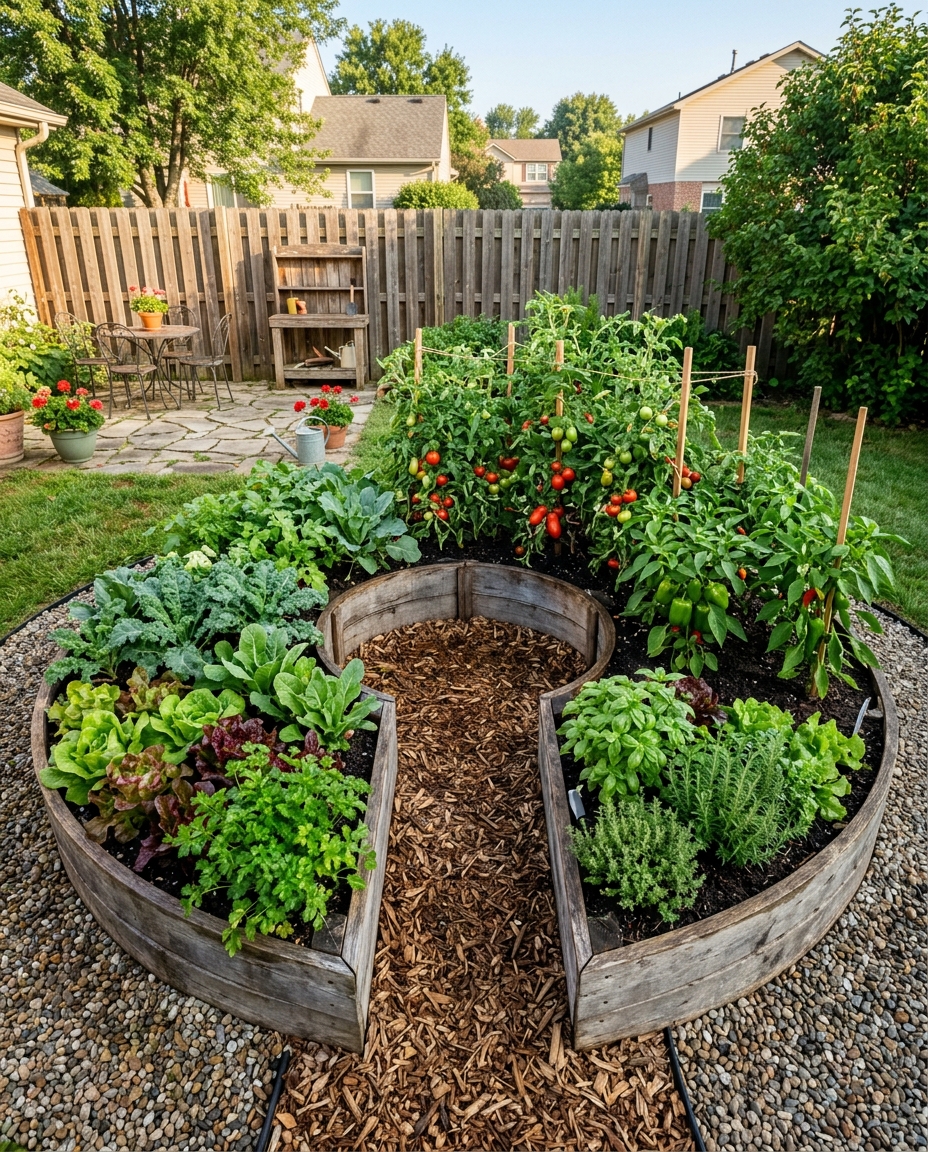
The bed should not be so wide that the outer sections become unreachable. The entire concept depends on keeping soil within comfortable arm’s reach from either the center or outer perimeter. Keyhole gardens are often associated with integrated compost baskets in the center, although that feature is optional. A simple planting version may be easier for beginners because irrigation and soil management remain straightforward.
The curved bed can be planted in layers. Tall crops such as tomatoes or okra can occupy the rear section, medium crops such as peppers or kale fill the middle, and herbs or greens sit near the edges.
Best For
Awkward corners, gardeners who prefer curved designs, and compact spaces where maximizing reachable edge matters.
7. A Patio Container Layout Organized by Height
Not every small backyard needs permanent garden beds. A patio filled with carefully arranged containers can be highly productive, especially for renters or anyone who wants flexibility. The biggest mistake in container gardening is scattering pots randomly until watering and access become difficult. A stronger layout organizes containers by height and frequency of use.
Place tall containers, tomato cages, or trellised vegetables along the back or edge of the patio. Medium containers with peppers, eggplant, or compact shrubs can sit in front, while herbs, lettuce, strawberries, or smaller pots occupy the nearest and easiest-to-reach areas.
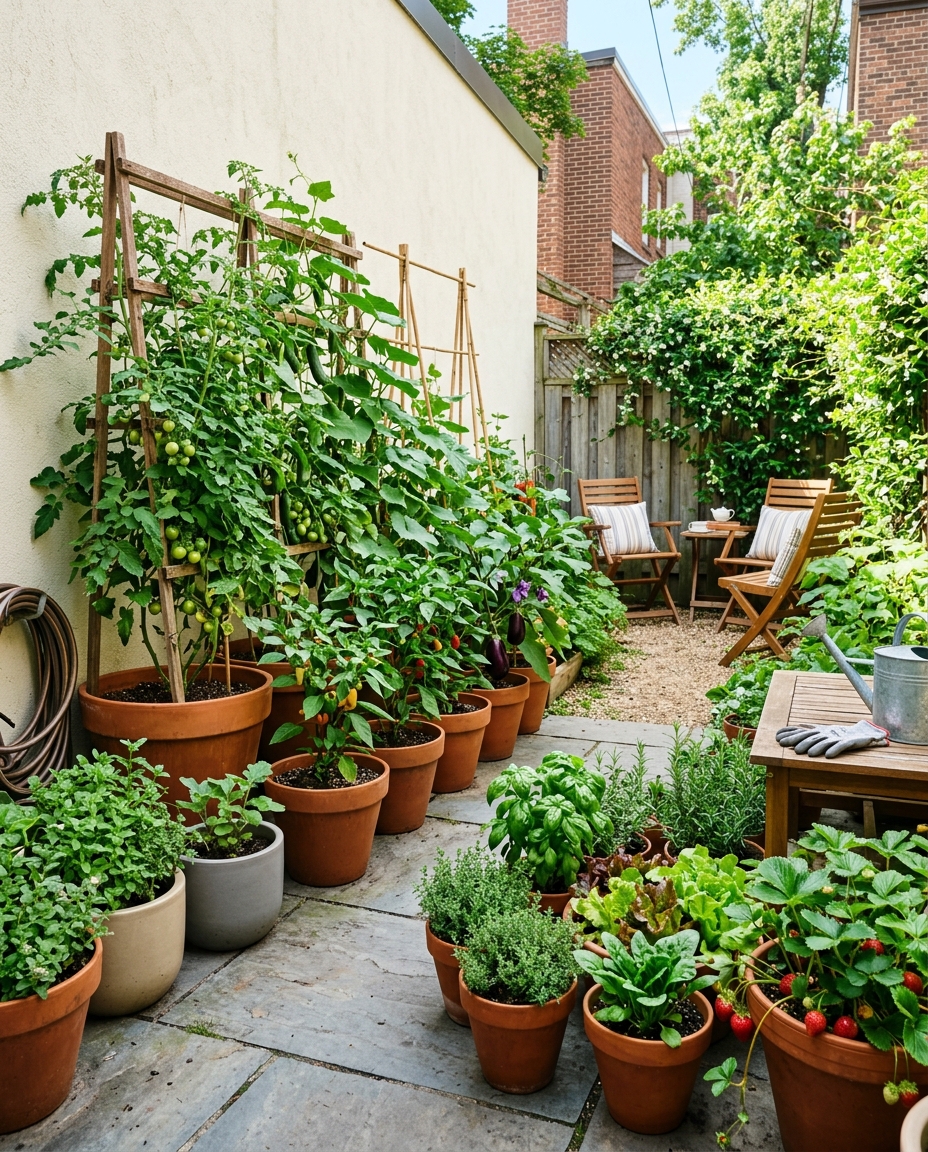
This creates a tiered visual effect and prevents large plants from shading everything else unnecessarily. It also makes watering faster because containers with similar needs can be grouped. Pot size is critical. Tomatoes, peppers, cucumbers, and other large vegetables need enough root volume to remain stable and hold adequate moisture. Tiny decorative pots may look attractive but dry rapidly and can restrict growth.
A patio layout can be adjusted through the season. Spring greens can occupy sunny spaces early, then be moved or replaced as heat-loving crops expand.
Container Layout by Height
| Zone | Good Choices |
|---|---|
| Back/tall | Tomatoes, trellised cucumbers, pole beans |
| Middle | Peppers, eggplant, compact zucchini varieties |
| Front | Lettuce, herbs, radishes, strawberries |
| Hanging | Strawberries, herbs, trailing edible plants where appropriate |
8. A Corner Garden With an Arch Trellis Over the Entrance
A small corner can become a highly productive garden zone when vertical space is used above the path rather than beside it. An arch trellis positioned over the entrance creates growing space for beans, cucumbers, small gourds, or other suitable vines while leaving the ground below open for movement. Raised beds can run along both sides of the corner, forming a compact entrance corridor. The arch connects them overhead and turns otherwise unused air into productive space.
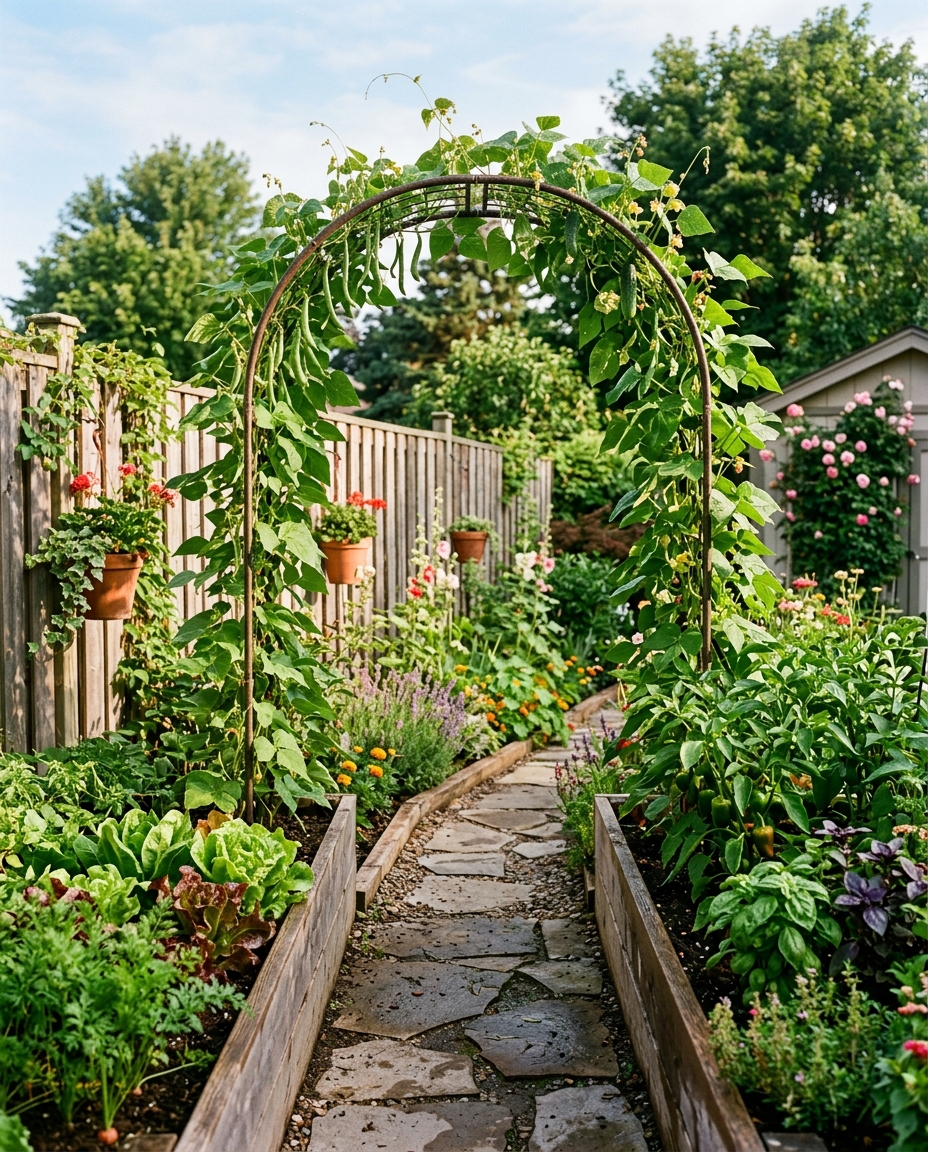
This design is especially useful when the garden must remain visually attractive because the arch becomes an architectural feature rather than simply a support. Once covered with vines, it creates shade and depth while drawing attention into the garden.
Crop selection matters. Extremely heavy fruit should not be grown overhead unless the trellis is strong enough to support both vines and mature produce. Lightweight climbers such as beans and many cucumbers are easier choices for a beginner. The beds beneath the arch can hold herbs, lettuce, carrots, peppers, or flowers, depending on how much shade the vines eventually create.
Best For
Backyard corners, cottage-style gardens, narrow entrances, and gardeners who want to combine structure with production.
9. A Succession-Planting Layout Divided Into Small Blocks
A small backyard becomes far more productive when the same soil grows more than one crop during the year. A succession layout divides beds into small blocks that can be replanted independently rather than waiting for an entire bed to finish at once.
For example, one section may begin with radishes and spinach in cool weather. When those crops are harvested, bush beans can take their place. Another block may start with lettuce, then transition to peppers or basil, followed by another cool-season crop later if the local season allows.
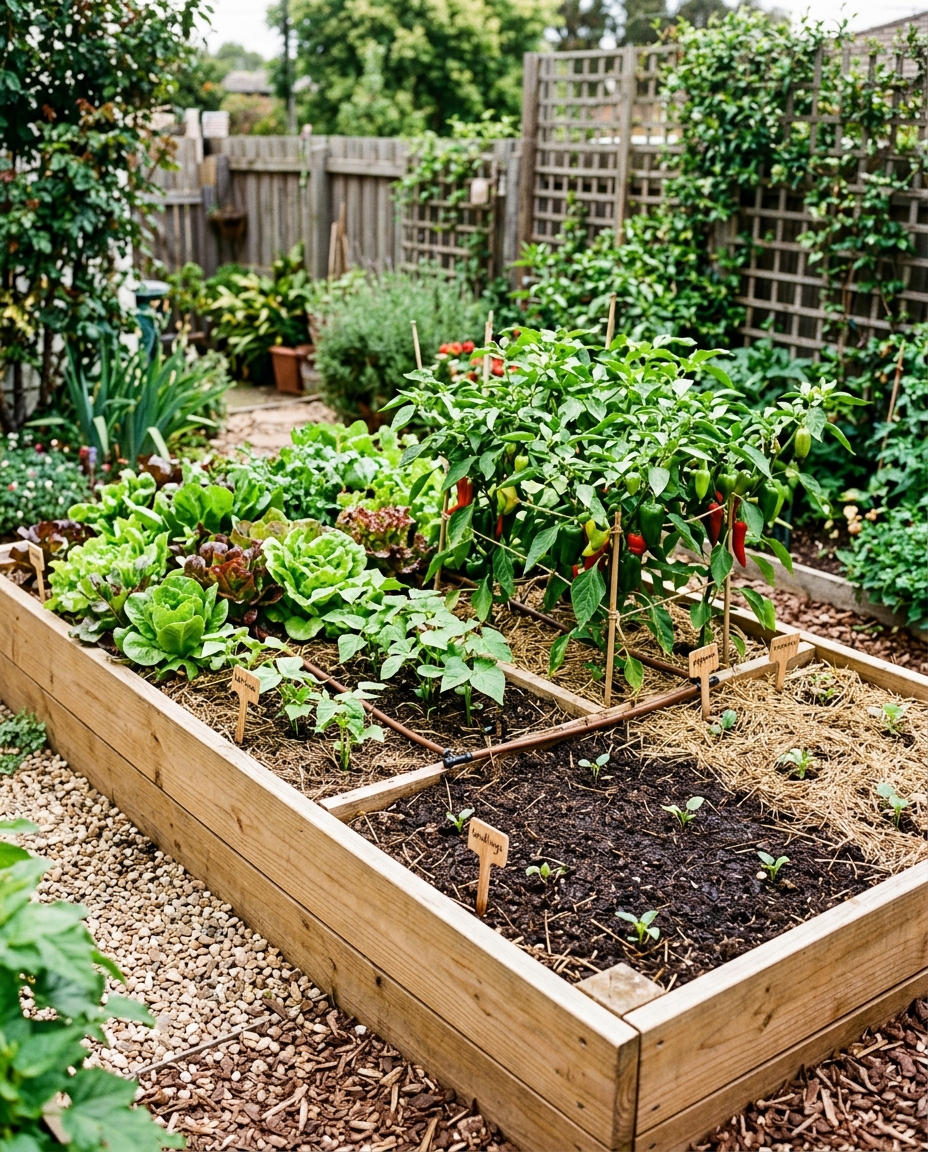
The important part is treating each block as a separate planting schedule. This prevents the common small-garden problem where one slow crop occupies an entire bed while several other areas remain empty after harvesting.
A garden notebook becomes especially useful with this layout because planting dates, expected harvest windows, and replacement crops need to be tracked. Seedlings can be started before the current crop is removed so that the transition happens quickly. This approach works particularly well with rectangular raised beds divided mentally or physically into sections of two to four feet.
Example Succession Plan
| Garden Block | Early Season | Warm Season | Later Season |
|---|---|---|---|
| A | Radishes | Bush beans | Spinach |
| B | Lettuce | Peppers | Lettuce |
| C | Peas | Cucumbers | Fall greens |
| D | Spinach | Basil | Radishes |
The exact sequence depends on climate, crop maturity, and seasonal temperatures.
10. A Mixed Edible Border Around the Backyard Perimeter
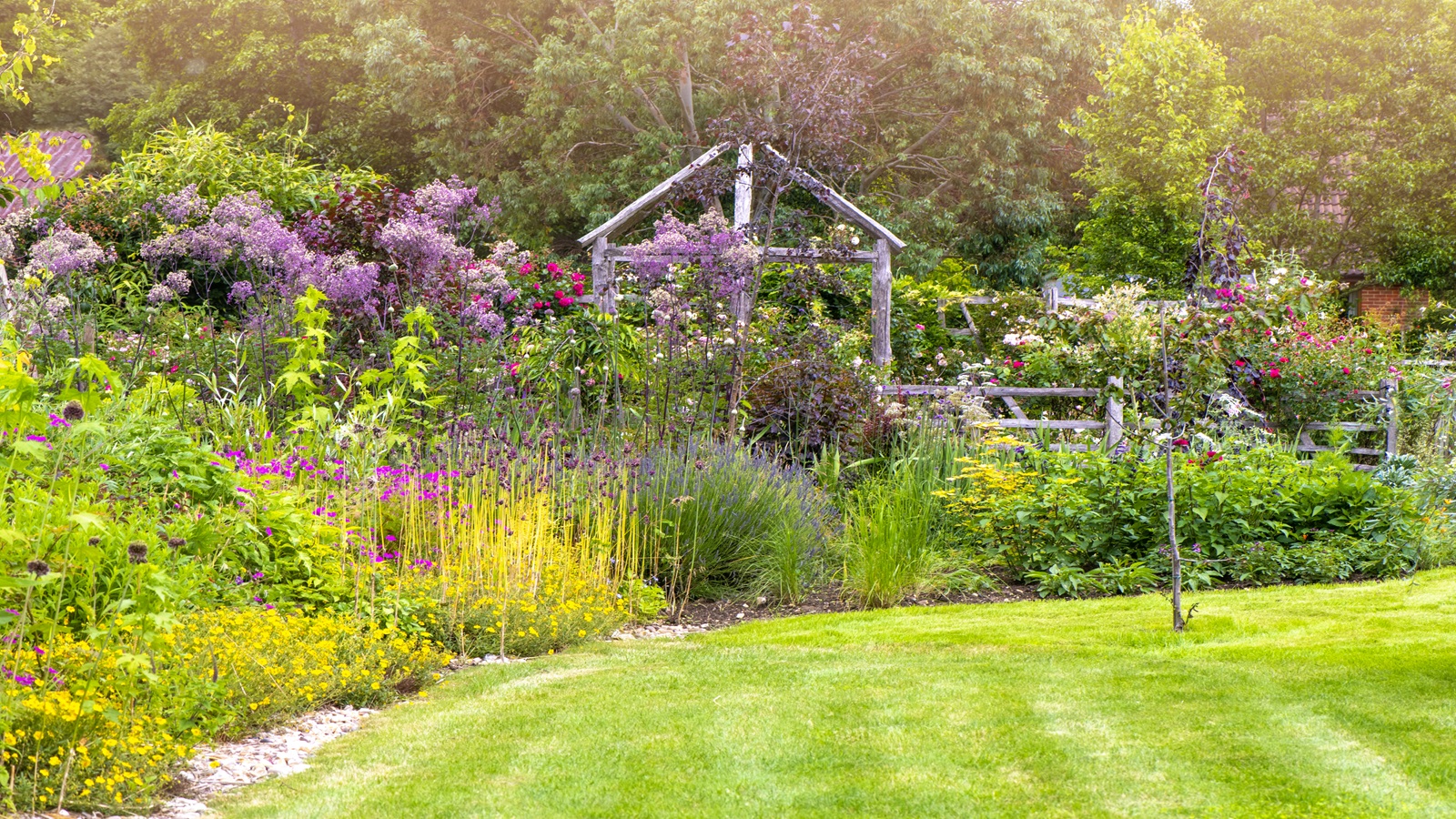
A perimeter garden is one of the best layouts for people who want to grow food without sacrificing the central backyard. Instead of creating a separate vegetable garden, productive plants are integrated along the edges of the property. Narrow beds can contain herbs, strawberries, peppers, dwarf fruit trees, berry bushes, and selected vegetables. Trellises along sunny sections support climbing crops, while lower herbs and flowers occupy the foreground.
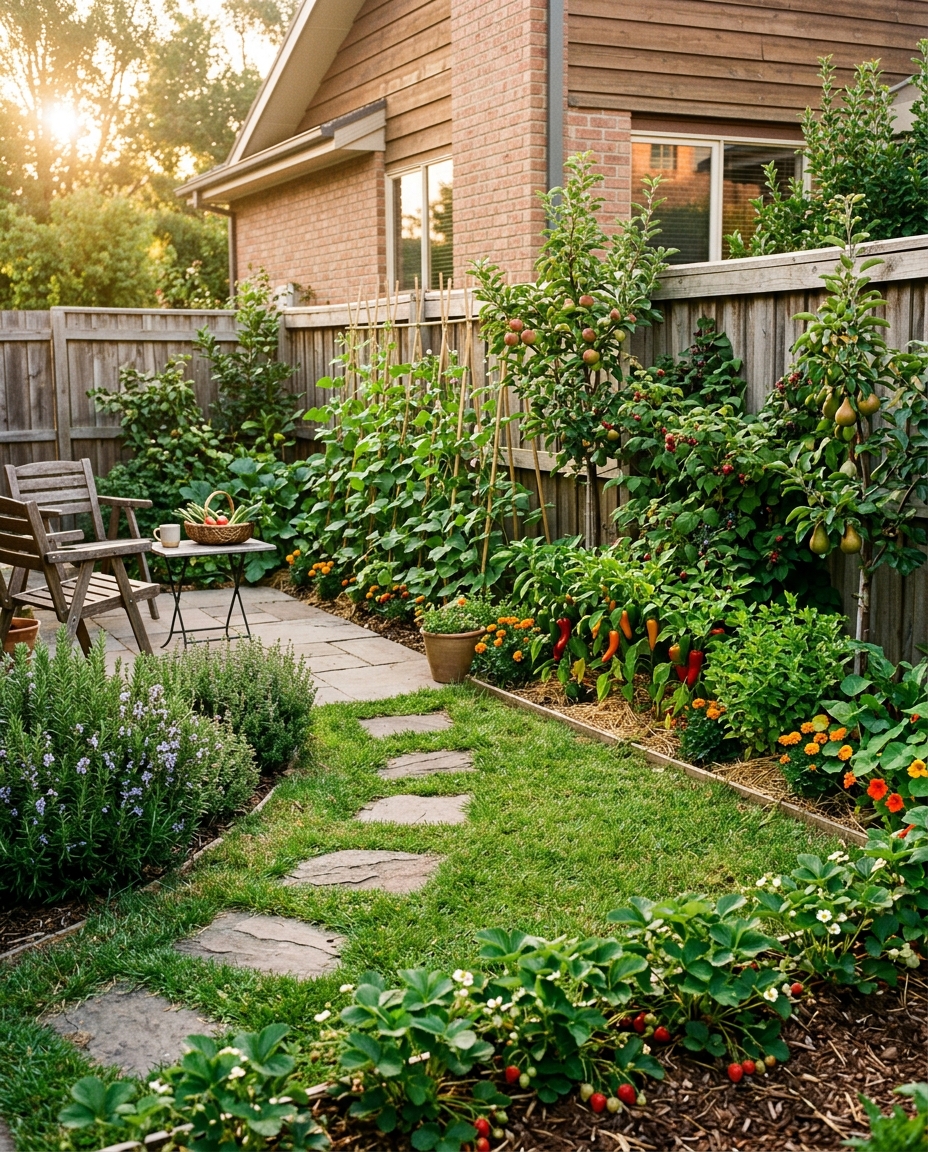
This approach works especially well for small homestead-style yards because it combines edible and ornamental landscaping. A blueberry bush can function as both a fruiting plant and landscape shrub where the soil is suitable. Strawberries can form low borders. Rosemary, thyme, chives, and sage can occupy areas that might otherwise contain ornamental perennials.
Not every edible plant works well in a permanent border. Large annual vegetables such as zucchini may overwhelm nearby plants, while vigorous mint should generally be controlled carefully. Choose crops according to mature size and maintenance needs. Perennial crops are particularly valuable because they reduce yearly replanting. Berries, herbs, and dwarf fruit trees can create a permanent framework, while annual vegetables fill sunny gaps.
Best For
Multipurpose backyards, homeowners who want to retain lawn or seating areas, edible landscaping, and small yards where a dedicated vegetable zone would feel too dominant.
How to Choose the Best Layout for Your Backyard
The right garden layout depends less on the total square footage and more on how that space behaves. Sunlight, shape, access, slope, water supply, and how the rest of the backyard is used all matter. A narrow side yard may be perfect for a fence-line garden but poorly suited to a four-bed grid. A square sunny area can handle a U-shaped or keyhole bed beautifully. A patio may produce more food through containers than through a permanent bed if the soil beneath it is poor or inaccessible.
Start by identifying your non-negotiable spaces. If the backyard needs room for children, pets, seating, grilling, or entertaining, preserve those areas first. A vegetable garden that consumes every useful part of the yard may produce food but make the property less enjoyable overall.
Sunlight should then determine where the main growing zone belongs. In many gardens, the brightest area deserves tomatoes, peppers, cucumbers, beans, and other sun-loving crops. Partial-shade areas can be reserved for greens, herbs, or non-growing functions such as compost storage and tool organization where appropriate.
Layout Selection Guide
| Backyard Situation | Layout That Often Works Well |
|---|---|
| Long narrow yard | Parallel beds or fence-line garden |
| Square sunny space | Four-bed grid or U-shape |
| Small patio | Container layout |
| Awkward corner | L-shape or keyhole |
| Need central lawn | Perimeter edible border |
| Want maximum yield | Succession blocks + vertical growing |
| Limited construction budget | Containers or simple in-ground blocks |
| Strong design priority | Arch entrance or symmetrical grid |
How Wide Should Garden Beds Be?
Garden beds should be designed around reach rather than maximum size. If you have to step into the soil to reach the center, the bed is probably too wide for the access available. Stepping into productive soil can compact it, especially when the ground is wet. Compaction reduces pore space and can make it harder for roots, water, and air to move through the soil.
A common raised-bed width is around four feet when the bed is accessible from both sides. Beds that can only be accessed from one side should usually be narrower.
There is no reason to force every bed into the same measurement. A fence-line bed may be only two feet deep, while a central bed accessible from both sides can be wider. The most productive dimension is the one you can comfortably maintain.
How Wide Should Garden Paths Be?
Paths are often treated as wasted space, but a garden without usable access quickly becomes difficult to maintain. A narrow footpath can work between small beds, while a primary path may need to be wider if you plan to use a wheelbarrow, cart, or large harvest baskets.
Consider mature plant spread when choosing width. A two-foot path may feel generous in spring when tomatoes are ten inches tall and become almost impassable in midsummer when branches extend from both sides.
The surface matters too. Mulch is affordable and comfortable but needs replenishment. Gravel provides a cleaner permanent look but can migrate into beds if borders are weak. Stepping stones preserve access while allowing lower-growing ground cover or mulch between them.
Practical Path Considerations
| Path Type | Approximate Purpose |
|---|---|
| Narrow secondary path | Foot access between small beds |
| Main working path | Harvesting, watering, baskets |
| Wheelbarrow route | Wider, straighter access |
| Patio-garden path | Often decorative and functional |
Exact measurements should reflect the gardener’s mobility and equipment rather than a rigid universal number.
Put Tall Crops Where They Will Not Shade Everything Else
Plant height should be part of the layout before anything goes into the ground. Tomatoes, pole beans, cucumbers, corn, okra, sunflowers, and trellised crops can create substantial shade once mature. In many Northern Hemisphere gardens, placing taller crops toward the northern side of a bed can reduce the amount of shade they cast across shorter vegetables, although actual sunlight patterns should always be observed directly because fences, buildings, and local orientation can change the result.
Shade is not always bad. During hot weather, partial shade from tall crops can help lettuce or other cool-season plants remain comfortable longer. This can be used intentionally. The mistake is allowing tall plants to shade crops accidentally. A garden plan should consider how it will look in midsummer, not just at planting time.
Use Vertical Space Before Adding Another Bed
When the ground is limited, growing upward is often more efficient than expanding sideways. Pole beans can produce from a relatively narrow soil footprint because most of their growth occurs vertically. Cucumbers can be trellised instead of allowed to sprawl across paths. Indeterminate tomatoes can be trained upward using stakes, strings, or sturdy panels.
Vertical growing also improves access. Fruit is easier to see and harvest, vines are less likely to disappear beneath neighboring crops, and pathways remain clearer.
Support strength should match the crop. A lightweight pea net is not a suitable support for a mature tomato loaded with fruit, and a decorative arch may not carry heavy winter squash without reinforcement. Install supports before plants need them. Adding a trellis after roots and vines have filled the bed is much harder.
How to Fit More Crops Without Overcrowding
Maximizing space does not mean reducing every spacing recommendation until plants touch. Overcrowding creates competition for light, moisture, nutrients, and airflow. It also makes harvesting and pest inspection more difficult. The better strategy is using time and height.
Grow fast crops between slower ones early in the season. Radishes or lettuce can mature before tomatoes become large enough to shade them. Trellis cucumbers vertically so shorter herbs can occupy the bed below. Replant blocks as crops are harvested instead of cramming all seasons into the soil at once. Variety choice helps too. Compact peppers, bush cucumbers, patio tomatoes, and dwarf vegetables can fit where full-size varieties would become unmanageable.
Space-Saving Strategy Comparison
| Strategy | How It Saves Space |
|---|---|
| Vertical trellising | Uses height instead of ground |
| Succession planting | Uses the same soil several times |
| Compact varieties | Reduces mature footprint |
| Interplanting | Uses temporary gaps between slow crops |
| Perimeter beds | Uses backyard edges |
| Containers | Turns patios into growing space |
| Mixed edible borders | Combines landscape + food production |
A Simple Small-Garden Crop Placement Formula
A practical small-space bed can be organized in layers. The back or tallest edge contains trellised vegetables. Tomatoes, cucumbers, beans, or peas use the upper vertical zone. Medium-height vegetables such as peppers, eggplants, kale, or bush beans occupy the middle.
Short crops such as lettuce, radishes, carrots, onions, herbs, and strawberries fill the front or edges. This layered arrangement reduces wasted vertical space and keeps smaller plants from being hidden behind larger ones. Root crops can also use soil beneath plants with relatively upright growth, provided spacing and competition remain reasonable. The goal is not stacking plants everywhere. It is making sure every layer of the garden has a purpose.
Example Layout for a 10-by-12-Foot Growing Area
A small area around ten by twelve feet can hold a surprisingly productive garden when the paths are planned carefully. One option is two three-foot-wide beds running lengthwise with a central three-foot path. At the far end, an arch trellis connects the beds and supports beans or cucumbers overhead.
The sunniest rear section holds two or three tomatoes spaced according to variety and training method. Peppers and basil occupy the middle zones. Lettuce, carrots, onions, and herbs fill the front sections. After spring lettuce and radishes finish, some of that space can be replanted with bush beans or basil. Later in the season, fall greens can replace warm-season crops as they decline if the climate allows. This is more productive than trying to create six tiny beds separated by excessive paths.
Which Layout Is Best for Raised Beds?
Raised beds work best when the layout provides access to every section without forcing the gardener to step into them. Parallel beds are the easiest option for beginners because irrigation, trellising, and pathways remain straightforward. A U-shaped bed makes better use of a square area but requires careful central access.
L-shaped beds work well around patios and fences. A four-bed grid is ideal for gardeners who want separate crop groups. The best layout should also consider construction cost. One large bed may use less framing material than four separate beds, although smaller beds provide more pathway access. Do not add raised beds purely for appearance if the existing soil is already good and an in-ground layout would work. Raised beds are a tool, not a requirement.
Common Small Garden Layout Mistakes
One of the biggest mistakes is creating beds that are too wide. Extra soil looks productive on paper until the center cannot be reached comfortably. Another common mistake is dedicating too much space to paths. Garden access matters, but three oversized walkways through a tiny yard can consume more land than the vegetables.
Poor crop placement also causes problems. Tall plants can shade shorter crops, sprawling squash can block pathways, and unsupported cucumbers can spread into every neighboring section. Gardeners also frequently underestimate mature plant size. A zucchini seedling may occupy only a few inches at planting time and become several feet wide later.
Finally, many small gardens lack succession planning. Once spring crops are harvested, entire sections remain empty even though another crop could use the space. The most productive layout considers the entire season rather than one planting day.
10 Small Backyard Garden Layouts at a Glance
| Layout | Best Feature | Best Yard Shape | Difficulty |
|---|---|---|---|
| Parallel raised beds | Simple and efficient | Long/rectangular | Easy |
| L-shaped garden | Preserves open center | Corner/patio | Easy |
| U-shaped bed | High growing area | Square | Moderate |
| Fence-line garden | Uses backyard edge | Narrow/long | Easy |
| Four-bed grid | Excellent organization | Square/rectangular | Easy |
| Keyhole garden | Maximum reach | Compact/awkward | Moderate |
| Patio containers | Flexible and renter-friendly | Patio | Easy |
| Arch corner garden | Uses overhead space | Corner | Moderate |
| Succession blocks | High seasonal productivity | Any bed | Moderate |
| Edible perimeter | Preserves central lawn | Multipurpose yard | Moderate |
Final Thoughts
A small backyard does not need a complicated design to become productive. In fact, compact gardens often work best when the layout is simple enough that every section is easy to reach, water, weed, and harvest.
Begin with the sunlight and the shape of the yard. Decide which areas need to remain open for daily life, then build the garden around those constraints rather than treating the entire property as potential vegetable space. Use edges before consuming the center. Use vertical space before adding another bed. Keep beds narrow enough to reach. Give mature plants enough room.
Position tall crops carefully. And plan what will replace each crop once it is harvested. Those decisions matter far more than squeezing one additional plant into every gap. A well-designed small garden can produce tomatoes, peppers, greens, herbs, roots, beans, cucumbers, berries, and more without making the backyard feel overcrowded. The goal is not to use every square inch. It is to make every square inch useful.