A small garden does not necessarily need more ground to become more productive. Sometimes it simply needs to start using the space above it.
Many of the vegetables gardeners struggle to fit into compact backyards are naturally capable of climbing, sprawling, or being trained vertically. Cucumbers can cover several feet of soil when left on the ground, pole beans can form a dense tangle across neighboring plants, indeterminate tomatoes can become surprisingly large, and vigorous squash vines can wander out of a raised bed before the season is halfway finished. A trellis changes the direction of that growth. Instead of allowing the plant to expand horizontally across valuable growing space, it gives stems and vines a structure that encourages them upward.
That does more than save room. A properly designed trellis can make harvesting easier because fruit is visible instead of hidden under leaves. It can improve access to the base of the plant, keep some fruit from resting directly on damp soil, create more usable planting space beneath or beside the vine, and make a vegetable garden feel substantially more organized. In raised beds, where every square foot matters, those benefits become particularly valuable.
But not every trellis works for every plant.
Peas can climb lightweight netting that would collapse under the weight of a mature cucumber vine. Pole beans can twist around narrow string or wire, while cucumbers prefer something their tendrils can easily grab. Tomatoes do not naturally climb in the same way beans do and usually need to be tied, clipped, woven, or otherwise trained onto their support. Heavy squash and melons may require strong framing and individual fruit support if they are grown vertically.
Sunlight matters just as much as strength. A trellis covered in dense foliage can become a living wall several feet tall, which means poor placement can shade crops that need full sun. In many Northern Hemisphere gardens, positioning taller vertical structures toward the northern side of the main growing area can reduce unwanted shading, although buildings, fences, slope, and the specific orientation of the garden still need to be considered.
The best trellis is therefore not simply the prettiest structure you can build.
It is the one that matches the mature weight and climbing behavior of the crop, fits naturally into the garden layout, remains accessible for harvesting, and uses vertical space without creating new problems elsewhere.
These twelve trellis ideas range from extremely simple structures for peas and beans to permanent arches capable of becoming major features of a small vegetable garden.
1. The Cattle-Panel Trellis — Strong Enough for Serious Vegetable Production
A rigid livestock or cattle panel is one of the most useful trellis materials for gardeners who want a structure that can support vigorous plants season after season. Unlike thin plastic netting, which may sag as vines become heavy, a properly anchored welded-wire panel retains its shape and can support crops such as cucumbers, pole beans, peas, tomatoes that are deliberately trained onto it, and some lighter squash varieties.
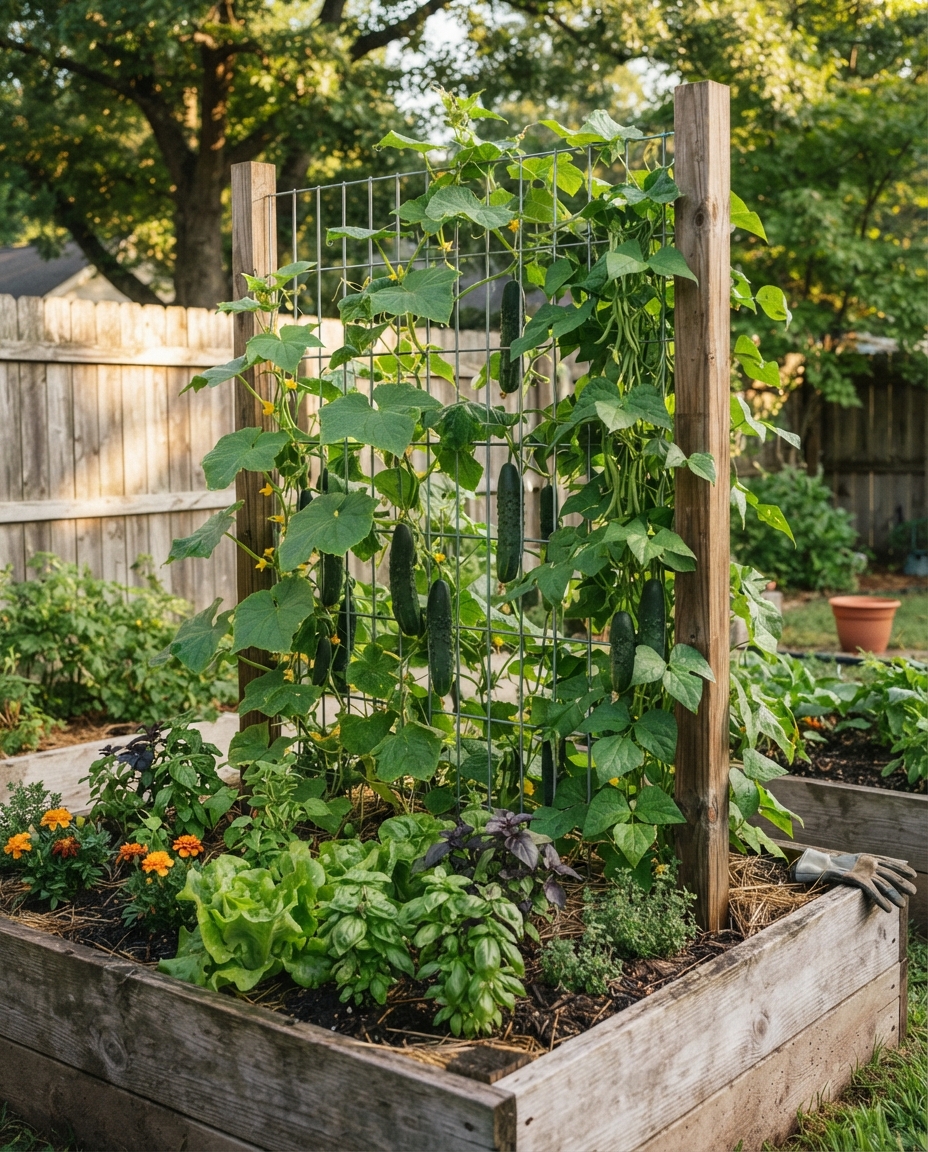
The simplest configuration is vertical. Secure the panel to strong posts driven beside a raised bed or directly into the ground, then plant climbing vegetables along its base. This creates a narrow growing wall that occupies very little soil surface relative to the amount of foliage it can support. In a small raised-bed garden, the area in front of the trellis can still be used for lower-growing crops as long as those plants receive enough light and the root systems are not excessively crowded.
The mesh openings are part of what makes this design practical. They are large enough for a gardener to reach through when harvesting while providing numerous attachment points for tendrils, ties, or clips. A cucumber can weave naturally through the grid, while a tomato stem can be secured at intervals as it grows upward. Compared with very narrow netting, the open grid also makes dead leaves, old vines, and plant debris easier to remove at the end of the season.
Strength still depends on installation. A tall panel covered in foliage behaves almost like a sail during strong wind, so simply leaning it against a garden bed is not enough. Posts should be substantial, well anchored, and spaced so the panel cannot flex excessively once the crop becomes heavy.
Technical Guide: Matching the Panel to the Crop
| Crop | Trellis Demand | Suggested Structure | Special Consideration |
|---|---|---|---|
| Pole beans | Moderate | Vertical rigid panel | Twine naturally around supports |
| Cucumbers | Moderate to heavy | Vertical or angled panel | Tendrils attach readily; guide young vines |
| Indeterminate tomatoes | Heavy | Strong vertical panel | Must be clipped, tied, or woven |
| Peas | Light | Panel is stronger than necessary but works well | Tendrils attach easily |
| Small climbing squash | Heavy | Reinforced panel | Large fruit may need slings |
| Melons | Heavy | Reinforced panel | Fruit often needs individual support |
Best for: Gardeners who want one highly durable support capable of handling several different crops over multiple seasons.
2. The Garden Arch Trellis — Turn the Walkway Into Growing Space
A garden arch takes vertical gardening one step further by using not only height but also the airspace above a pathway. Two raised beds can sit several feet apart with a strong wire panel bent between them to create a tunnel. Vines planted along either side climb upward, cross overhead, and eventually create a green canopy while the path beneath remains usable.
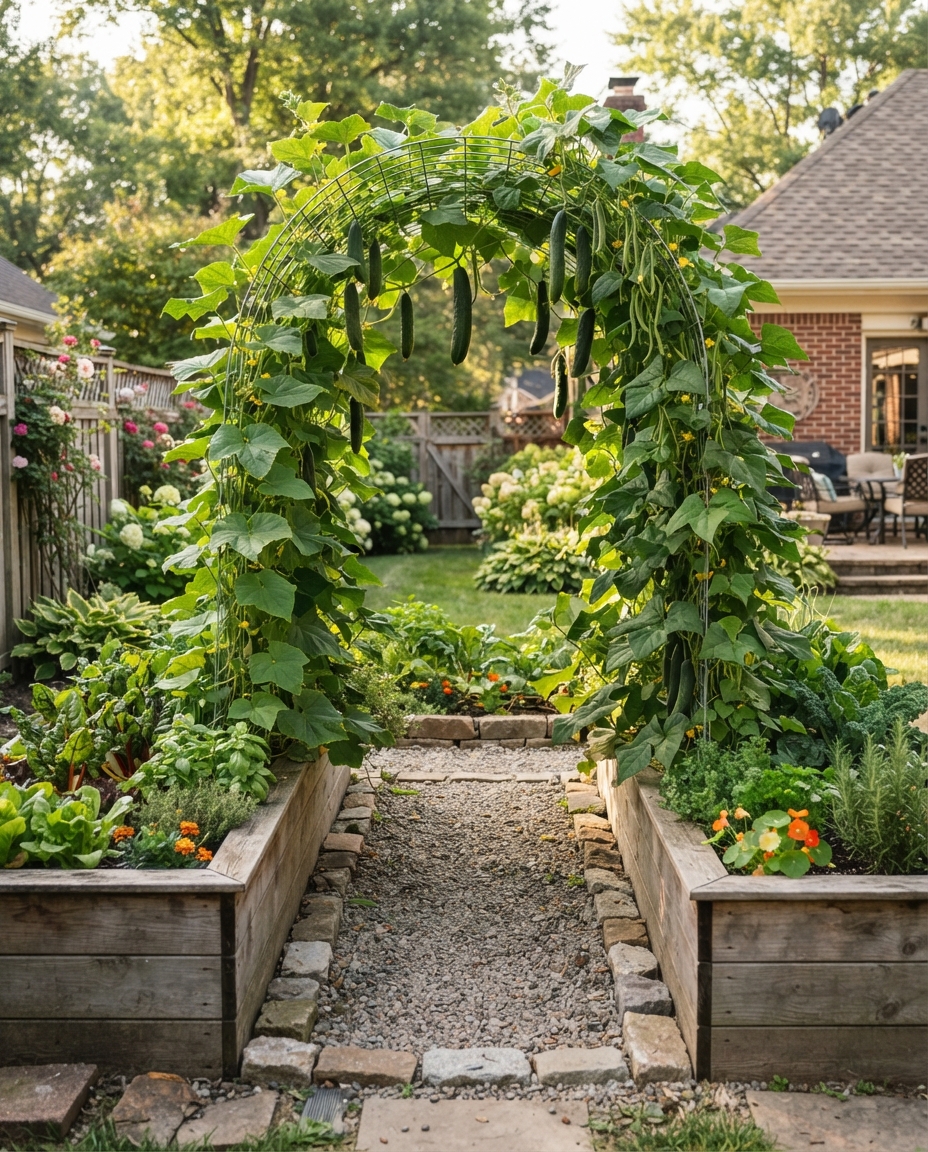
This is one of the most efficient trellis configurations for small gardens because the structure occupies space that would otherwise produce nothing. The pathway still performs its original job, yet the area several feet above it becomes part of the growing system. Cucumbers and pole beans are particularly well suited to this arrangement because their fruit can hang down through the mesh, making harvesting easy and creating one of the most visually satisfying features in an edible garden.
Arch geometry matters. If the structure is too low, mature vines and hanging vegetables will reduce headroom and make walking underneath uncomfortable. If it is too narrow, heavy foliage from both sides can close the passage almost entirely. The support must also be strong at the base because the curved panel holds substantial plant mass once both sides are covered.
Orientation should be planned carefully. An arch covered in leaves produces meaningful shade, which may be welcome over a path but less useful if it blocks sun from neighboring peppers, tomatoes, or other sun-loving crops. Observe the garden during the growing season rather than choosing placement based only on how attractive the arch will look.
One clever strategy is to place crops with different harvest times on opposite sides. Early peas can occupy one section of the arch before summer beans, or cucumbers take over, allowing the same structure to remain productive for a longer portion of the season.
Best for: Cucumbers, pole beans, peas, some gourds, and gardens where two raised beds already face one another.
3. The A-Frame Trellis — Two Growing Faces in One Compact Structure
The A-frame trellis is one of the most efficient freestanding supports because both sides can be planted. Two rectangular frames lean toward each other and connect along the top, creating a triangular structure that remains relatively stable while providing separate climbing surfaces on either side.
This arrangement works particularly well for cucumbers, peas, and beans. The vines grow up the outer faces, leaving an open shaded area beneath the structure. Depending on the crop and spacing, that interior can sometimes remain empty for access or be used carefully for shade-tolerant plants during hot weather.
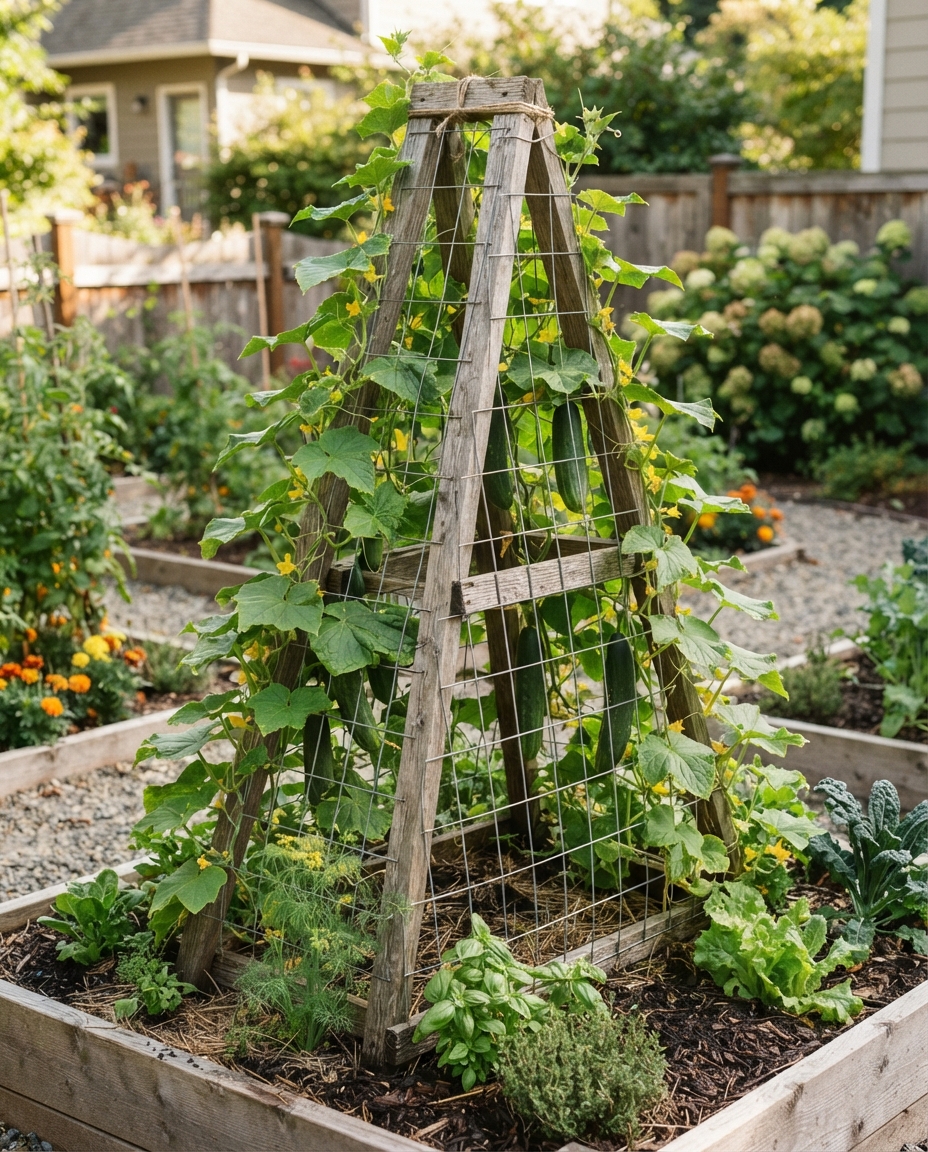
The angle creates a practical harvesting advantage with cucumbers. As fruit develops, some cucumbers naturally hang through the trellis instead of becoming trapped within the foliage. They remain visible and relatively straight, and gardeners can often harvest from the interior or outer side without digging through a sprawling vine.
An A-frame also avoids the need for a wall, fence, or permanent row of posts, making it useful in gardens where the layout changes from season to season. Hinged frames can even be folded for storage after the growing season.
The main mistake is making the structure too small. A vigorous cucumber plant can easily reach several feet, and pole beans can grow higher still. A short decorative A-frame may look appropriate when the plants are young but become overwhelmed later. Build according to the mature vine length and expected foliage, not the dimensions of the seedlings.
A-Frame Sizing Guide
| Feature | Practical Range | Why It Matters |
|---|---|---|
| Height | About 5–7 ft for many climbing vegetables | Gives vigorous vines useful vertical room |
| Base width | Roughly 3–5 ft | Provides stability and workable angle |
| Mesh opening | Large enough for tendrils and harvesting access | Prevents the trellis from becoming difficult to clean |
| Path clearance | Enough room to harvest both faces | Avoids inaccessible crops |
| Anchoring | Stakes or fixed base strongly recommended | Prevents tipping in wind |
These dimensions are not universal construction rules; crop vigor, wind exposure, material, and gardener height should all influence the final design.
Best for: Cucumbers, peas, pole beans, movable gardens, and gardeners who want usable trellis surface on both sides.
4. The Fence-Line Trellis — Make the Garden Boundary Work Harder
A sunny fence can provide far more value than simply marking the property line. By adding a trellis slightly in front of the fence, a narrow strip of otherwise unused yard can become a productive vertical growing zone.
The small gap between the trellis and fence is important. Placing vines directly against a solid wooden fence can limit airflow, make maintenance difficult, and create a tangled mass that is hard to access from behind. Installing wire, mesh, or a freestanding frame several inches away from the surface gives vines something to grab while leaving enough room for air and occasional cleaning.
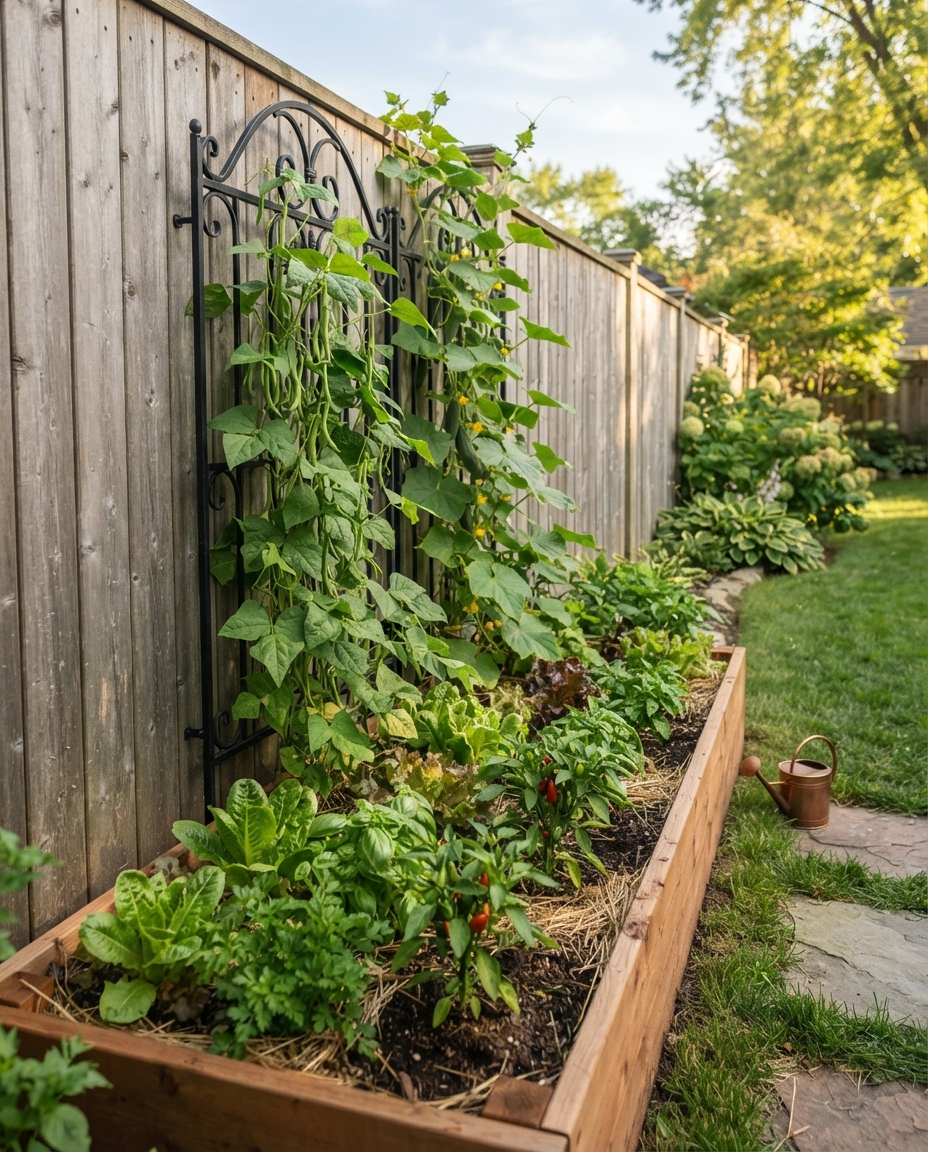
A fence-line trellis works especially well with narrow raised beds. Beans, cucumbers, peas, climbing flowers, or trained tomatoes occupy the rear vertical plane, while herbs, greens, radishes, strawberries, or other shorter crops use the soil toward the front. This essentially creates two growing layers in the footprint of one narrow bed.
Sun orientation is critical. Some fences receive strong light throughout much of the day, while others create deep shade because of their orientation or nearby buildings. The trellis cannot compensate for insufficient light. Observe the fence during the actual growing season before committing sun-loving crops to it.
The fence itself should not automatically be treated as a load-bearing structure. If the trellis will become heavy with mature vines, give it its own posts unless you know the fence is strong enough and you are comfortable attaching the system permanently.
Best for: Very small yards, narrow side gardens, fence borders, and gardeners who want to preserve open space in the center of the backyard.
5. The String Trellis — Minimal Material, Maximum Growing Height
A string trellis uses one of the simplest vertical systems possible: strong cords run from an overhead support down to individual plants or attachment points near the soil. This design is particularly useful for indeterminate tomatoes and some climbing vines because each plant receives its own vertical lane.
For tomatoes, the plant does not climb the string independently. The main stem must be clipped, tied, or wrapped carefully around the support as it grows. Many gardeners using this system deliberately prune tomatoes to one or a limited number of leaders, producing a narrow vertical plant instead of allowing multiple large stems to spread through a cage.
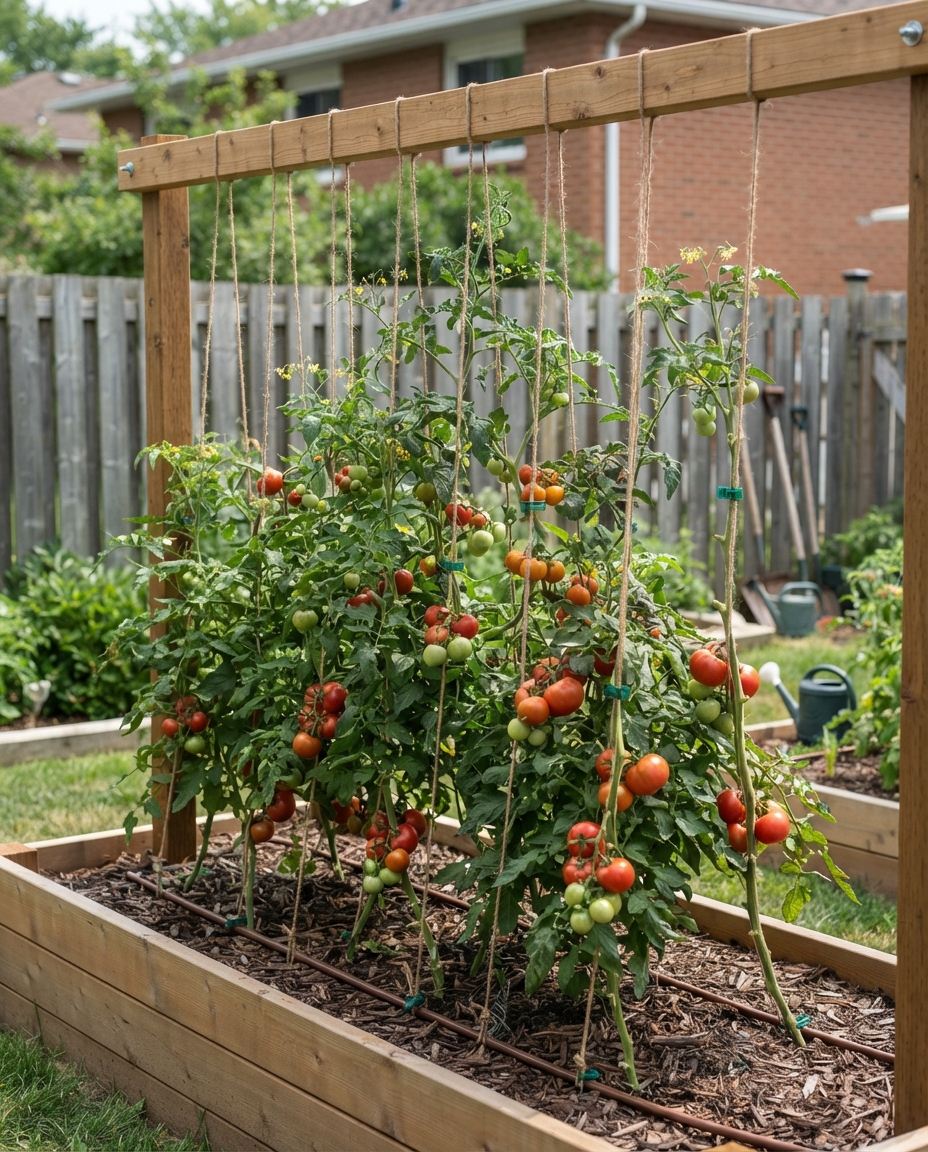
That management style can be extremely useful in a small garden because several tomato plants can occupy a relatively narrow row, but it demands more attention. A heavily pruned single-leader tomato needs regular training throughout the growing season. If suckers are allowed to grow unchecked, the plant quickly becomes too wide and heavy for the intended system.
The overhead frame must be strong. A mature indeterminate tomato plant can become surprisingly heavy, particularly when carrying multiple clusters of fruit. Lightweight PVC or decorative wood may sag if multiple plants hang from the same beam.
For beans, peas, or lighter vines, the requirements are less demanding, and strings can be arranged close together to form a temporary seasonal wall.
String Trellis Comparison
| Crop | Does It Climb the String Naturally? | Training Needed | Structural Load |
|---|---|---|---|
| Pole beans | Mostly yes | Minimal guidance | Moderate |
| Peas | Tendrils may need additional cross strings | Light | Light |
| Cucumbers | Tendrils attach but may need guidance | Moderate | Moderate |
| Indeterminate tomatoes | No | Frequent tying/clipping and pruning | Heavy |
| Climbing flowers | Depends on species | Low to moderate | Usually light |
Best for: Narrow rows, indeterminate tomatoes, compact intensively managed gardens, and gardeners comfortable with regular pruning and training.
6. The Lean-To Trellis — Create a Productive Sloping Wall
A lean-to trellis stands at an angle rather than vertically. The top is supported by posts or a frame, while the bottom extends outward, creating a sloping surface for vines. This design is particularly useful for cucumbers because developing fruit often hangs beneath the angled mesh, making it easy to see and harvest.
The slope also creates a naturally shaded strip beneath the trellis. In warm climates, that space can sometimes be useful for crops that appreciate partial relief from intense afternoon sun, such as certain leafy greens or herbs. This should be planned carefully, however, because the shade may be too heavy in cooler or less sunny climates.
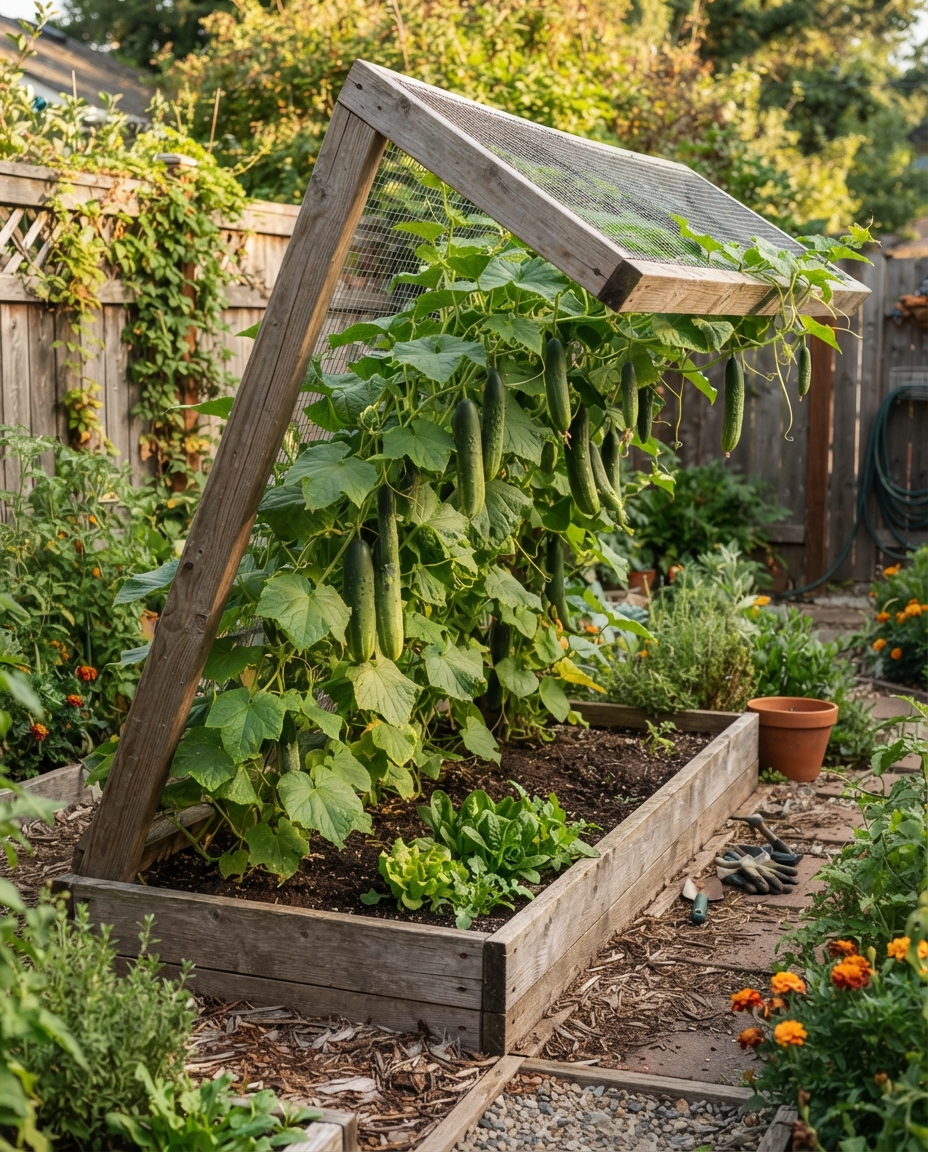
The structure should lean enough to create useful access but not so far that it consumes the same ground space the trellis was meant to save. An angle around which you can comfortably reach both the vines and fruit is more important than following a fixed measurement.
Because much of the plant mass is suspended away from the vertical axis of the posts, anchoring becomes important. As the vines grow, gravity and wind place additional force on the frame. Strong corner connections and stakes make the structure much more reliable than simply resting the trellis against another object.
Best for: Cucumbers, lighter gourds, some squash vines, and hot gardens where the shaded zone beneath the structure can be useful.
7. The Obelisk Trellis — Vertical Growing for Containers and Tiny Beds
Not every small garden has room for a long trellis. An obelisk uses height within a very small footprint, making it particularly useful in containers, compact square beds, or decorative kitchen gardens. The structure typically consists of three or four vertical poles that taper together at the top, with horizontal rings, crosspieces, or wire providing additional attachment points. Peas, smaller climbing beans, flowering vines, and some compact cucumber varieties can climb around the structure rather than spreading into surrounding paths.
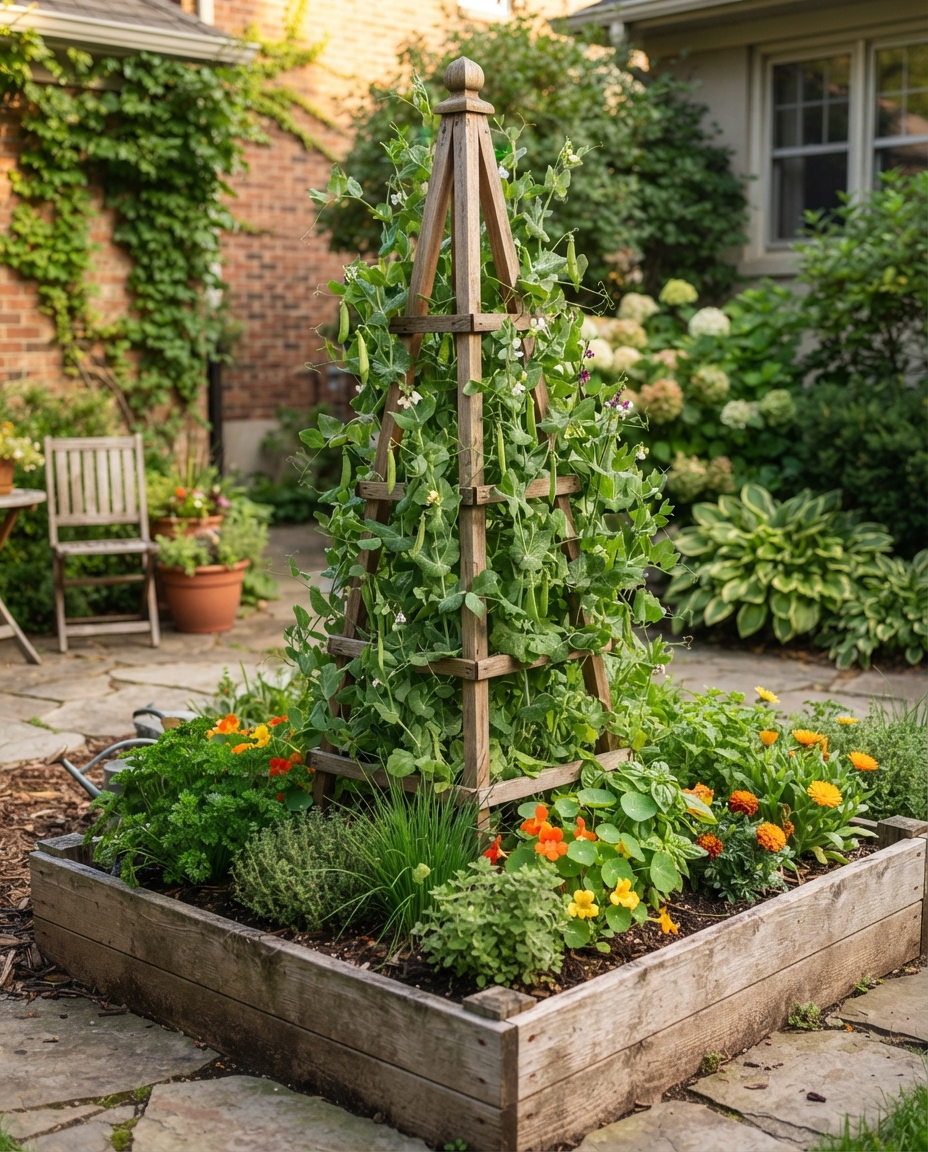
One of the advantages of an obelisk is that the planting can surround it. Instead of placing vines in a straight line, several plants can be arranged around the base and trained toward the central structure. This makes good use of a round container or square-foot section of a raised bed.
The limitation is capacity. A narrow obelisk can become completely engulfed by an extremely vigorous vine, reducing airflow and making interior fruit difficult to find. When using pole beans or cucumbers, choose a structure with enough height and diameter for the expected mature plant rather than a small decorative ornament designed primarily for flowers.
It also makes a strong visual feature. Because the support has an architectural form even before the plants cover it, an obelisk is particularly useful in edible gardens that are visible from patios or entertaining areas.
Best for: Containers, small raised beds, decorative kitchen gardens, peas, moderate climbing beans, and compact climbing varieties.
8. The T-Post and Wire Trellis — Simple, Strong, and Easy to Expand
A trellis made from metal T-posts and wire mesh is one of the most practical solutions when appearance matters less than durability and flexibility. The posts can be driven directly into the ground or positioned beside a raised bed, while welded wire or another appropriate mesh spans between them.
The major advantage is modularity. A short row can support several cucumber plants one year, then be extended later if the garden expands. Unlike a permanent wooden frame, posts can often be relocated with less work, which is useful in gardens where crop rotation or bed layout changes over time.
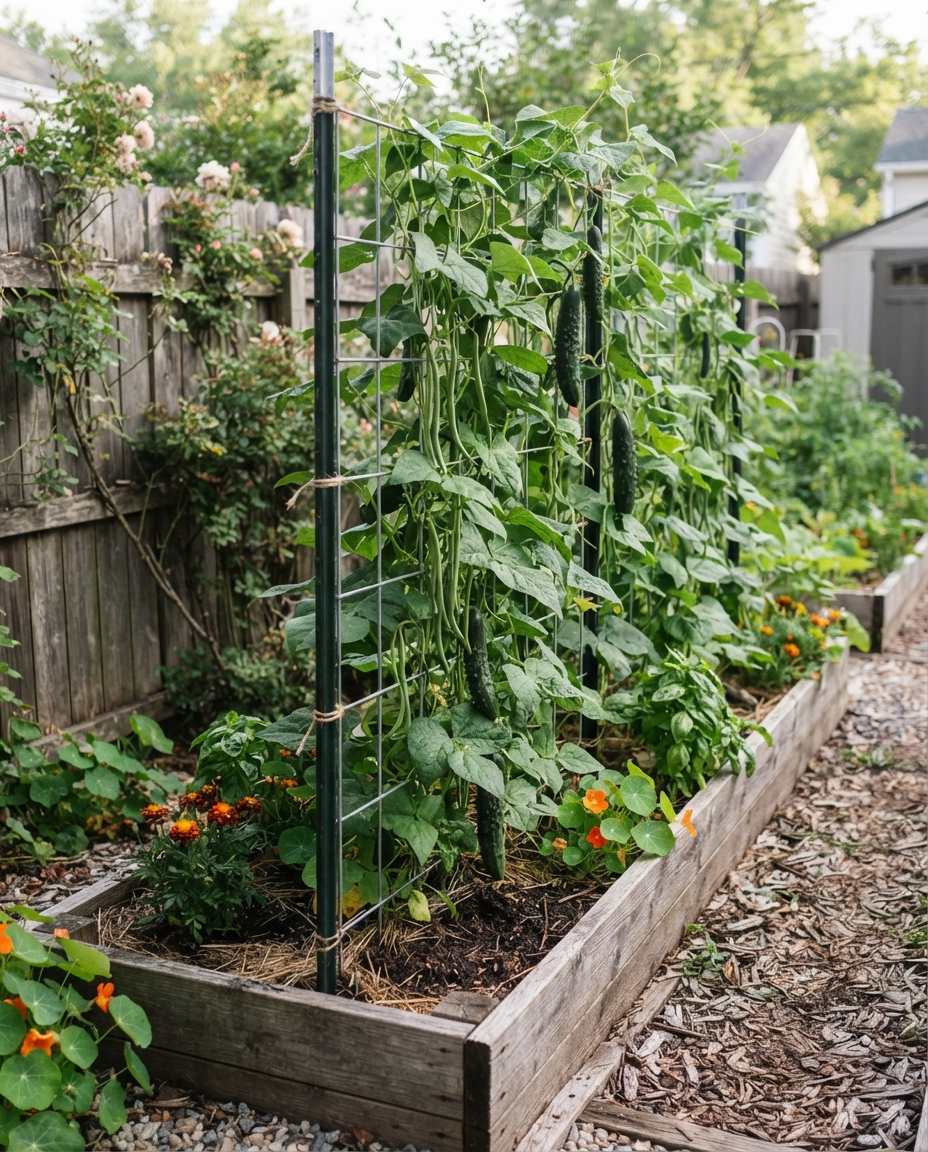
Post spacing depends on the rigidity of the mesh, crop weight, wind exposure, and soil conditions. If supports are too far apart, the wire can bow under mature vines. Adding another post is generally easier than repairing a trellis that collapses in July.
The system also works well where a gardener wants different trellis heights. Wire can be cut to suit a short pea row or installed significantly taller for pole beans and vigorous cucumbers. When the growing season ends, vines can be removed without dismantling an elaborate frame.
Be careful with exposed wire edges. Cut mesh can leave sharp points, so finished ends should be bent, capped, framed, or positioned where hands and clothing are unlikely to catch them.
Best for: Practical vegetable gardens, long beds, crop rotation, cucumbers, peas, beans, and gardeners who want a relatively low-cost durable structure.
9. The Hinged Folding Trellis — A Flexible Option for Changing Gardens
Garden needs change during the year. Peas may require support in spring, cucumbers take over in summer, and the same bed may hold low-growing vegetables in another season. A hinged folding trellis is useful because it can stand when needed and collapse or be removed when it is not.
A simple version consists of two framed mesh panels connected by hinges along the top, creating a freestanding A-frame. Another version attaches a trellis panel to the back edge of a raised bed with hinges so it can be raised during the growing season and folded down during storage or maintenance.
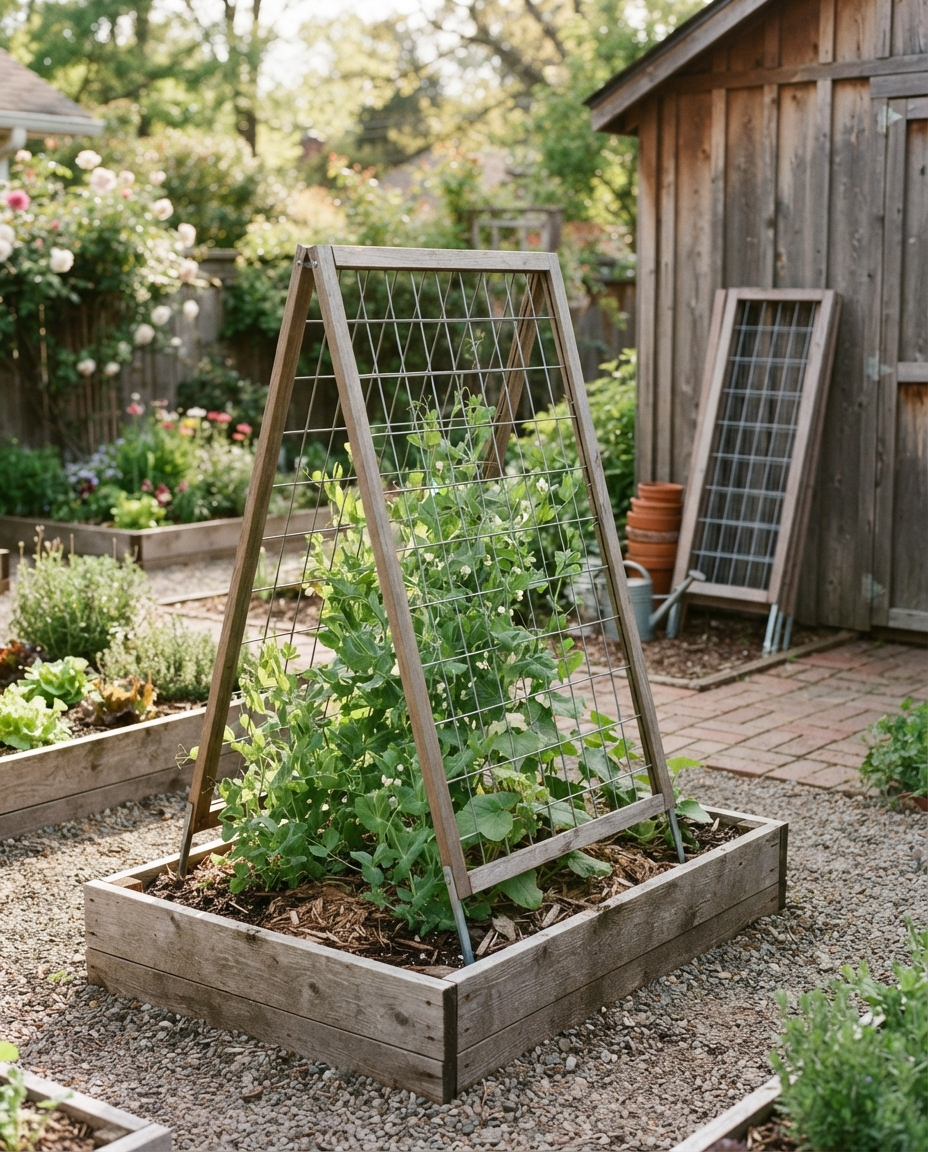
The practical advantage is not simply portability. A removable or folding support makes soil amendment, bed covering, and seasonal cleanup much easier. Permanent vertical structures can interfere with tarps, row covers, compost spreading, or attempts to rotate crops; a folding system reduces that problem.
Construction quality matters because hinges become stress points. They should be strong enough to handle repeated movement and outdoor conditions, and the frame still needs stakes or another method of preventing accidental collapse when covered in plants.
This design is especially useful for gardeners who rent, expect to redesign their beds, or simply dislike having large empty trellises dominate the winter garden.
Best for: Seasonal gardens, renters, rotating crops, peas, cucumbers, and gardeners who value flexibility.
10. The Pergola-Style Trellis — Build a Permanent Vertical Growing Zone
For gardeners who know vertical crops will remain an important part of the garden for many years, a small pergola-style structure can create a permanent growing framework. Strong posts support horizontal beams overhead, while strings, wire panels, or netting can be attached in different configurations depending on what is being grown that season.
This is essentially the heavier-duty version of a string trellis. Because the main frame remains in place, the gardener only needs to change the seasonal support material. Tomatoes may use vertical strings one year, while beans or cucumbers occupy removable mesh panels the next.
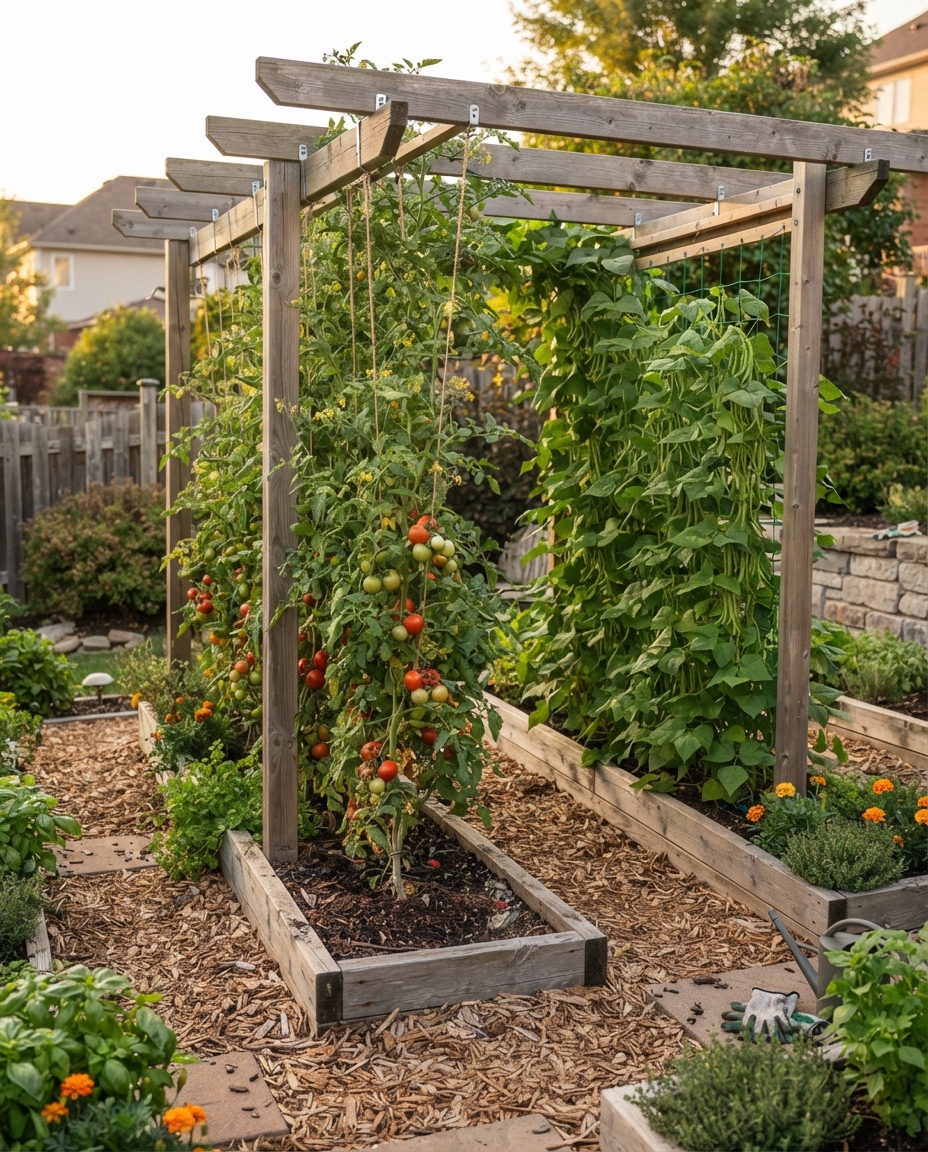
A permanent structure needs more careful placement than a temporary trellis. It will affect the garden visually throughout the year and may cast partial shade even when vines are absent. Posts must also be installed deeply and securely enough to remain stable through wind and the cumulative weight of mature plants.
The advantage is reliability. Instead of rebuilding supports every spring, the gardener has a dedicated vertical-growing station ready for whichever crop fits the rotation.
A pergola-style frame can also help organize irrigation, shade cloth, or temporary protective materials, although every additional use should be considered during construction so the structure is not overloaded unexpectedly.
Best for: Serious small-space vegetable gardeners, indeterminate tomatoes, beans, cucumbers, and gardens where vertical growing is a permanent strategy.
11. The Ladder Trellis — Simple Geometry With Plenty of Attachment Points
A ladder-style trellis consists of two vertical side supports connected by evenly spaced horizontal rungs. It can be built from wood, bamboo, metal, or other weather-resistant garden materials and works particularly well for plants that benefit from repeated horizontal attachment points.
The structure can stand independently in a raised bed, attach to posts, or lean slightly against a separate support. Peas and beans can climb naturally around the rungs, while cucumbers can be guided upward as their tendrils begin searching for something to grab.
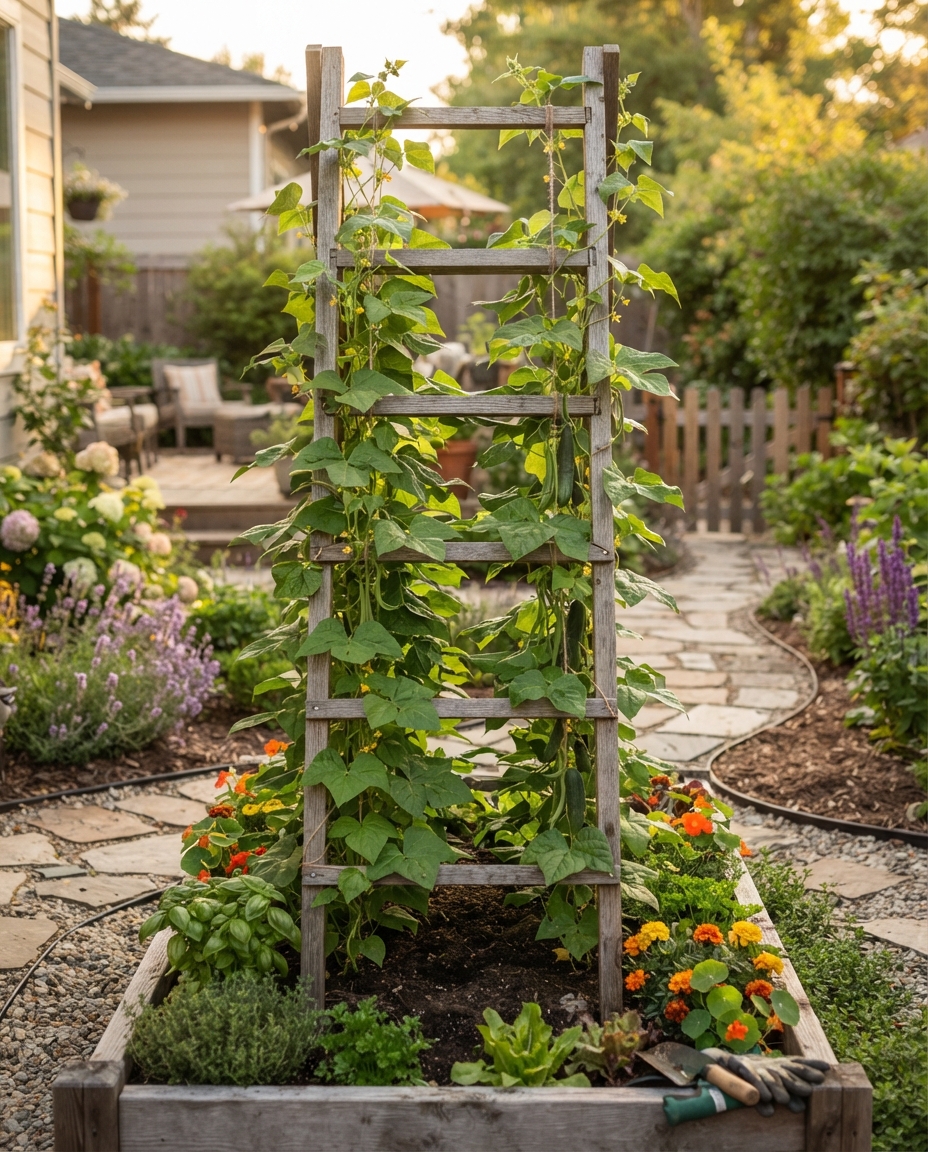
The spacing between rungs determines how useful the ladder is. Very wide gaps may force young vines to stretch before finding the next attachment point, while extremely narrow spacing adds material without necessarily improving growth. Additional garden twine can be tied vertically or diagonally across the rungs if a crop needs a denser network.
Wooden ladder trellises are particularly attractive in visible garden areas because they look intentional even before plants cover them. Unlike thin netting, they remain an architectural part of the garden after harvest.
The limitation is that the rigid rungs provide less continuous attachment surface than mesh. This is rarely a major problem with beans, but cucumbers and peas may benefit from added twine if the gaps are large.
Best for: Peas, pole beans, compact cucumbers, ornamental edible gardens, and gardeners who want a structure that looks attractive year-round.
12. The Raised-Bed Corner Trellis — Use the Space the Bed Already Has
Not every raised bed needs a large trellis spanning the entire back edge. Sometimes a single corner can support one or two vertical plants while the rest of the bed remains open for lower crops.
A corner trellis can be formed from two narrow mesh panels meeting at roughly a right angle, a triangular wooden frame, or several poles tied together above the bed. The structure uses very little planting space yet creates enough support for a few cucumbers, beans, peas, or a carefully trained tomato.
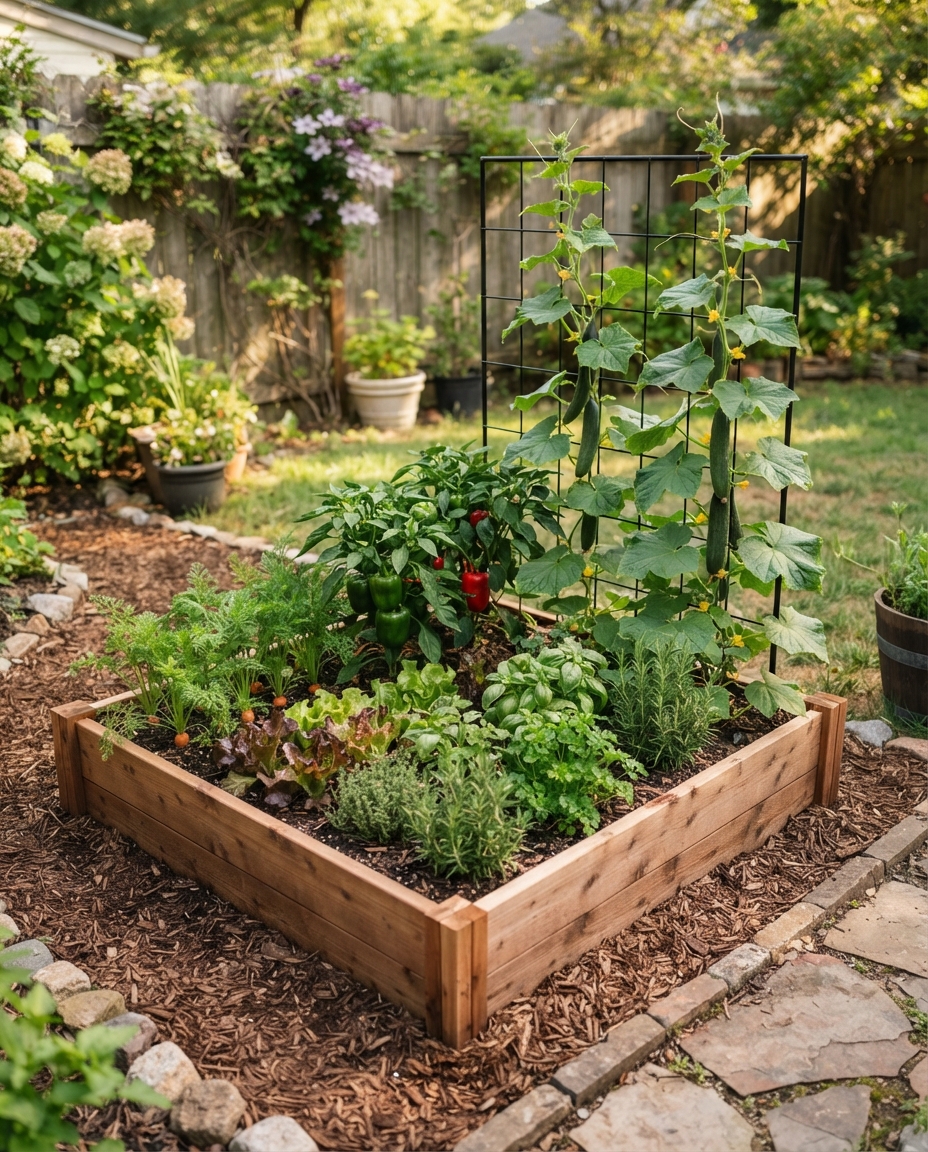
This arrangement is particularly effective for square raised beds. Instead of allowing one climbing plant to dominate the center, it is assigned to the corner and directed upward immediately. The remainder of the bed stays available for peppers, herbs, carrots, onions, lettuce, or other crops with smaller vertical footprints.
A corner position can also protect paths. Vines trained upward are less likely to fall over the bed edge and sprawl across walkways, which becomes increasingly important in small gardens where the passages between beds may already be narrow.
However, avoid positioning a dense trellis on the sun-facing side if it will shade the entire bed. Think of the structure as a seasonal wall and place it according to the movement of sunlight through your specific garden.
Best for: Square raised beds, very small gardens, one or two climbing plants, and gardeners who do not need a full-length trellis.
How to Choose the Right Trellis for What You’re Growing
The most common trellis mistake is choosing the structure first and deciding what to plant on it afterward.
A better approach is to begin with the crop.
Plants interact with supports in very different ways. Pole beans wrap their stems around narrow supports. Peas use tendrils that search for nearby objects to grab. Cucumbers also use tendrils but produce heavier vines and fruit. Indeterminate tomatoes are not true climbers and must be actively trained. Squash vines can be directed upward but may eventually carry fruit far heavier than the structure was designed to support.
The table below provides a useful starting point.
| Crop | How It Climbs | Useful Trellis Type | Approximate Support Need | Gardener Training |
|---|---|---|---|---|
| Pole beans | Twining stem | String, mesh, arch, ladder | Moderate | Low |
| Peas | Tendrils | Netting, mesh, A-frame | Light | Low |
| Cucumbers | Tendrils | Mesh, arch, lean-to, A-frame | Moderate–heavy | Moderate at first |
| Indeterminate tomatoes | Must be tied/clipped | String, panel, pergola frame | Heavy | High |
| Small gourds | Tendrils/vining | Arch or reinforced mesh | Heavy | Moderate |
| Melons | Vining/tendrils | Strong mesh or arch | Heavy | Moderate; fruit support may be needed |
| Climbing flowers | Varies | Obelisk, string, ladder | Usually light–moderate | Depends on species |
The strength category describes the overall plant and crop load rather than an exact engineering specification. Wind, variety, pruning, irrigation, fruit load, and trellis dimensions can change structural demand substantially.
How Tall Should a Vegetable Trellis Be?
Trellis height should reflect the mature growth habit of the plant and the gardener’s ability to harvest it.
A three-foot support may be sufficient for shorter peas, but it will do very little to contain an eight-foot pole bean. Similarly, an indeterminate tomato can continue producing vertical growth for much of the season and may quickly exceed a decorative four-foot support.
There is also little value in building a trellis so tall that harvesting becomes dangerous. A twelve-foot bean tower may produce impressive vines, but if the upper pods require a ladder every few days, the structure may be poorly matched to the gardener.
For many home gardens, five to eight feet is a useful practical range for vigorous climbing vegetables because it provides meaningful vertical space while remaining reasonably accessible. This is a design range rather than a biological requirement; dwarf varieties may need far less, while some vigorous vines can grow well beyond it.
Practical Height Guide
| Crop | Common Useful Home-Garden Trellis Range | Main Reason |
|---|---|---|
| Peas | 3–6 ft | Depends strongly on variety |
| Bush-type cucumbers | Often little or no trellis required | Compact growth habit |
| Vining cucumbers | 5–7 ft | Provides room for extended vines |
| Pole beans | 6–8 ft | Vigorous vertical growth |
| Indeterminate tomatoes | 6–8+ ft | Continuous growth when conditions permit |
| Small melons/gourds | 5–7+ ft | Need area for long vines and fruit spacing |
Always check the expected mature habit of the actual variety you are planting rather than relying only on the crop name.
Where Should You Put a Trellis So It Doesn’t Shade the Rest of the Garden?
A trellis covered in leaves behaves very differently from an empty frame. During early spring, sunlight may pass straight through the structure, making its placement seem irrelevant. By midsummer, the same trellis can be a dense green wall six or seven feet high. This matters particularly in raised beds where peppers, tomatoes, eggplants, herbs, and other sun-loving crops may sit only a few feet away.
In the Northern Hemisphere, placing taller plants and trellises toward the northern side of a growing area is often a useful starting principle because the sun generally tracks through the southern portion of the sky. That can reduce the amount of shade cast across shorter crops. In the Southern Hemisphere, the relationship is generally reversed.
However, backyard gardens rarely exist in open agricultural fields. Houses, trees, sheds, fences, walls, and neighboring buildings can completely alter the actual light pattern. Observe your garden directly during the growing season, ideally at several points during the day.
Think in terms of the trellis at full maturity. If a seven-foot cucumber wall occupied this exact location, what would be behind it at 10 a.m., noon, and 4 p.m.? That simple exercise can prevent one of the most frustrating small-garden mistakes: creating additional growing space vertically while accidentally reducing productivity everywhere beside it.
How Much Space Can Vertical Gardening Actually Save?
There is no universal percentage because plant habit and training method matter enormously, but the spatial advantage can be dramatic. Consider a cucumber vine. When allowed to sprawl naturally, its stems may travel several feet across the soil and into adjacent paths. The actual roots occupy a relatively small area, but the foliage claims a much larger horizontal footprint.
Train that same plant upward and the footprint changes. The roots still require appropriate soil volume and spacing, but much of the foliage now occupies vertical airspace. The surface that would have been covered by the vine may become available for carefully chosen lower-growing crops or at least remain accessible for watering and maintenance.
The same logic applies to pole beans compared with bush beans. A vertical bean plant can grow to several feet of height while using relatively little ground area around its stem. Vertical gardening does not eliminate plant spacing requirements. Roots still compete underground, foliage still needs light, and overcrowding can still reduce airflow and productivity. The benefit comes from changing where the mature foliage occupies space, not from giving every plant zero ground area.
Choosing Trellis Materials: Wood, Metal, Wire, String, or Netting?
Every trellis material involves trade-offs between cost, strength, longevity, appearance, storage, and ease of construction.
| Material | Strength | Longevity | Best Uses | Main Drawback |
|---|---|---|---|---|
| Natural wood | Moderate–high depending on dimensions | Moderate | Permanent frames, ladders, pergolas | Eventually weathers/rots |
| Galvanized metal panel | High | High | Cucumbers, beans, tomatoes, arches | Higher initial cost; cut edges can be sharp |
| Garden string/twine | Low–moderate | Often seasonal | Tomatoes, beans, temporary systems | Must be replaced or maintained |
| Plastic netting | Light | Variable | Peas and lightweight vines | Can tangle badly during cleanup |
| Metal T-posts | High | High | Structural supports for mesh | Utilitarian appearance |
| Bamboo poles | Moderate | Variable | Teepees, light frames, temporary trellises | May split or deteriorate |
| Wire cable | High | High if suitable outdoor material | Permanent systems | Requires secure anchors and tensioning |
Material should be chosen according to the heaviest crop you realistically expect the structure to support.
A beautiful bamboo trellis may be perfect for peas but completely inappropriate for a massive mature squash vine. Likewise, a heavy cattle-panel frame is unnecessary if you are supporting only a small row of dwarf peas.
How to Trellis Cucumbers Properly
Cucumbers are among the easiest vegetables to move from the ground onto a trellis because they naturally produce tendrils. Young plants may not immediately understand where you want them to go, so gently guide the main vines toward the support as they begin extending. Once tendrils discover the mesh, wire, or string, the plant usually becomes increasingly capable of attaching itself.
Avoid aggressively wrapping tender cucumber vines around supports. Young stems can be brittle, and forcing a bend may damage them. Redirect them gradually.
Mesh is particularly effective because the tendrils have many nearby attachment points. A very smooth, thick pole provides fewer opportunities to grip unless additional string or crosspieces are added.
Once the plants mature, check the interior of the foliage regularly. Trellising improves visibility, but cucumbers are exceptionally good at hiding behind leaves and becoming oversized before you notice them.
Regular harvesting also encourages the plant to continue putting energy into new flowers and fruit rather than maturing an old cucumber far beyond the stage you intended to eat it.
How to Trellis Tomatoes Without Treating Them Like Vines
Tomatoes deserve special attention because they are often described as climbing plants even though their growth behavior is very different from beans or cucumbers. An indeterminate tomato produces long stems that continue growing throughout the season, but those stems do not naturally wrap themselves around a trellis. The plant must be supported.
This can be done with clips attached to vertical strings, soft ties connecting the stems to wire panels, weaving between horizontal supports, or other systems designed to prevent the stem from collapsing under its own weight.
If using a single-string system, pruning strategy becomes part of trellising. Many gardeners select one main leader and regularly remove competing suckers, producing a tall, narrow plant that is easier to train vertically. Others retain two or more leaders depending on spacing and management preferences.
The more stems you allow to develop, the more trellis space the plant requires. Ties should never constrict the stem. Tomato stems thicken considerably as they mature, so supports need enough room to accommodate growth. The objective is to carry the weight of the plant and fruit while keeping stems upright and accessible, not to force the tomato to behave like a pole bean.
Can Squash and Melons Really Be Grown on a Trellis?
Some can, but this is where structural strength and variety selection become especially important. Smaller-fruited squash, gourds, and melons are much easier to grow vertically than extremely large varieties. The vines may climb successfully, but once fruit begins developing, the load on the trellis can increase substantially.
A heavy melon suspended several feet above the ground also places stress on the stem attaching it to the vine. Gardeners sometimes support developing fruit with slings made from breathable, flexible material that cradle the fruit while attaching securely to the trellis. The trellis itself should be reinforced accordingly.
This is not the place for lightweight decorative netting. Before attempting a vertical melon or squash crop, check the expected mature fruit size and vine vigor. A structure that easily supports peas may fail under several mature squash plants. Vertical growing can still be valuable, but it should be approached as a structural gardening technique rather than a visual trick.
Trellis Spacing in Raised Beds
A trellis saves horizontal space above the soil, but the plants at its base still require appropriate root and canopy spacing. Do not place six cucumber plants where two properly spaced plants should grow simply because they are being trained vertically. Excessive density can create a solid wall of foliage with poor interior airflow, severe competition for water, and fruit that becomes difficult to see.
Spacing should begin with recommendations appropriate to the crop and variety, then be adjusted according to training method and local conditions.
Trellised tomatoes pruned to a narrow leader can often be managed differently from unpruned plants with several large stems. Pole beans may intentionally grow relatively close along a trellis because their narrow growth habit is fundamentally different from that of mature tomatoes. The trellis controls the direction of foliage. It does not remove the biological needs of the plant.
How to Combine Vertical and Low-Growing Crops
One of the most productive uses of trellising is layering plants by height. A tall cucumber trellis can occupy the back edge of a bed while lettuce grows closer to the front. Tomatoes trained vertically may share a bed with basil. Pole beans can climb at the rear while radishes or onions occupy lower zones.
The concept is simple, but successful combinations depend on timing and sunlight. A lettuce plant that grows perfectly beneath a young cucumber vine in May may be deeply shaded once the cucumber forms a dense canopy in July. That may be helpful in a very hot climate but detrimental somewhere cooler.
Root competition matters as well. Two plants can occupy different heights above ground and still compete intensely below it. A productive layered bed therefore combines plants whose mature sizes, growing seasons, root demands, and light requirements complement one another rather than simply planting something in every visible gap.
Example Vertical Bed Layout
| Bed Zone | Possible Crop | Why It Fits |
|---|---|---|
| Back/north trellis | Cucumbers or pole beans | Uses vertical airspace |
| Middle | Peppers or compact herbs | Moderate height |
| Front edge | Lettuce, radishes, scallions | Short and easy to harvest |
| Corners | Parsley, basil, edible flowers | Makes use of smaller spaces |
This is only a conceptual layout; climate, sun orientation, variety size, and spacing should determine the actual planting plan.
Common Trellis Mistakes That Reduce Garden Productivity
The first mistake is underbuilding the structure. A trellis that feels perfectly sturdy in spring may behave very differently after it is covered with wet foliage and mature vegetables. Design for peak-season load, not early-season appearance. The second is building too short. Vigorous crops quickly outgrow decorative supports, forcing vines to fold over the top and create a tangled canopy.
Another common mistake is ignoring harvest access. Very fine netting may support peas beautifully but make it difficult to reach through and collect cucumbers. Similarly, placing a trellis directly against an inaccessible fence can trap fruit between foliage and the wall.
Shading is another major problem. Installing a dense trellis on the wrong side of a small bed can reduce light to everything behind it. Finally, avoid adding vertical plants so densely that they simply create congestion above the bed instead of on the soil. Growing upward is meant to organize plant growth, not compress unlimited vegetation into a small area. A good trellis gives the plant direction. A great trellis also gives the gardener access.
Which Trellis Should You Build? A Quick Comparison
| Trellis Style | Best Crops | Space Efficiency | Strength | Difficulty | Ideal Garden |
|---|---|---|---|---|---|
| Cattle panel | Cucumbers, beans, tomatoes | Excellent | Very high | Moderate | Raised beds |
| Arch | Cucumbers, beans, gourds | Excellent | High | Moderate | Beds facing each other |
| A-frame | Cucumbers, peas, beans | Excellent | Moderate–high | Easy–moderate | Flexible layouts |
| Fence-line | Beans, peas, cucumbers | Excellent | Depends on frame | Moderate | Tiny/narrow yards |
| String | Tomatoes, beans | Excellent | Depends on overhead frame | Moderate | Intensive gardens |
| Lean-to | Cucumbers, light squash | Very good | Moderate–high | Moderate | Beds with side access |
| Obelisk | Peas, beans, compact vines | Very good | Moderate | Easy | Containers/tiny beds |
| T-post + wire | Most climbing vegetables | Excellent | High | Easy–moderate | Practical gardens |
| Folding | Peas, cucumbers | Very good | Moderate | Moderate | Seasonal gardens |
| Pergola frame | Tomatoes, beans, cucumbers | Excellent | Very high | Advanced | Permanent gardens |
| Ladder | Peas, beans, cucumbers | Good | Moderate | Easy | Decorative gardens |
| Corner trellis | Cucumbers, beans, tomatoes | Excellent | Moderate | Easy | Square raised beds |
FINAL THOUGHTS
A trellis is one of the rare garden upgrades that can change how much usable growing space you have without changing the physical size of the garden. That is especially important in a small backyard.
A cucumber no longer needs to crawl across the path when it can climb six feet into the air. Pole beans can turn a narrow strip of soil into a wall of harvestable growth. Tomatoes can be trained into organized vertical rows instead of becoming an impenetrable thicket. Even the empty air above a walkway can become productive when an arch trellis connects two raised beds. But vertical gardening works best when it is treated as more than a space-saving trick.
For lightweight peas, that may mean nothing more complicated than netting and posts. For cucumbers, a rigid mesh panel or A-frame may provide the ideal balance of strength and access. For intensively trained tomatoes, a permanent overhead frame and string system may justify the additional work. And where two beds already face one another, a simple garden arch can transform otherwise empty air into some of the most productive space in the backyard.
The smartest small gardens do not try to squeeze endlessly outward. They learn when to grow up.