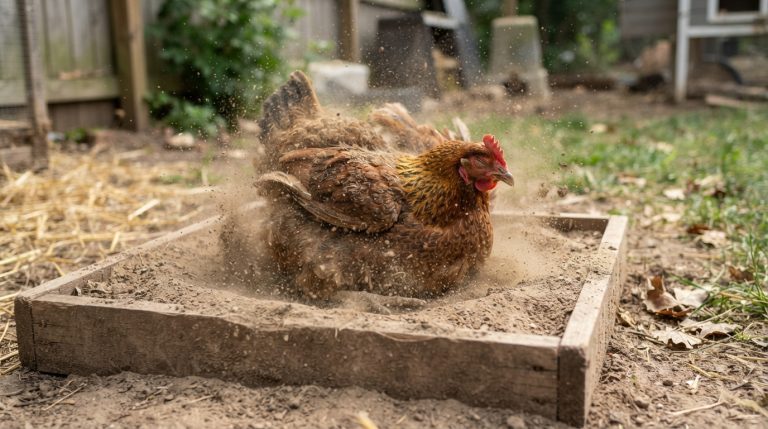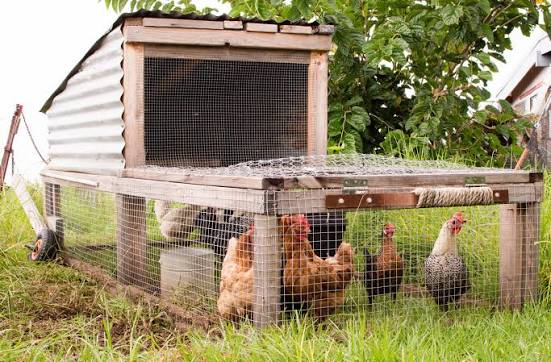
A chicken run can solve several backyard-flock problems at once, but a poorly planned one can create just as many. A secure run gives chickens protected outdoor space when unrestricted free-ranging is not practical. It can keep birds away from vegetable beds, patios, neighboring properties, roads, and landscaping while giving the flock room to scratch, dust bathe, forage, exercise, and interact outside the coop. It can also make daily flock management easier because feeders, waterers, enrichment, shade, and shelter can all be concentrated in one predictable area.
The problem is that chickens are exceptionally good at changing whatever ground they occupy. A grassy run can become bare soil surprisingly quickly. Bare soil can become mud during wet weather. Shade structures can become awkward obstacles. Feed attracts rodents if it is handled poorly. Lightweight fencing may contain chickens while doing very little against determined predators, and a large enclosure built without any attention to landscaping can make an otherwise attractive backyard feel as though the entire property has been converted into poultry infrastructure.
That is why the strongest chicken runs are designed as part of the backyard rather than added to it as an afterthought. Safety comes first. The enclosure has to address the predators that actually exist in your area, including threats that may climb, dig, reach through fencing, or attack from above. But security alone is not enough. Drainage, cleaning access, shade, flock behavior, ground conditions, ventilation, feeder placement, and how the run looks from the patio all influence whether the design remains practical after several seasons.
A run also needs to be designed for the birds when they are fully using the space, not simply for how empty the enclosure looks on construction day. Chickens gather around feeders, scratch along edges, congregate beneath shade, dig dust-bathing depressions, and repeatedly walk the same routes between the coop and their favorite areas. These traffic patterns can destroy vegetation faster than many first-time keepers expect.
The goal is therefore not to preserve a perfect lawn inside the chicken run. A more realistic goal is creating a durable, well-drained, enriched outdoor area for the flock while protecting the rest of the yard from excessive wear.
The twelve ideas below approach that problem from different angles. Some are designed for small suburban properties. Others work better for larger backyards or flock owners who want movable grazing areas. Several focus on keeping the enclosure visually attractive, while others solve drainage, predator protection, shade, or ground deterioration. The best chicken run usually combines several of them.
1. Build a Fully Framed Predator-Resistant Run Beside the Coop
The most reliable backyard chicken run is often the simplest conceptually: a permanent framed enclosure attached directly to the coop. Instead of using lightweight poultry netting as the primary barrier, construct the run from a rigid frame and a more substantial wire mesh appropriate to the predators in your area. Chicken wire is excellent for keeping chickens inside an enclosure, but it should not automatically be treated as a serious predator barrier. Animals capable of tearing, bending, squeezing, or reaching through weak wire can still injure birds even when they cannot enter completely.
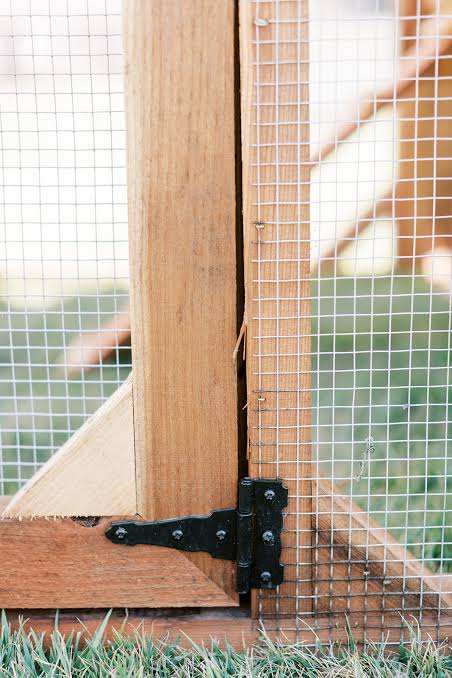
A welded hardware-style mesh is commonly chosen for high-security areas because the openings are smaller and the material is more resistant to reaching predators than traditional chicken wire. The exact gauge and opening size should be selected according to local predator pressure, construction method, and whether the mesh is being used on walls, roof sections, vents, or buried barriers.
The run should also be attached to the coop without obvious gaps. Small openings around corners, doors, roof intersections, or uneven ground can become the weakest points in an otherwise strong enclosure. A permanent attached run has another advantage: daily flock movement becomes simple. Birds leave the coop directly into their protected outdoor area rather than crossing exposed yard, and you can often access both structures from one service area.
To keep the enclosure from dominating the yard visually, match the frame material or finish to the coop. A run made from the same timber, stain, paint, or roof style can look like one integrated backyard structure instead of a wire cage attached as an afterthought.
Predator-Protection Components to Think About
| Run Area | Potential Weakness | Stronger Design Approach |
|---|---|---|
| Side walls | Reaching, tearing, climbing | Rigid predator-resistant mesh |
| Ground perimeter | Digging | Buried barrier or outward apron |
| Roof | Hawks, climbing animals | Solid roof or secure wire covering |
| Door | Weak latch or gaps | Strong frame + secure latch |
| Coop/run connection | Small construction openings | Continuous protected transition |
| Corners | Mesh separating from frame | Secure fasteners and reinforced edges |
Best for: Suburban flocks, owners who need dependable daily confinement, and yards where chickens cannot safely free-range unattended.
2. Add an Outward Wire Apron Instead of Digging a Deep Trench
Digging predators are one of the most frustrating run-security problems because the fence can appear completely intact above ground while an animal works underneath it. One common approach is burying wire vertically below the fence line. Another is creating an outward horizontal apron around the perimeter. The apron extends away from the base of the enclosure beneath soil, mulch, gravel, or vegetation so that a predator attempting to dig directly beside the fence encounters wire.
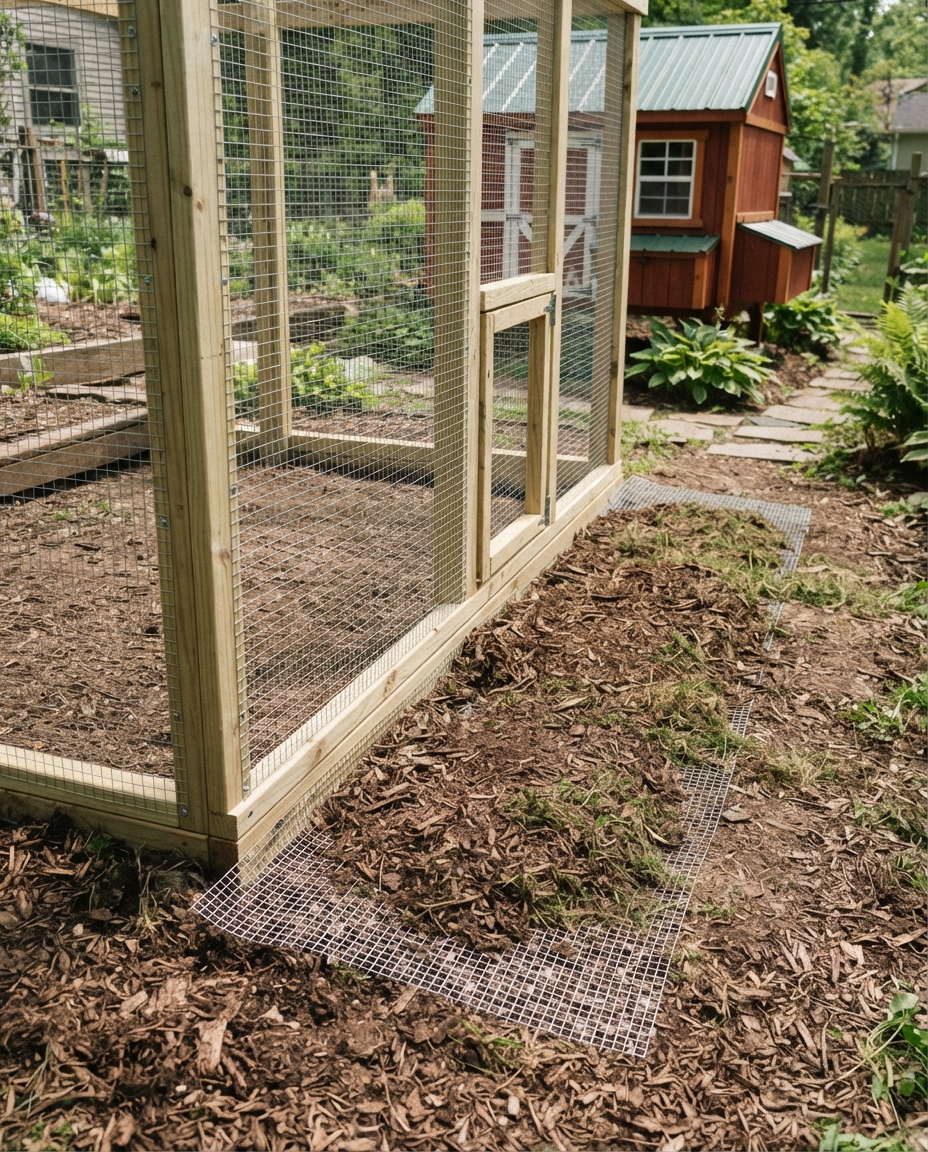
The main advantage of an apron is installation. Digging a deep trench around an entire run can be difficult in rocky, root-filled, or compacted soil. An outward barrier can often be installed with much less excavation. The design still needs proper attachment. The inner edge of the apron should connect securely to the run so that there is no gap where the fence meets the ground. Over time, the outer portion can become hidden beneath landscaping, mulch, or shallow soil, making the security feature nearly invisible from the yard.
Avoid leaving sharp cut-wire edges exposed where people, pets, or chickens can encounter them. An apron is also not automatically suitable for every site. Drainage, landscaping equipment, tree roots, buried utilities, and local predators should all be considered before construction.
Best for: Permanent runs where digging predators are a concern and deep trenching would be difficult.
3. Use a Solid or Partially Solid Roof to Keep the Run Drier
A roof changes a chicken run more than almost any other upgrade. Without cover, rain repeatedly hits the same ground where chickens scratch and walk. Vegetation disappears, the soil becomes exposed, and frequent traffic can turn wet areas into mud. Once that happens, the birds continue scratching and compacting the same surface, making recovery difficult.
A solid roof over at least part of the run creates a reliably dry zone. That dry area can hold feeders, dust-bathing material, perches, and enrichment while giving birds somewhere comfortable to stay during rain. It can also reduce how much feed gets wet and spoiled.
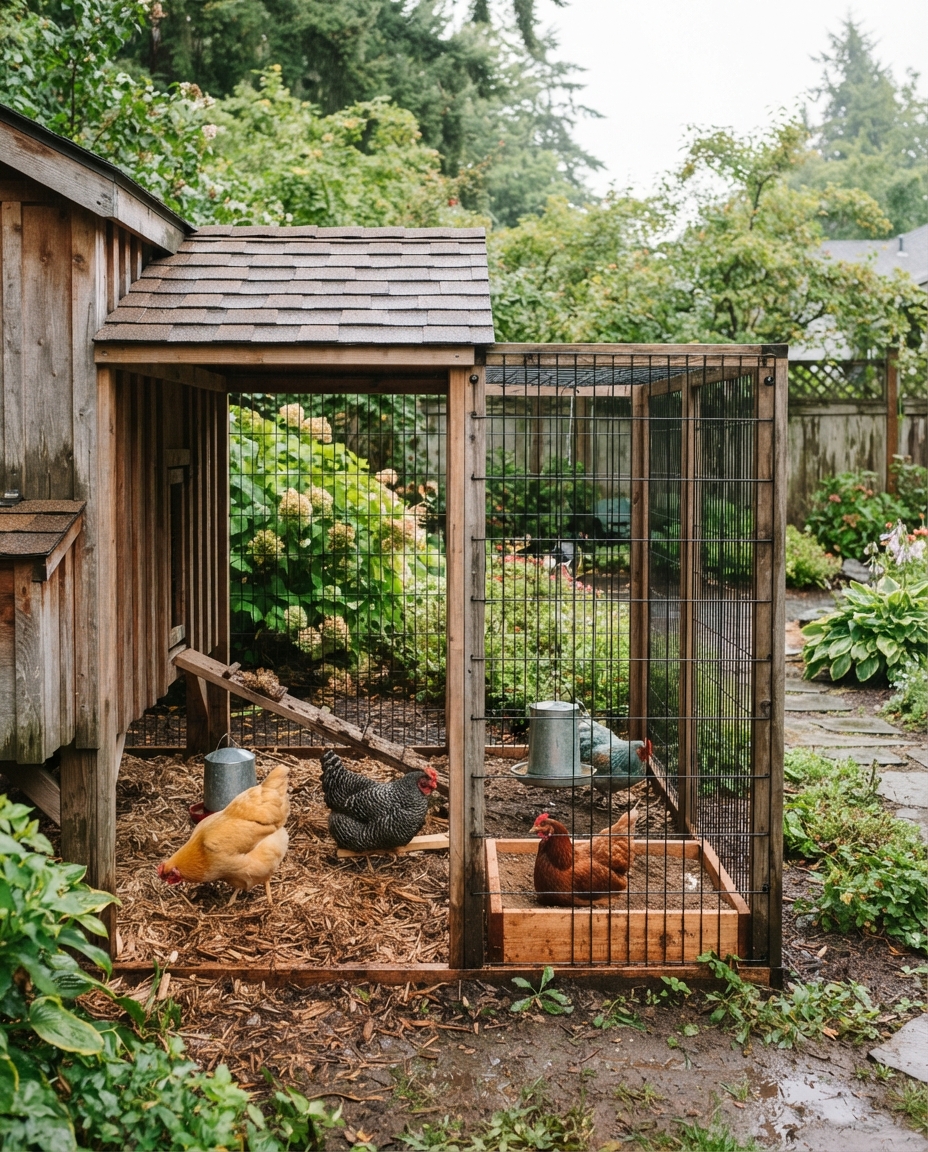
A partially roofed design often works well because it balances weather protection with daylight and airflow. The covered section can sit closest to the coop, while another section remains open to appropriate sunshine and weather where conditions permit. Roof slope matters. Water should run away from the coop foundation and high-traffic entrances rather than pouring directly into the run. Gutters can make the design even cleaner by redirecting runoff to drainage areas or an appropriate collection system.
In hot climates, roof material should also be chosen with heat in mind. A dark poorly ventilated roof can create an uncomfortable enclosed area during summer, while shade combined with strong ventilation can significantly improve comfort.
Roof Options Compared
| Roof Type | Rain Protection | Shade | Main Consideration |
|---|---|---|---|
| Solid metal/polycarbonate | High | High depending on material | Heat and runoff management |
| Shingles matching coop | High | High | Heavier structural load |
| Secure wire roof | Low | Low | Predator protection without weather cover |
| Shade cloth over secure structure | Low-moderate | High | Not a substitute for predator roof |
| Partial solid roof | Moderate-high | Moderate | Good compromise for many backyards |
Best for: Rainy climates, muddy runs, small yards where the chicken area needs to remain visually tidy.
4. Create a Deep-Litter or Mulched Run Surface Instead of Trying to Preserve Grass
One of the easiest ways to ruin the appearance of a backyard chicken area is trying indefinitely to keep grass alive in a heavily used permanent run. Chickens scratch, they eat vegetation, they dig dust baths, and they repeatedly walk the same routes. Unless the enclosure is extremely large relative to the flock or birds are rotated frequently, the vegetation inside a permanent run often declines.
A more realistic strategy is creating a deliberate organic surface rather than waiting for grass to turn into bare soil and mud. Coarse wood chips, dry leaves, appropriate untreated plant material, and other suitable carbon-rich materials can create a deep, absorbent run surface. Chickens scratch through the material, manure becomes distributed rather than sitting on exposed hard ground, and the run can look far more intentional than a patch of destroyed lawn.
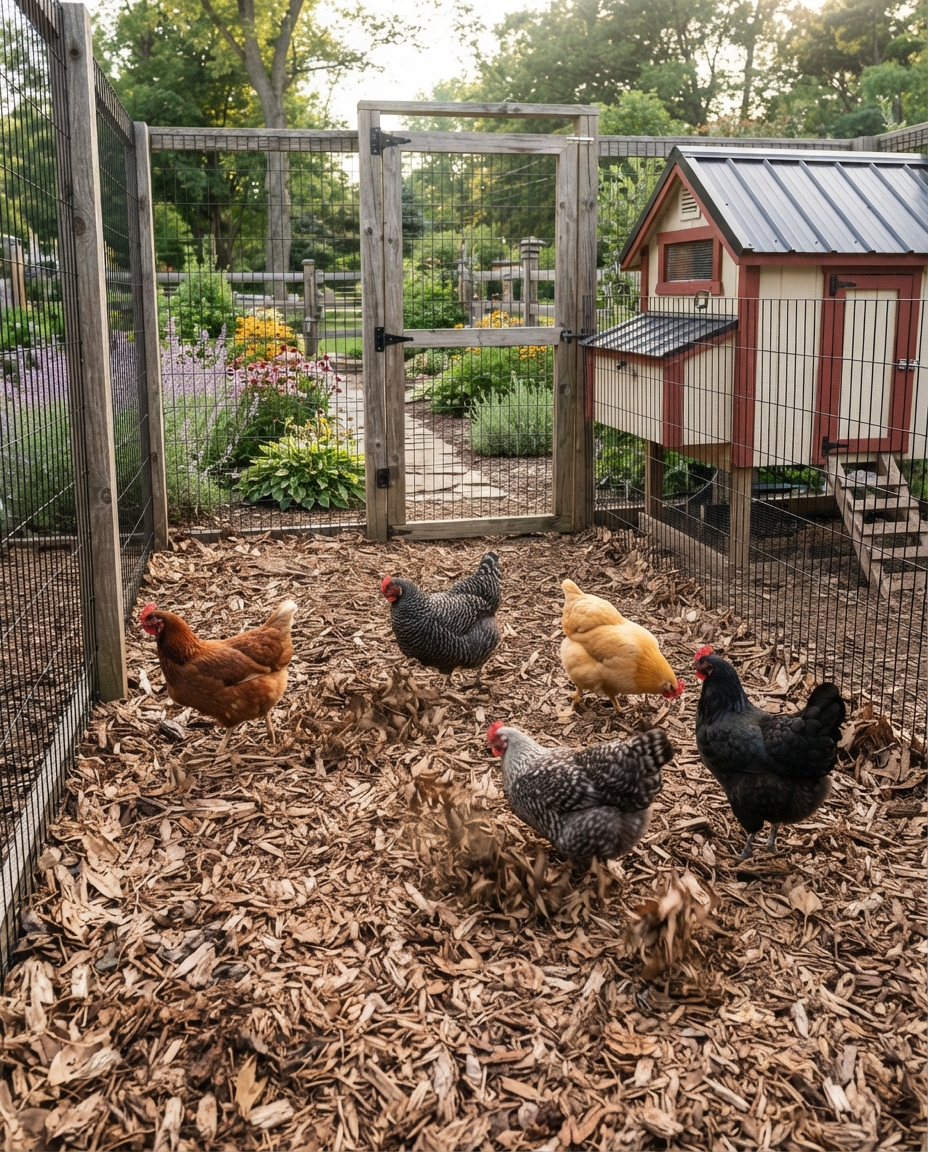
The surface should remain loose and relatively dry rather than becoming a compacted wet mass. Fresh material can be added as needed, and areas around waterers or entrances should be monitored closely because they often become wet first. This system is different from simply dumping an enormous layer of fine sawdust into the enclosure. Very fine material can become dusty when dry or compacted when wet. Coarser materials usually create better structure.
Avoid materials that are chemically treated, moldy, toxic, or otherwise inappropriate around poultry. The visual benefit is substantial. A mulched run looks like a designed garden zone rather than a failed patch of lawn.
Best for: Permanent runs, wet climates, high-traffic flock areas, and keepers who value easier ground management.
5. Build a Rotational Run With Two or Three Separate Sections
If preserving some vegetation is important, rotation is much more realistic than expecting chickens to remain on one small grassy patch indefinitely. A rotational system divides the outdoor area into two or more sections. Chickens use one area while another rests and begins recovering. After a period determined by vegetation condition, weather, flock size, and soil, access can be switched.
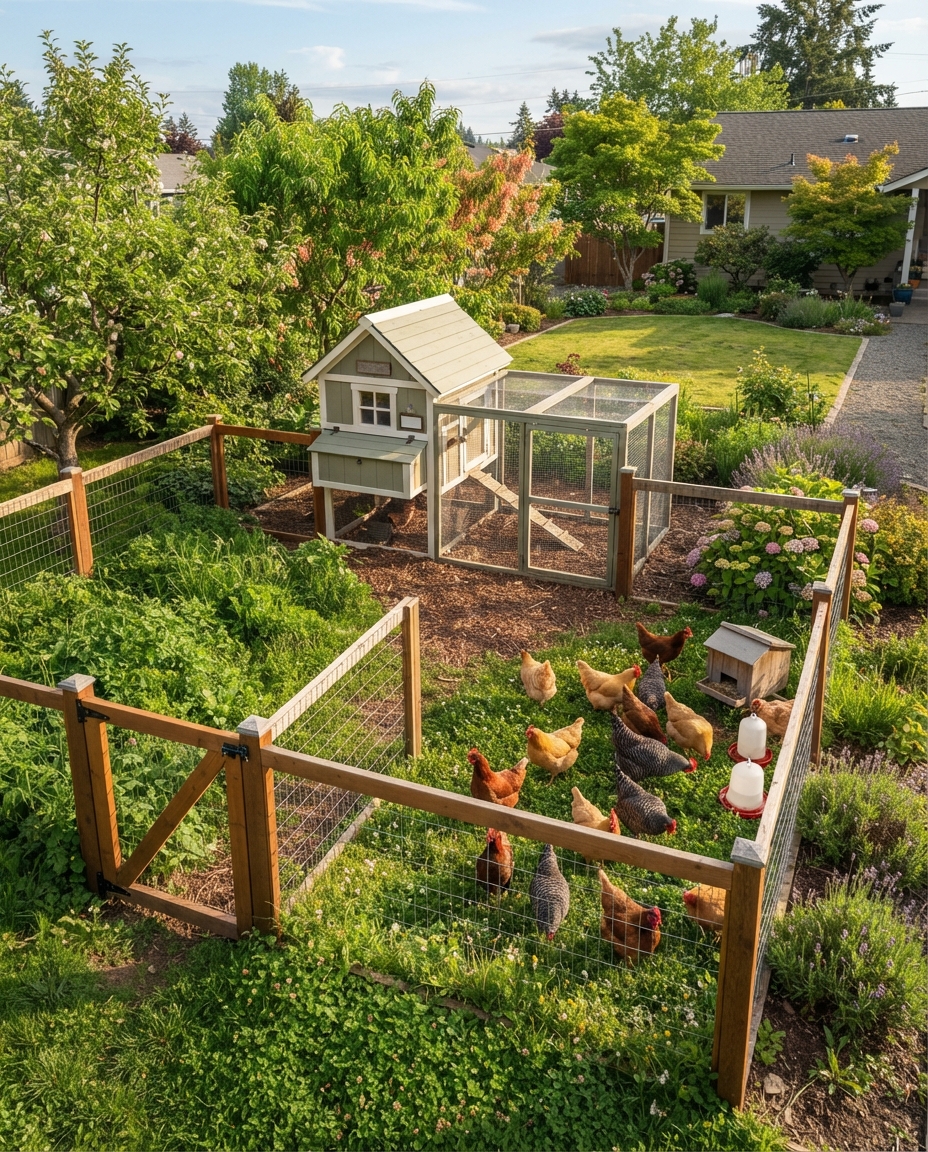
This can reduce pressure on individual sections, although it does not guarantee a perfect lawn. Recovery depends heavily on how quickly plants regrow, whether the ground has been compacted, rainfall, temperature, and how much time chickens spend in each section. Rotation also allows areas to serve different purposes.
One section may be heavily mulched and used during wet weather, while another contains living vegetation for drier periods. A third could be planted or rested behind temporary fencing. For small yards, the partitions do not need to look agricultural. Low internal fences connected to one central secure run can divide the space subtly. Gates allow access to each section without requiring the entire enclosure to be rebuilt.
The most important requirement is that every area remains secure when in use. A rotation system should not depend on flimsy temporary fencing if local predator pressure requires stronger protection.
Rotational Run Concept
| Section | Main Use | Management Goal |
|---|---|---|
| Run A | Current active grazing/scratching | Allow normal flock use |
| Run B | Resting vegetation | Recovery |
| Covered core | Wet-weather area | Protect soil and feed |
| Optional Run C | Seasonal rotation | Longer recovery cycle |
Best for: Larger suburban yards, flock owners who want some living ground cover, and properties where several smaller run areas can connect to one coop.
6. Use a Walk-In Run So Cleaning and Maintenance Stay Easy
A run that is comfortable for chickens but miserable for the human caring for them will eventually become difficult to maintain. Low tunnels and short enclosures may save material initially, but they can make routine tasks frustrating. Replacing water, carrying feed, raking bedding, catching a bird, inspecting fencing, or cleaning corners becomes much harder if every job requires crouching or crawling.
A full-height walk-in run solves this problem. The door should be wide enough for normal movement while carrying a feeder, bucket, rake, or possibly a wheelbarrow depending on the size of the enclosure. Interior height should allow the owner to stand comfortably across the primary work area.
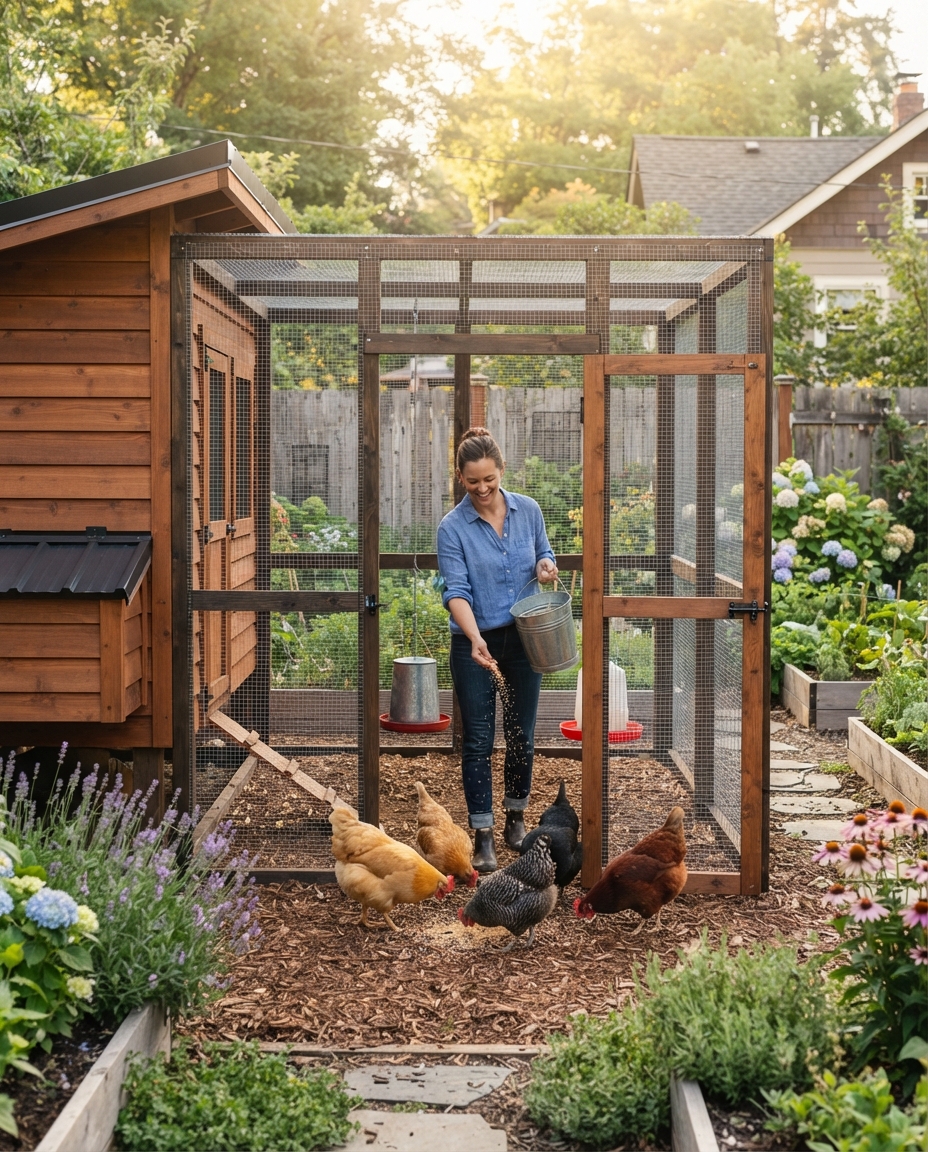
Maintenance access also improves safety because you are more likely to notice loose fencing, rodent activity, damp bedding, damaged roofing, or sharp objects when you can comfortably inspect the enclosure. A walk-in run can also look much more intentional. Full-height framing creates clean architectural lines and makes it easier to match the run visually to the coop or nearby garden structures.
Think about the door swing before construction. A door that opens inward can be blocked by bedding, birds, or objects inside the run. One that opens outward must have enough yard clearance. Use a secure latch that is not easily manipulated by predators known for dexterous paws.
Best for: Nearly every permanent backyard flock where there is enough space to build full height.
7. Turn the Chicken Run Into an Attractive Garden Structure With Landscaping Outside
A secure chicken run does not need to resemble a temporary wire pen. One of the best ways to integrate it into a backyard is landscaping around the enclosure rather than relying on delicate plants inside it. Chickens are remarkably efficient at destroying newly planted vegetation they can reach. A shrub that looks beautiful beside the fence may quickly lose lower leaves if birds can pull them through the mesh.
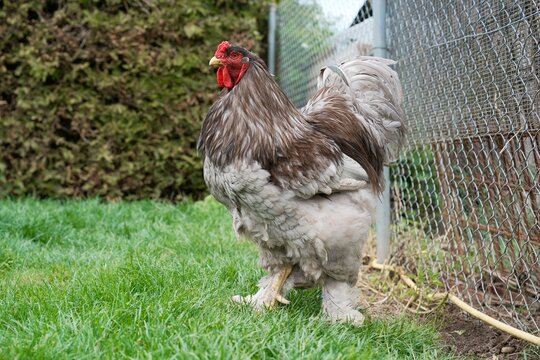
Plant outside the run far enough that mature foliage can soften the structure without being stripped through the wire. Evergreen shrubs, flowering perennials, ornamental grasses, herbs, or other regionally suitable plants can visually connect the coop and run to the rest of the landscape. Avoid planting species that are toxic to poultry where birds might access leaves, berries, seeds, or fallen material.
The run itself can use the same design language as the house or garden. Black mesh often visually recedes more effectively than bright shiny wire from a distance. Timber stained to match a fence can help the frame disappear into the yard. A roof that echoes the coop makes the entire structure feel intentional.
You can also hide practical elements. Feed-storage containers may be placed inside an attractive weatherproof cabinet nearby. Hoses can be routed discreetly. Compost bins can be screened with fencing or shrubs. The objective is not disguising the fact that chickens live there. It is making the poultry area look like a planned part of the property.
Best for: Visible suburban backyards, patios overlooking the run, and owners who care as much about landscape design as flock management.
8. Create Protected Grazing Frames Inside the Run
If you want chickens to have access to living greens without allowing them to destroy the plants immediately, protected grazing frames are a useful compromise. A grazing frame is essentially a shallow planted area covered with strong wire or mesh positioned above the soil. Grass, clover, or another poultry-appropriate planting grows beneath the barrier, while birds can peck at the leaves that extend through without scratching the roots completely out of the ground.
This does not create unlimited forage. Repeated pecking can still weaken the planting, and different climates will affect how quickly vegetation recovers. But the frame protects the root zone enough to give plants a better chance than they would have on exposed run soil.
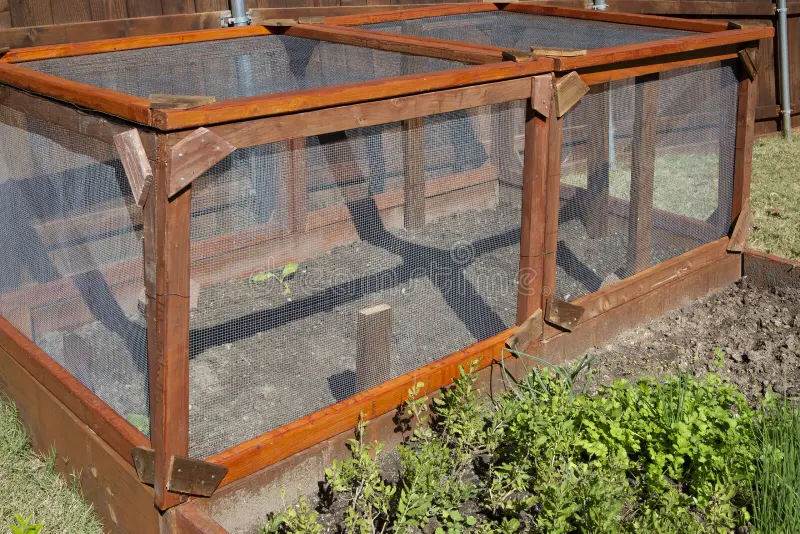
The structure should be built so birds cannot trap feet, heads, or legs in awkward openings. The covering also needs to support the birds if they walk across the top. A raised frame can double as visual enrichment because chickens spend time pecking and investigating the growing material. Several small frames are often easier to maintain than one enormous planting bed. Use only plants appropriate for poultry and avoid treating the planting with lawn chemicals, pesticides, or fertilizers that are unsafe around birds.
Best for: Permanent runs where keepers want some living vegetation without sacrificing the entire plant root system.
9. Add a Dedicated Covered Dust-Bathing Zone
Dust bathing is a normal chicken behavior, and if you do not provide an appropriate location, the flock will usually choose one for itself. That location may be directly beside the run door, underneath the feeder, against the coop foundation, or in the one remaining patch of vegetation you hoped to preserve. A designated dry dust-bathing area helps concentrate the behavior.
Choose a section that remains protected from rain, then provide dry, loose material appropriate for dust bathing. The exact composition does not need to become an elaborate internet recipe filled with unnecessary additives. Dry loose soil or sand-like material appropriate to the site can often provide the physical medium chickens are looking for. The key is dryness. A dust bath that repeatedly fills with rain becomes mud and will likely be abandoned for another part of the run.
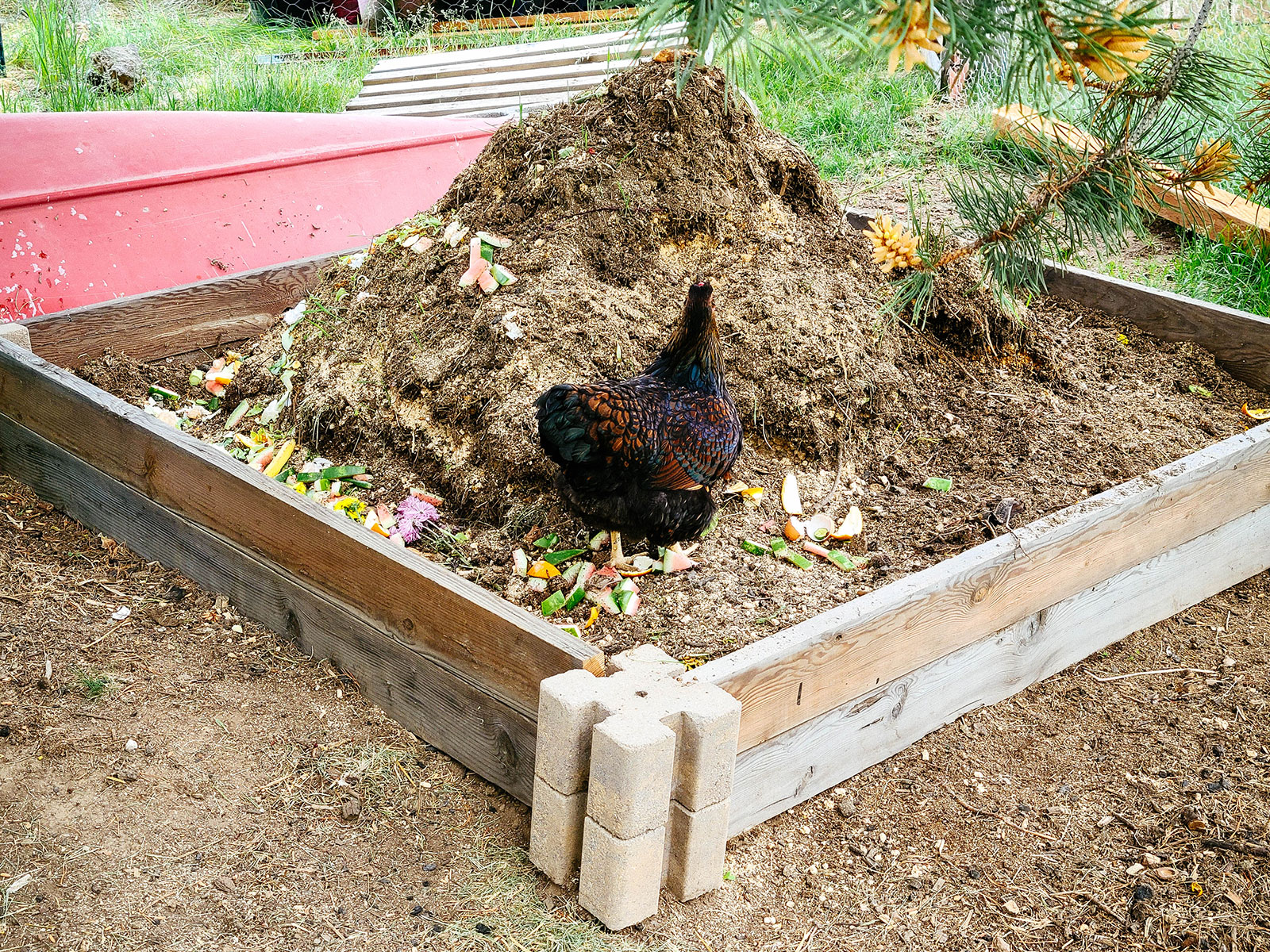
The area should also be large enough for more than one bird because flock members often dust bathe together. Creating a defined zone can actually make the run look better because the flock is less likely to dig random crater-like depressions throughout the entire enclosure.
Best for: Any enclosed flock, particularly permanent runs with mulch or protected vegetation.
10. Add Perches, Stumps, and Platforms to Use Vertical Space Inside the Run
A chicken run can feel much larger to the flock when it contains different heights. Chickens naturally enjoy perching, stepping onto objects, investigating elevated areas, and moving between zones. An empty run gives them ground area but little environmental complexity. Adding securely mounted roost bars, logs, tree stumps, low platforms, or simple perching structures can make the space more interesting without dramatically increasing the run footprint.
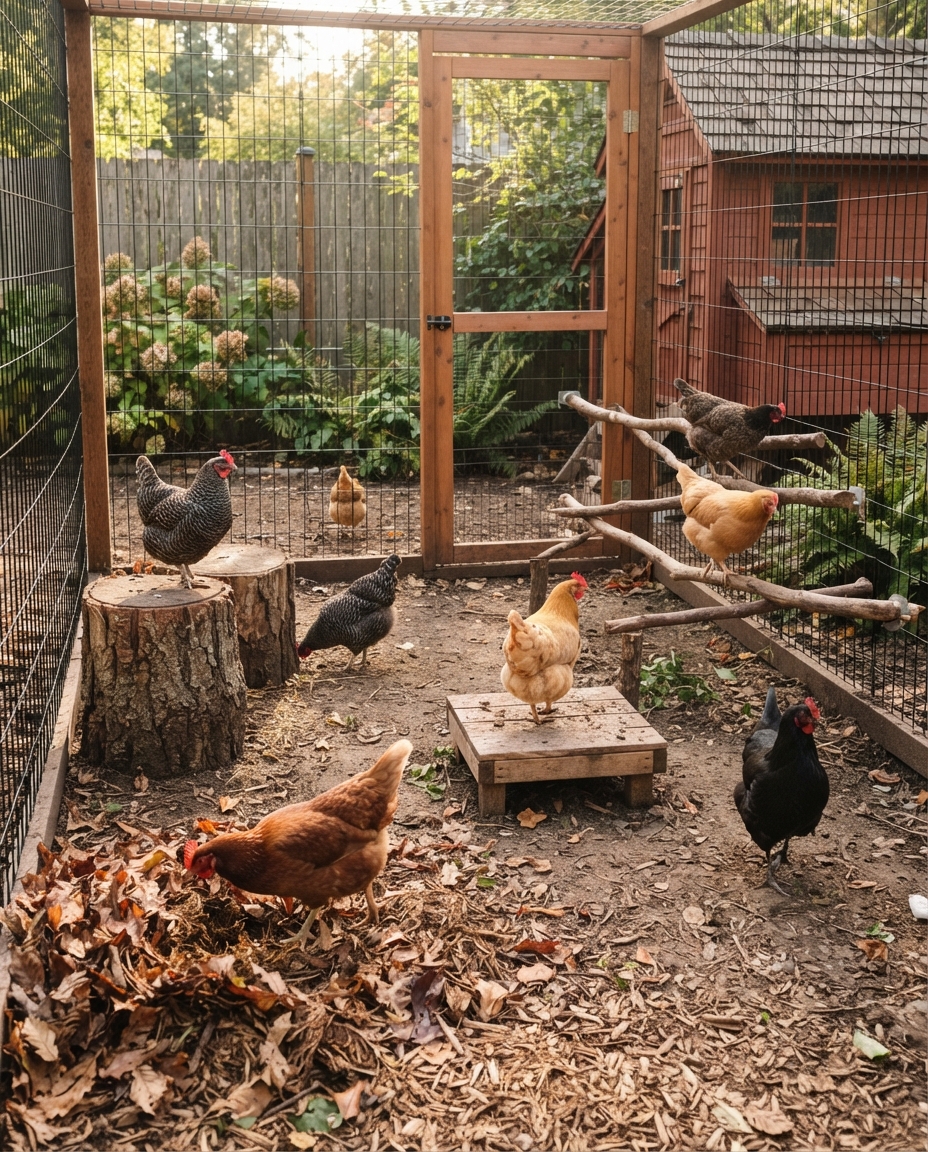
This becomes particularly valuable in a smaller enclosure. A low platform may create shade beneath it while providing an elevated resting area above. A branch mounted diagonally can add multiple perching heights. Stumps can become stepping points while also giving birds surfaces to inspect.
Safety matters. Structures should not have sharp exposed screws, unstable branches, splintered timber, or narrow traps where feet can become caught. Elevated platforms should remain low enough that ordinary jumping does not create unnecessary injury risk, particularly with heavier breeds. Avoid filling every bit of space. Birds still need open ground for scratching, dust bathing, moving away from one another, and accessing resources.
The objective is creating complexity, not clutter.
Simple Run Enrichment
| Feature | Purpose |
|---|---|
| Low natural branch | Perching and exploration |
| Stable stump | Raised observation point |
| Low platform | Resting + shaded space beneath |
| Hanging greens | Controlled foraging activity |
| Leaf pile | Scratching and searching |
| Grazing frame | Access to protected vegetation |
| Dust-bath zone | Supports normal behavior |
11. Create a Narrow Side-Yard Chicken Run Instead of Sacrificing the Main Lawn
Some backyards have limited central space but contain long narrow strips along the side of the house, fence, garage, or shed. These areas can sometimes be excellent locations for a chicken run. A side-yard run preserves the main lawn, patio, vegetable garden, or children’s play area while converting an otherwise underused strip into productive flock space. The layout should still provide adequate width for normal chicken movement and human access. Simply squeezing chickens into a narrow corridor that is technically fenced but difficult to clean is not a good solution.
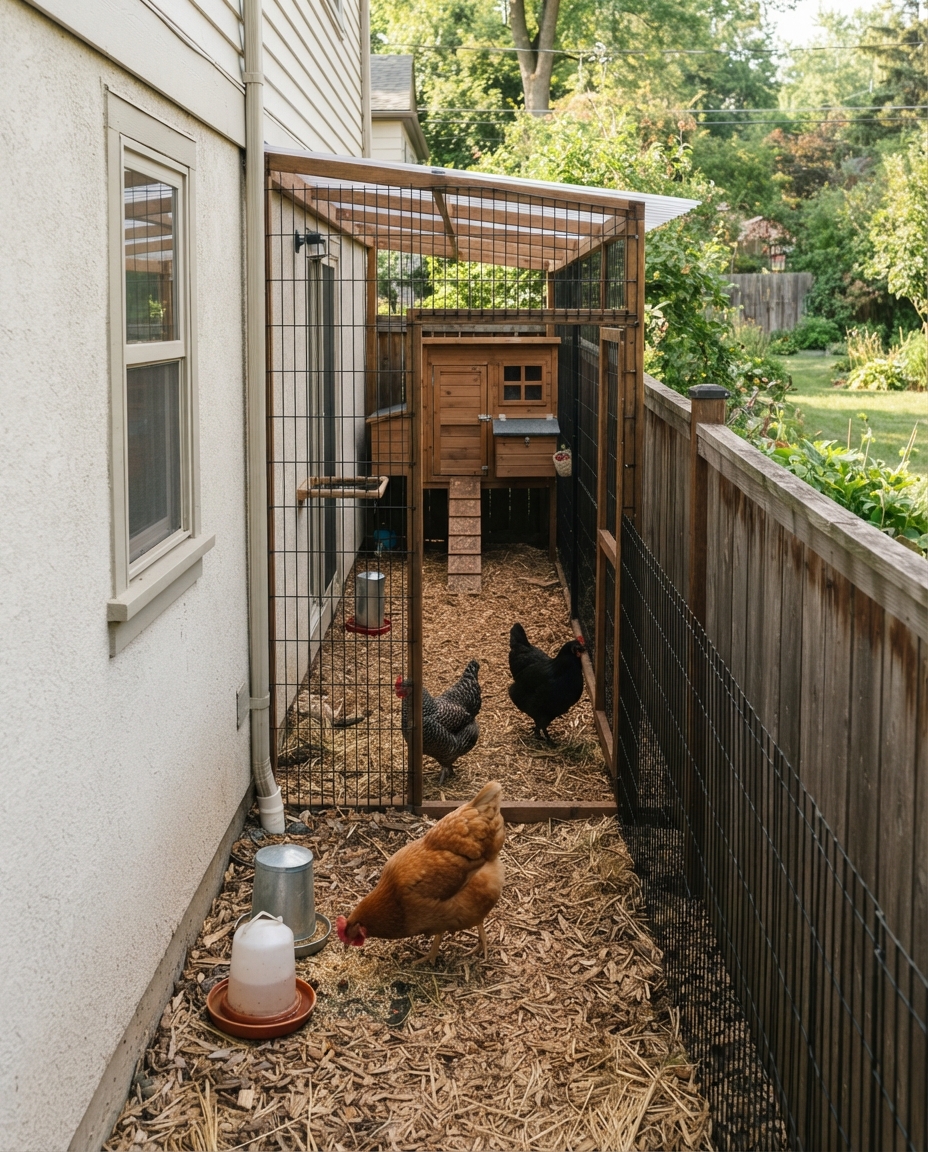
Drainage needs particular attention because side yards often receive roof runoff, stay shaded, or contain compacted pathways. A roof gutter dumping water into the enclosure can create a permanent mud problem. Shade may be either helpful or excessive. In hot climates, some shade can be extremely valuable. In cool, damp climates, a deeply shaded run may remain wet and receive very little drying sun.
The connection between coop and run should also be convenient. A side-yard run works best when the coop itself is incorporated into the same zone rather than requiring the birds to cross exposed yard. Visually, this design has one major advantage: much of the poultry infrastructure disappears from the primary backyard view.
Best for: Narrow suburban properties, small yards, and homes with useful side-space that receives suitable drainage and ventilation.
12. Use a Secure Mobile Run or Chicken Tractor for Controlled Yard Access
A movable enclosure can provide chickens with temporary access to different sections of the yard while preventing them from roaming everywhere at once. Commonly called chicken tractors or mobile runs, these structures are designed to be moved periodically so birds can scratch and forage in a new area before the ground is completely destroyed.
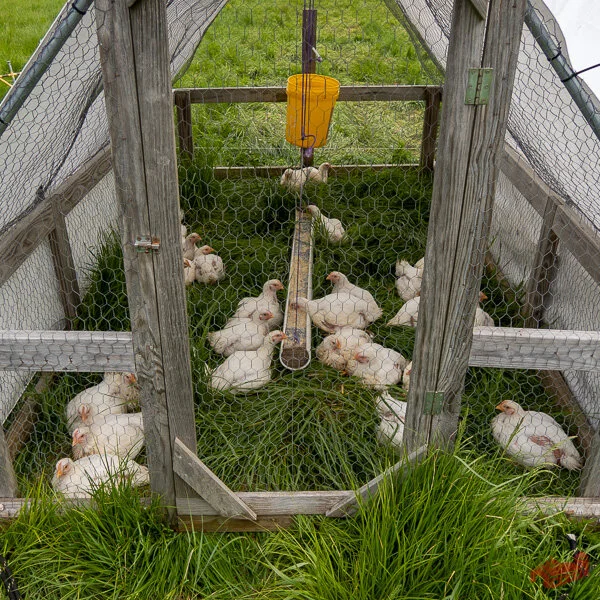
The biggest advantage is controlled rotation. Instead of giving the flock unrestricted access to flower beds, patios, vegetable gardens, and lawn, you decide exactly where they can spend time. The design must still be predator-conscious. A lightweight mobile run is not automatically safe simply because it has wire walls. Ground gaps, weak latches, overhead access, and digging predators may all remain concerns.
Mobility also creates a structural tradeoff. The enclosure needs to be light enough to move but strong enough to remain secure. Wheels, skids, handles, or lightweight framing can help, but windy areas may require additional anchoring while the run is in place. Mobile runs work especially well as a supplement to a permanent secure coop and run. Chickens can spend part of the day in the movable enclosure when conditions allow, then return to the more secure permanent structure.
This gives the yard temporary flock access without turning the entire lawn into one permanent chicken zone.
Best for: Larger lawns, rotational access, gardens where permanent fencing is undesirable, and flock owners who already have secure nighttime housing.
Chicken Wire vs. Hardware-Style Mesh: Why the Difference Matters
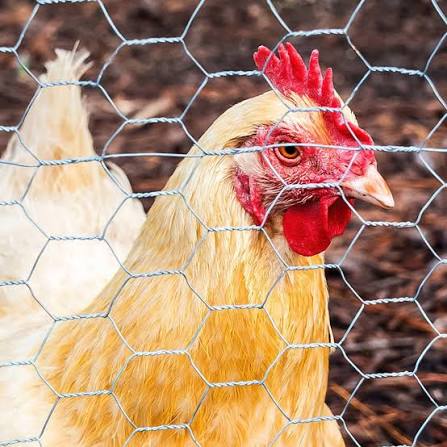
One of the most important run-design distinctions is the difference between containing chickens and excluding predators. Traditional chicken wire was developed largely to contain poultry. Its relatively large openings and lightweight construction make it easy to use, but those same characteristics can create weaknesses when the goal is serious predator resistance.
A welded hardware-style mesh generally uses smaller openings and a more rigid construction, making it more useful in vulnerable areas such as lower walls, ventilation openings, run doors, and other sections where animals could reach through or damage lighter fencing. The exact material needed depends on local predators.
A backyard where hawks are the primary concern requires different planning from a rural area with raccoons, foxes, coyotes, weasels, snakes, or other threats.
Basic Barrier Comparison
| Material | Good for Keeping Chickens In | Predator Resistance | Typical Use |
|---|---|---|---|
| Standard chicken wire | Yes | Limited | Interior partitions, low-risk containment |
| Welded hardware-style mesh | Yes | Much better | Secure run walls and openings |
| Heavy welded livestock panel | Yes | Strong structurally but openings may be large | Structural fencing combined with finer mesh |
| Plastic poultry netting | Yes in some situations | Low | Temporary supervised containment |
| Electric poultry netting | Can be useful with correct system | Depends on setup and predator | Rotational outdoor systems |
Predator protection should be designed as a complete system. Strong mesh does little if the door latch is weak or a large gap remains beneath the enclosure.
Should a Chicken Run Have a Roof?
For many backyard flocks, some form of overhead coverage is extremely useful, but different materials solve different problems. A secure overhead barrier can help protect chickens from aerial predators and may also prevent climbing animals from entering from above, while a solid roof provides additional protection from rain, harsh sun, and other weather. These functions should not be confused. Shade cloth may create valuable shade but is not necessarily a reliable predator barrier, while wire mesh can provide strong overhead security without keeping the run dry. A solid roof can address both shade and rainfall, but it still requires proper framing, ventilation, and secure edges to function well.
In many cases, a combination of materials provides the best balance. One section of the run can be covered with a solid roof to create a consistently dry, shaded area for feeding, dust bathing, and resting, while another section is secured with predator-resistant mesh to allow more sunlight and airflow. This approach gives chickens access to both protected shelter and a brighter, better-ventilated outdoor area without sacrificing security.
How to Keep a Chicken Run From Turning Into Mud
Mud is usually a drainage problem before it is a chicken problem. Chickens can certainly make conditions worse by scratching exposed soil and wearing away vegetation, but the underlying issue is usually that water is entering the run faster than it can drain away. The first step is to identify the source. Check whether the coop roof drains directly into the enclosure, whether the backyard slopes toward the run, whether the waterer spills frequently, whether one doorway receives most of the foot traffic, or whether dense clay soil is slowing drainage. Understanding where the excess moisture comes from makes it much easier to choose an effective solution instead of simply adding more bedding on top of wet ground.
A roof and properly directed gutters can eliminate a large amount of direct rainfall, while site-specific solutions such as French drains, shallow swales, gravel borders, or minor grading may help move water away from problem areas. Any drainage work should suit the property and local conditions, and water should never be redirected toward neighboring land or building foundations. Inside the run, a coarse, carbon-rich mulch can create a more resilient walking surface and reduce the amount of exposed mud. Waterers should also be placed where spills can be contained so they do not continually saturate the bedding or soil beneath them.
Mud Problem Diagnosis
| Problem | Likely Cause | Possible Response |
|---|---|---|
| Mud directly below roof edge | Runoff | Add gutter/redirect water |
| Mud around waterer | Spills | Raise or relocate waterer |
| Entire run wet after rain | No roof/poor drainage | Add cover and improve drainage |
| Mud at doorway | Heavy traffic | Add durable surface |
| Persistent puddles | Low spot/compacted soil | Regrade or improve drainage |
What Should You Put on the Ground of a Chicken Run?
There is no single best surface for every chicken run because climate, drainage, flock size, and how heavily the area is used all influence what works well. Grass can be an excellent option when flock pressure is low enough for vegetation to survive or when chickens are rotated between different sections before the ground becomes worn. Coarse wood chips are also useful in many permanent runs because they create a comfortable scratching surface, help absorb organic material, and can perform well when the area drains properly. Dry leaves can be added as another source of carbon while also giving chickens loose material to scratch through and explore.
Other surfaces can work well in the right conditions but often require more careful management. Sand is used successfully by some flock keepers, especially in dry climates or covered runs, although it behaves differently in consistently wet conditions and may require more frequent manure removal. Gravel is particularly useful around drainage zones, gates, and human pathways, but it is usually better as a targeted material than as the only surface across the entire chicken-living area. Bare dirt is the simplest option, yet it can quickly become troublesome when heavy use turns it into mud during wet weather or hard, dusty, compacted soil during dry periods. The best surface is therefore the one that matches the local climate, drainage conditions, and intensity of flock use.
Ground-Surface Comparison
| Surface | Advantages | Limitations |
|---|---|---|
| Grass | Natural forage, attractive | Often destroyed quickly |
| Coarse wood chips | Good scratching, helps mud control | Needs replenishment |
| Dry leaves | Cheap/free, excellent scratching | Break down quickly |
| Sand | Easy manure removal in some setups | Climate-dependent, can become wet/compact |
| Gravel | Durable around paths/water | Not ideal as only scratching surface |
| Bare soil | No installation cost | Mud, dust, compaction |
In many permanent backyard runs, a mixed deep organic surface is more realistic than trying to preserve lawn indefinitely.
How Much Space Should a Chicken Run Have?
There is no single amount of run space that works perfectly for every flock because several factors influence how much room chickens actually need. Breed size, temperament, climate, the number of birds, feeder placement, enrichment, and whether the flock also receives supervised free-range time all affect how comfortable and manageable an enclosure will be. In general, more usable space makes flock management easier. A larger run gives birds more opportunities to move away from one another, reduces pressure on heavily used patches of ground, and creates more room for perches, enrichment, shade, feeders, waterers, and dust-bathing areas without causing unnecessary congestion.
When planning the enclosure, however, it is important not to focus only on total dimensions. Areas that chickens cannot use effectively should not be treated as valuable living space simply because they add square footage on paper. A narrow dead-end corner behind the coop, for example, may technically make the run larger while contributing very little to how the flock actually uses the space. It is better to think in terms of usable layout, with enough open and accessible room for chickens to move comfortably between food, water, shade, dust baths, resting areas, and enrichment without constantly squeezing past one another.
How to Protect the Yard Outside the Run
A well-designed chicken area helps protect the rest of the yard by giving the birds enough stimulation inside their enclosure. If chickens are constantly released onto the lawn because the run is bare, cramped, or boring, they will naturally return to garden beds, mulch, patios, and landscaped areas where scratching and foraging are more rewarding. Providing loose scratching material, reliable shade, dust-bathing areas, perches, platforms, protected forage frames, and safe enrichment such as hanging greens can make the run much more engaging. The more natural behaviors chickens can perform inside their designated space, the less pressure there is to give them unrestricted access to the entire backyard.
If you still want the flock to explore beyond the run, controlled access is usually easier to manage than unlimited roaming. Temporary fencing can keep chickens away from vegetable beds and delicate landscaping, while a mobile run can direct their scratching toward areas where it is actually useful. Rotational access also gives sections of lawn time to recover before the birds return. The goal is not to eliminate chicken activity, but to decide where that activity is beneficial and where it is likely to become destructive.
Attractive Chicken Run Design: How to Make It Look Intentional
Backyard poultry structures usually look best when they repeat materials and finishes that already appear elsewhere on the property. If the fence is built from dark-stained timber, using similar framing on the run helps everything feel connected. If the coop is white with a dark roof, carrying those same colors through the enclosure creates a more cohesive look. Straight edges, level framing, and a single consistent fence style also make a major difference compared with several unrelated materials patched together. The same principle applies to the smaller details: create one clear path to the run, keep storage out of sight, route hoses deliberately, and use landscaping outside the wire to soften the enclosure without making it feel cluttered.
The visual difference between an improvised poultry pen and an attractive backyard chicken area often has less to do with cost than with consistency. A modest run with straight framing, clean mulch, one roof style, coordinated colors, and intentional landscaping can look significantly more polished than a much more expensive enclosure built from several mismatched materials. When the structure feels like it belongs with the house, fence, garden, and surrounding landscape, the chicken area becomes part of the backyard design rather than something that looks added as an afterthought.
Safety Features Worth Checking Every Month
Predator protection is not a one-time construction project. Materials loosen. Soil moves. Wood swells and shrinks. Mesh fasteners can fail. Animals may repeatedly test the same area. A quick monthly inspection can catch weaknesses before they become serious.
Monthly Run Inspection
| Check | Look For |
|---|---|
| Mesh | Holes, rust, loose fasteners |
| Lower perimeter | Digging or erosion |
| Door | Gaps, warped frame, weak latch |
| Roof | Loose panels or mesh |
| Coop connection | New openings |
| Ground | Mud, sharp debris, exposed wire |
| Shade | Adequate coverage for current season |
| Water | Leaks or saturated bedding |
| Feed area | Rodent evidence or spilled feed |
| Enrichment | Loose branches, exposed screws |
12 CHICKEN RUN IDEAS AT A GLANCE
| Run Idea | Best Benefit | Yard Impact | Difficulty |
|---|---|---|---|
| Framed secure run | Strong everyday protection | Moderate | Moderate-high |
| Predator apron | Digging protection | Very low once hidden | Moderate |
| Partial solid roof | Mud/weather control | Low | Moderate |
| Deep mulched floor | Cleaner permanent run | Low | Easy |
| Rotational runs | Helps vegetation recover | Moderate-high | Moderate |
| Walk-in design | Easier maintenance | Low | Moderate |
| Landscaped exterior | Better backyard appearance | Low | Moderate |
| Grazing frames | Protected living greens | Very low | Easy |
| Dust-bath zone | Controls digging behavior | Very low | Easy |
| Perches/platforms | More enrichment in same area | Very low | Easy |
| Side-yard run | Preserves main backyard | Low | Moderate |
| Mobile run/tractor | Controlled yard access | Temporary | Moderate |
A Practical Small-Backyard Chicken Run Layout
Imagine a modest suburban backyard rather than a large rural property. The coop sits toward the rear or along one side of the yard so it does not dominate the main patio view, while a full-height permanent run extends directly from it. The section closest to the coop is roofed and remains dry year-round, making it the ideal place for the feeder, waterer, dust bath, and a low perch. The outer section is covered with secure overhead mesh and receives more sunlight, giving the birds a brighter space while still keeping them protected.
Instead of trying to maintain grass inside a heavily used permanent run, the ground is covered with coarse wood chips that are more durable and easier to manage. One corner contains a grazing frame so the chickens can access fresh vegetation without destroying it, while a branch and small platform add vertical interest and encourage natural movement. Outside the enclosure, shrubs and flowering plants soften the appearance of the fencing without growing through the wire. A gravel or stone path provides clean access during wet weather, and the perimeter is protected with a predator-resistant apron that can be hidden beneath the surrounding landscaping.
If the property has additional lawn, a mobile tractor or temporary supervised enclosure can give the chickens occasional access to fresh ground without allowing them to damage the entire yard. The key is that the flock area remains one organized part of the property rather than taking over everything else. There can still be a patio, usable lawn, vegetable beds, and attractive landscaping alongside the chickens. For a small backyard flock, this kind of clearly defined layout usually creates the best balance between animal care, practicality, and keeping the rest of the yard enjoyable.
Common Chicken Run Mistakes
One of the biggest mistakes when designing a chicken run is focusing only on containment rather than protection. A fence that keeps chickens from wandering may do very little to stop a determined predator from getting inside, so the entire structure should be designed from the predator barrier outward. Decorative fencing can look attractive, but it should never replace secure materials, strong fastenings, and proper predator-proofing. Style should come after security, not before it.
Another common mistake is assuming that grass will survive indefinitely inside a small permanent run. Once the birds wear down the vegetation, the ground can quickly turn into mud, leaving owners struggling with drainage and maintenance instead of intentionally switching to a more durable surface. Poor drainage can ruin an otherwise well-designed enclosure, especially if water collects around high-traffic areas. Feeder placement matters for the same reason, since feeders positioned where wind-driven rain can reach them may create wet bedding, spoiled feed, and additional mess. Building the run too low can also become frustrating over time, because cleaning and caring for the flock is much harder when you cannot stand comfortably inside the enclosure.
Enrichment is another element that should be planned from the beginning rather than added only after the birds begin showing signs of boredom or destructive behavior. Perches, dust-bathing areas, leaf piles, shaded zones, and protected forage spaces are much easier to incorporate during construction than after every part of the run is already occupied. A well-designed chicken run should therefore balance security, drainage, accessibility, durable ground surfaces, and enrichment from the start, creating a space that is easier to maintain while also supporting the birds’ natural behaviors.