A duck enclosure has to solve a slightly different set of problems from a typical chicken coop. Ducks are enthusiastic around water, quick to turn a clean patch of soil into mud, and happiest when they have enough ground-level room to move, forage, preen, and rest. At the same time, they are vulnerable to many of the same predators that threaten other backyard poultry, including raccoons, foxes, coyotes, dogs, snakes, rats, and aerial predators.
That combination means a good enclosure cannot be designed around appearance alone. It needs a dry sleeping shelter, secure walls, a protected roof or overhead barrier, drainage around water stations, and some form of protection against animals that dig beneath fencing. It should also be easy enough to enter that cleaning, refilling water, checking birds, and repairing weak points do not become unpleasant chores.
Penn State Extension recommends about 3 square feet of indoor housing and 15 square feet of outside run space per duck as a minimum small-scale poultry guideline, while also emphasizing dry, well-drained housing and secure covered runs. It specifically notes that waterers for waterfowl are often better placed in the outside run because this helps reduce humidity inside the shelter.
Predator resistance depends heavily on construction details. Penn State recommends burying run fencing at least 12 inches and turning the buried section outward to discourage digging predators, while Mississippi State advises using mesh openings smaller than one inch where predators such as raccoons may reach through. A University of Minnesota mobile-poultry design goes further by using ½-inch hardware cloth on the lower half of the enclosure because ordinary poultry wire allows some ground predators to reach through.
No backyard enclosure should be treated as absolutely predator-proof. Wood can rot, latches can loosen, wire can be pulled away from framing, animals can dig, and predators can exploit surprisingly small weaknesses. The goal is therefore to create several layers of protection so that one weak point does not immediately expose the flock.
The ten designs below use that principle in different ways, from permanent walk-in runs to mobile duck tractors and compact enclosures for smaller yards.
1. The Walk-In Hardware-Cloth Duck Run
For a permanent backyard flock, a full-height walk-in run is one of the most practical designs because it gives the ducks usable ground space while giving you enough room to clean, refill water, and inspect the enclosure without crawling inside.
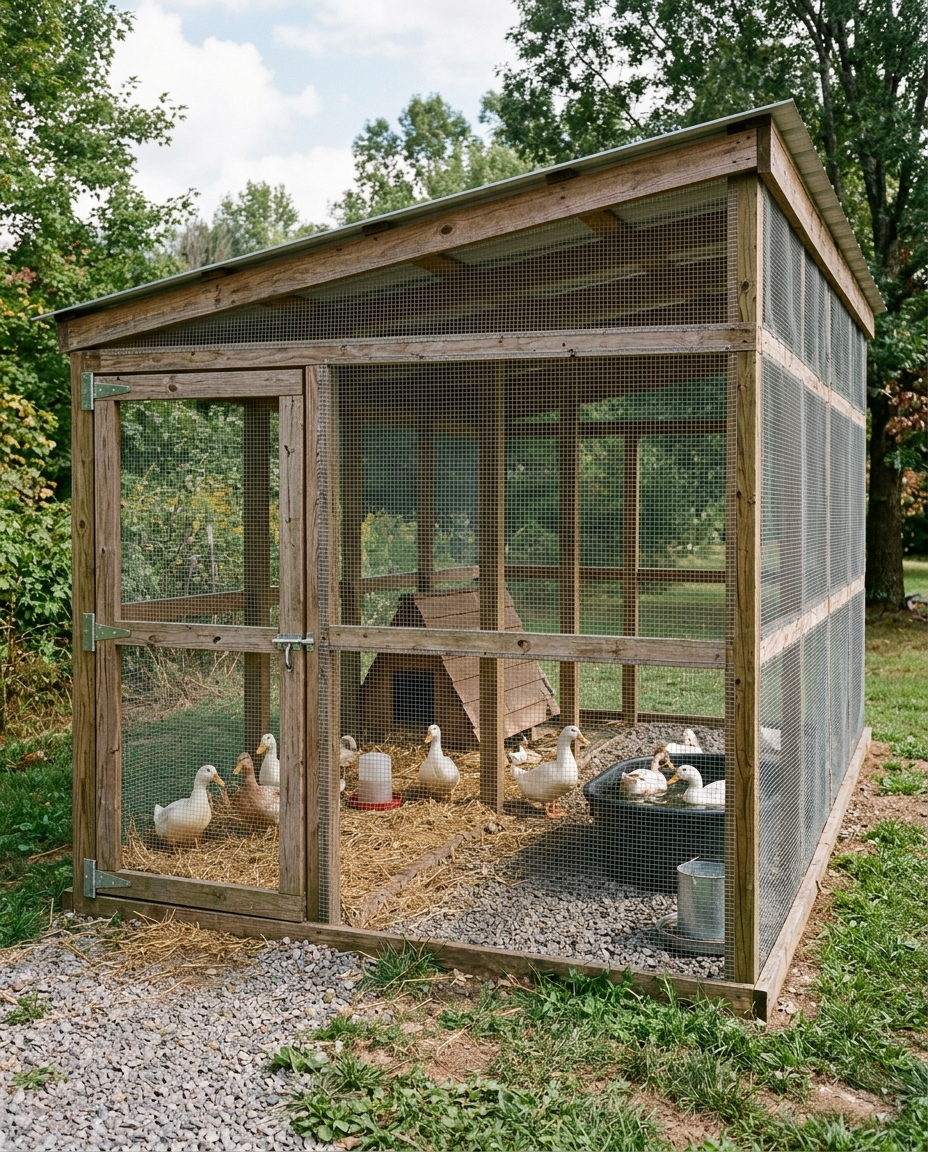
The basic structure can be built from pressure-appropriate exterior framing, metal posts, or another weather-resistant frame, then enclosed with strong welded mesh or hardware cloth. The lower portion deserves particular attention because raccoons and other predators may reach through larger mesh openings. University of Minnesota’s mobile poultry-hut design uses ½-inch hardware cloth around the entire lower half for exactly this reason, while larger poultry wire is reserved for upper sections where reach-through attacks are less likely.
For a duck run, extending hardware cloth higher than the minimum lower zone is often worthwhile if budget allows. Ducks frequently rest beside enclosure walls, so limiting the ability of a predator to reach through wherever birds may sleep or gather adds another layer of protection.
A roof makes the design substantially stronger. Penn State recommends covering outdoor runs to protect poultry from hawks and owls, and Mississippi State likewise recommends overhead wire or netting to reduce attacks from aerial predators and contact with wild birds.
The interior should be divided loosely into dry and wet zones. Place drinking and bathing water toward one end over gravel, pavers, or another drainage-friendly surface, while keeping the sheltered sleeping area and feed at the drier end. This prevents the entire enclosure from becoming one continuously saturated surface.
Best For
Permanent backyard flocks, larger ducks, owners who want easy human access, and anyone who prefers a run that can be cleaned while standing upright.
Predator-Resistance Priorities
Use strong mesh on the lower walls, protect the roof, eliminate gaps around doors, secure the bottom edge against digging, and use a latch that cannot be easily pushed or manipulated open.
2. The Duck House With a Fully Covered Attached Run
A small enclosed duck house connected directly to a secure run provides one of the clearest ways to separate nighttime protection from daytime activity. The house becomes the dry sleeping area, while the run contains the messier parts of duck life, including most drinking, splashing, and bathing.
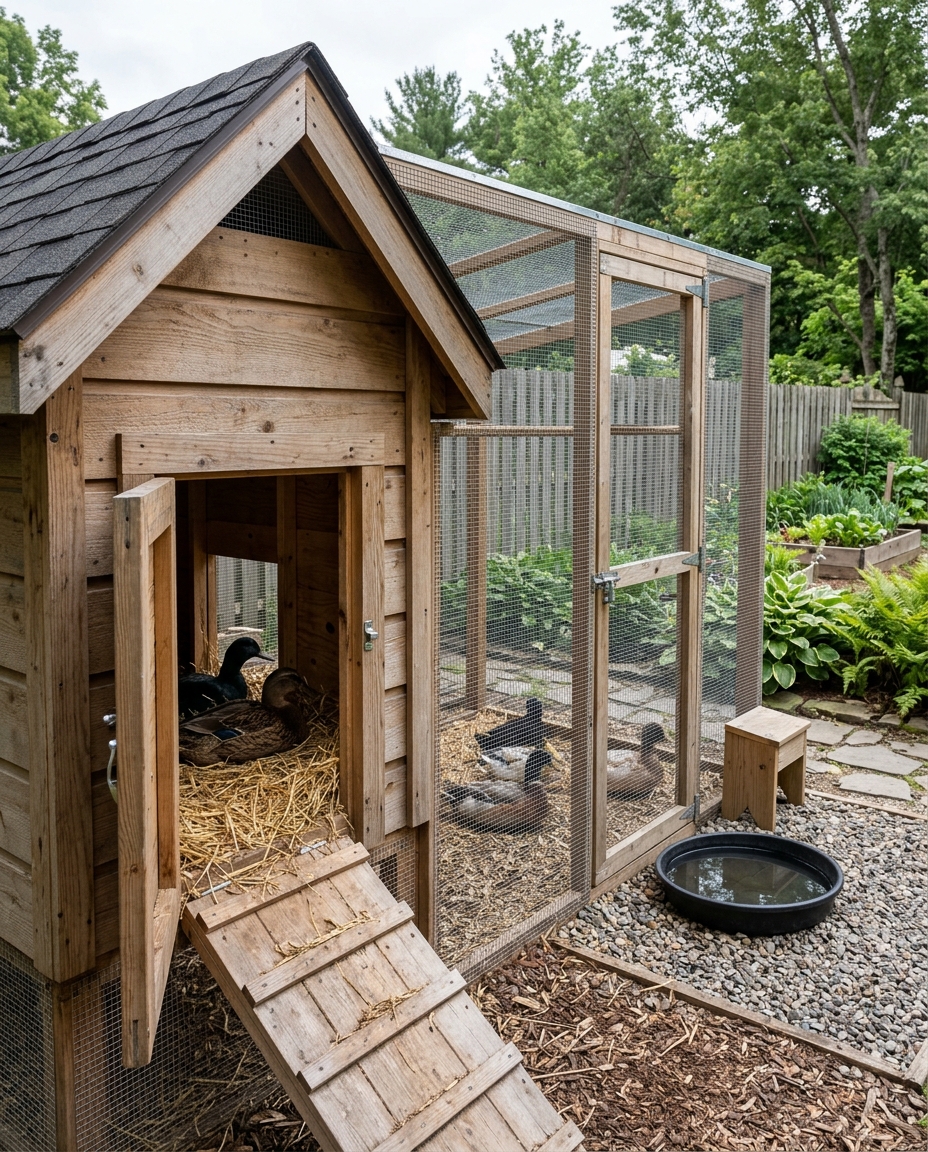
The sleeping house does not need chicken-style roosting infrastructure. Instead, prioritize dry floor space, bedding, ventilation, and easy access for cleaning. Penn State recommends dry, draft-free poultry housing and adequate ventilation, and it specifically advises placing waterers outside whenever practical for waterfowl because indoor water contributes to humidity.
The run should connect directly to the house through a low, easy-to-use duck doorway. Avoid steep ramps where possible because ducks are ground-oriented and generally move more comfortably through wide, low entrances. If elevation requires a ramp, make it broad, gently sloped, and textured enough to provide traction.
At night, the house adds another physical barrier between the flock and predators. Penn State and Oregon State both recommend securely closing poultry inside at night when outdoor runs are not completely predator resistant.
A removable wall panel or wide clean-out door makes the structure far easier to maintain. Because duck bedding can become damp quickly, a shelter that requires crawling through a tiny access hatch will become frustrating almost immediately.
Best For
Small to medium backyard flocks, wet climates, and keepers who want a clearly defined dry sleeping area.
3. The Hardware-Cloth Apron Enclosure
Burying fencing deeply can be effective, but it also requires significant digging and can be difficult in rocky or root-filled soil. An alternative DIY approach is an outward horizontal hardware-cloth apron around the perimeter.
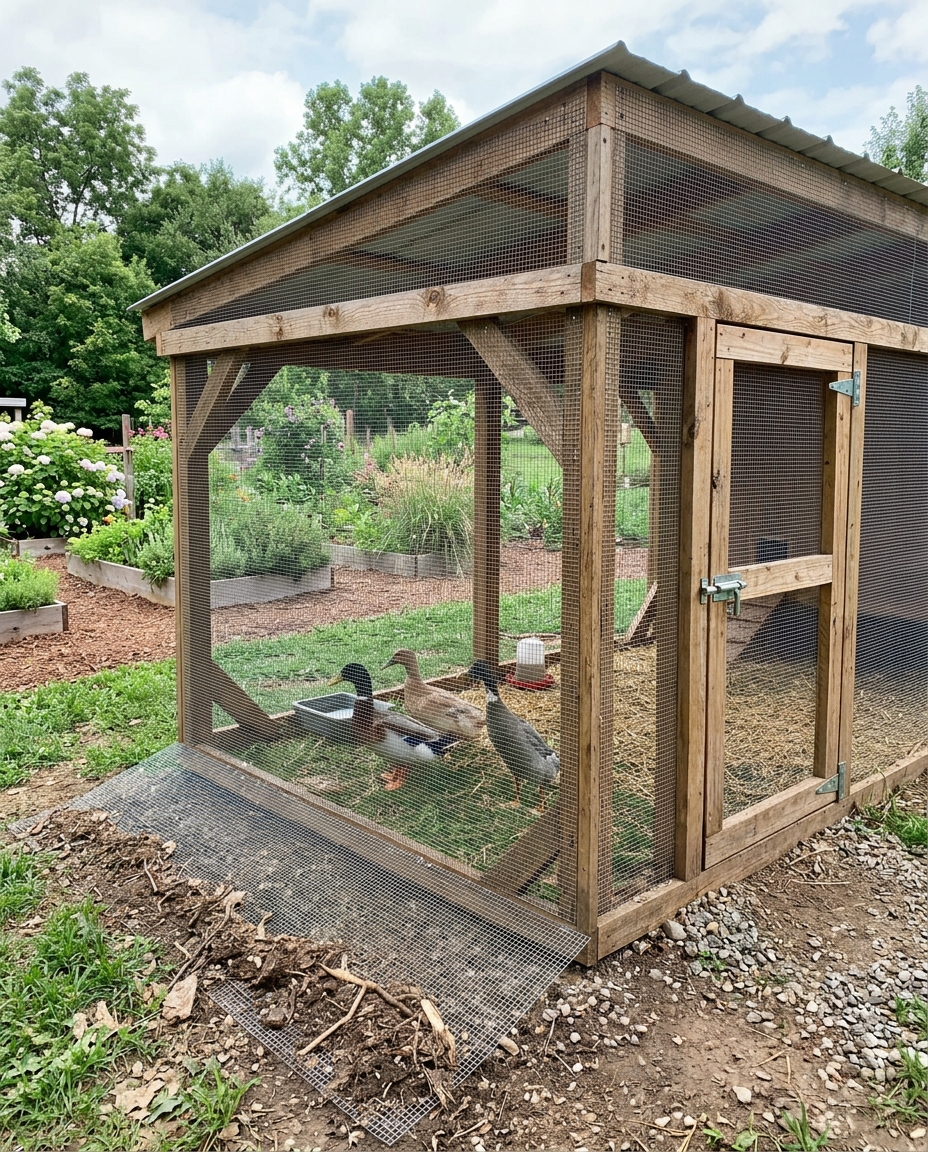
The basic principle is the same as buried fencing: digging predators tend to begin immediately beside the fence. Instead of finding open soil beneath the wall, they encounter wire extending outward from the base and must move much farther away before digging successfully.
Penn State’s poultry-housing guidance recommends burying fencing at least 12 inches and turning it outward approximately six inches because predators usually dig directly at the base of the fence. The apron design adapts this same principle horizontally and can be particularly useful where deep excavation is impractical.
The apron should be secured tightly to the enclosure wall with no gap at the connection point. It can then be pinned to the soil and covered lightly with soil, mulch, gravel, or turf as appropriate. The exact width should reflect local predator pressure and site conditions rather than relying on one universal measurement.
This style works particularly well around a permanent timber-framed enclosure where the walls are already strong, but the ground perimeter remains the weakest point.
Best For
Hard or rocky soils, established yards where deep trenching would be difficult, and retrofitting an existing enclosure.
4.The Deep-Buried Fence Duck Pen
If you are building a permanent enclosure from scratch and the soil is easy to excavate, a buried perimeter remains one of the most straightforward anti-dig designs.
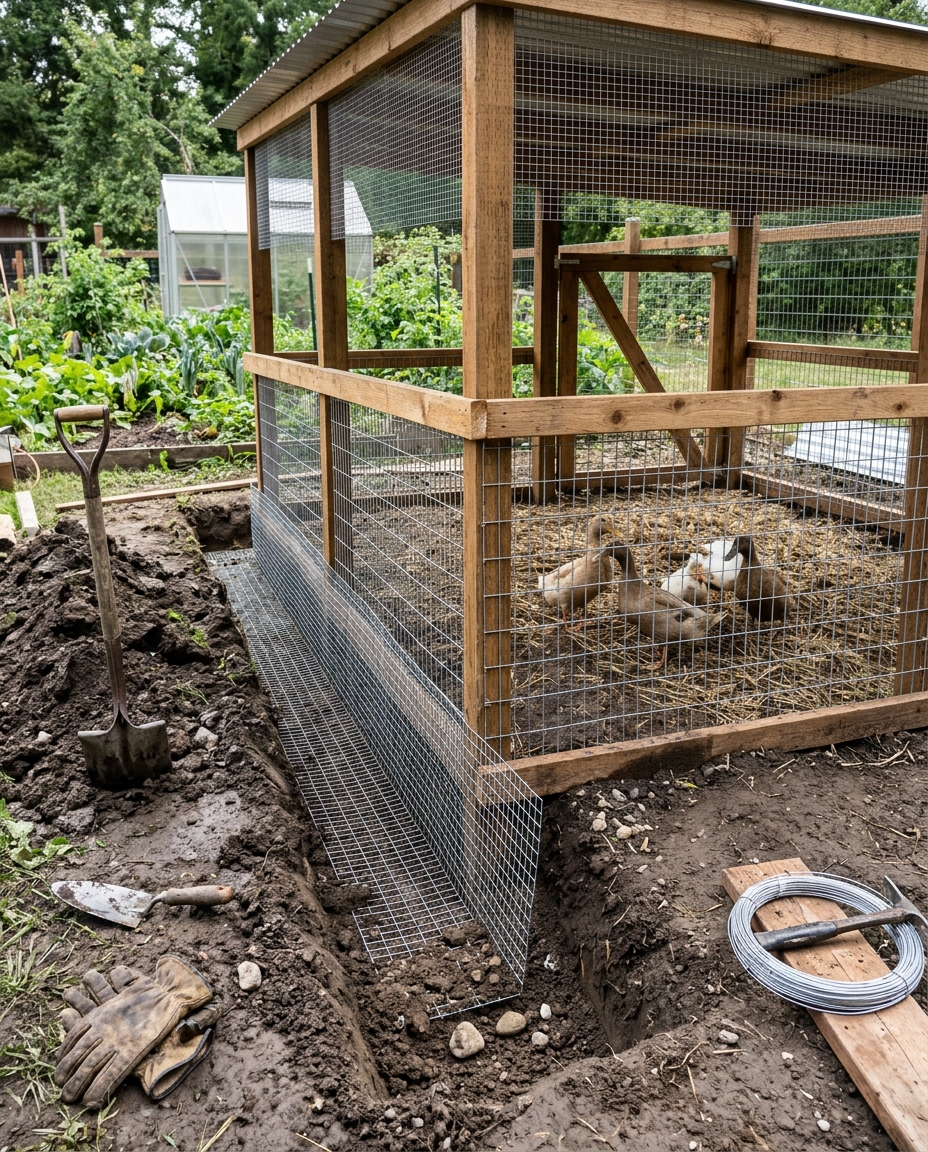
Penn State recommends burying poultry-run fencing approximately 12 inches and turning the lower section outward by about six inches. Oregon State’s backyard-poultry guidance similarly recommends burying fencing between six inches and one foot to discourage coyotes, foxes, rodents, dogs, and other digging predators.
The buried material should be durable enough to remain intact in damp soil. Galvanized welded mesh or hardware cloth is generally more appropriate for predator barriers than lightweight chicken wire, which is primarily designed to contain poultry rather than withstand determined predators.
The advantage of this design is that the visible enclosure can remain relatively clean and simple. Once the trench is backfilled, the anti-dig system disappears beneath the surface.
The disadvantage is inspection. Buried wire is harder to examine for corrosion or damage, which makes material quality important from the beginning. In areas with very wet soil, drainage around the perimeter also deserves attention because constantly saturated ground accelerates deterioration and creates unpleasant conditions for ducks.
5. The Covered Cattle-Panel Hoop Enclosure
Cattle panels are useful for DIY poultry projects because their rigidity makes it possible to create a curved roof without complicated framing. Two or more panels can be bent into an arch over a rectangular base, creating a walk-in tunnel-shaped structure.
University of Minnesota uses cattle panels in its DIY mobile poultry-hut design, then wraps the lower half with ½-inch hardware cloth to reduce reach-through attacks by ground predators. The university specifically warns that ordinary poultry wire has openings large enough for some predators to reach through and injure birds.
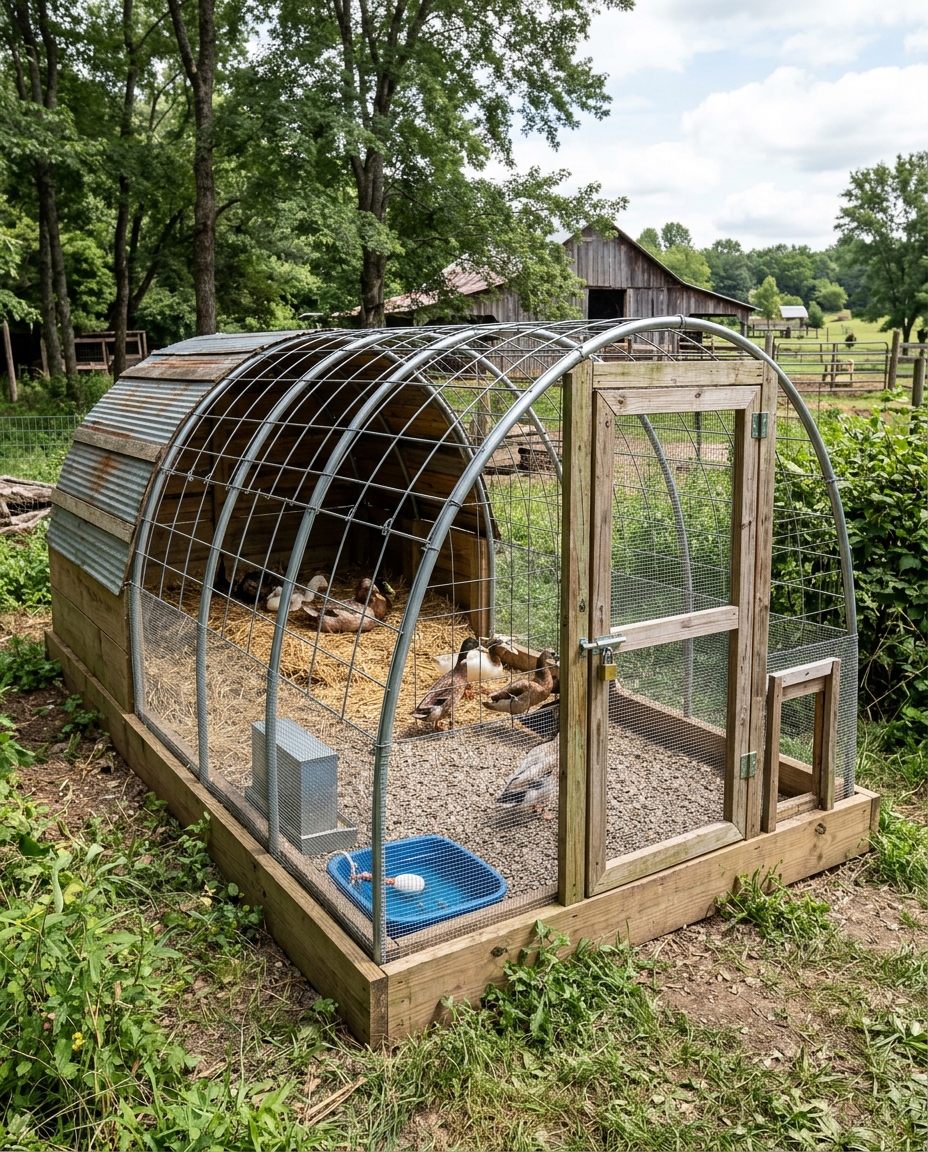
For ducks, the lower hardware-cloth section is particularly useful because the birds spend nearly all of their time at ground level. Finish the upper arch with additional welded mesh and a weatherproof roof section that provides shade and rain protection.
One end can contain a simple dry sleeping shelter or three-sided weather refuge, while the opposite end becomes the water zone. Because the structure naturally has good headroom in the middle, it remains easy for a person to enter with bedding or cleaning tools.
The primary weakness of hoop designs is the connection between the curved panel and the ground frame. Every gap along that lower edge should be reinforced carefully, and the structure should be anchored strongly enough that wind cannot lift it.
Best For
Budget-conscious DIY builders, medium-sized runs, temporary-to-semi-permanent setups, and anyone comfortable working with cattle panels.
6. The Raised Duck House Over a Secure Run
Raising the sleeping house above part of the run makes good use of vertical space even though the ducks themselves spend most of their time on the ground. The shaded area beneath the structure becomes additional covered run space while the elevated floor keeps the sleeping bedding farther from damp soil.
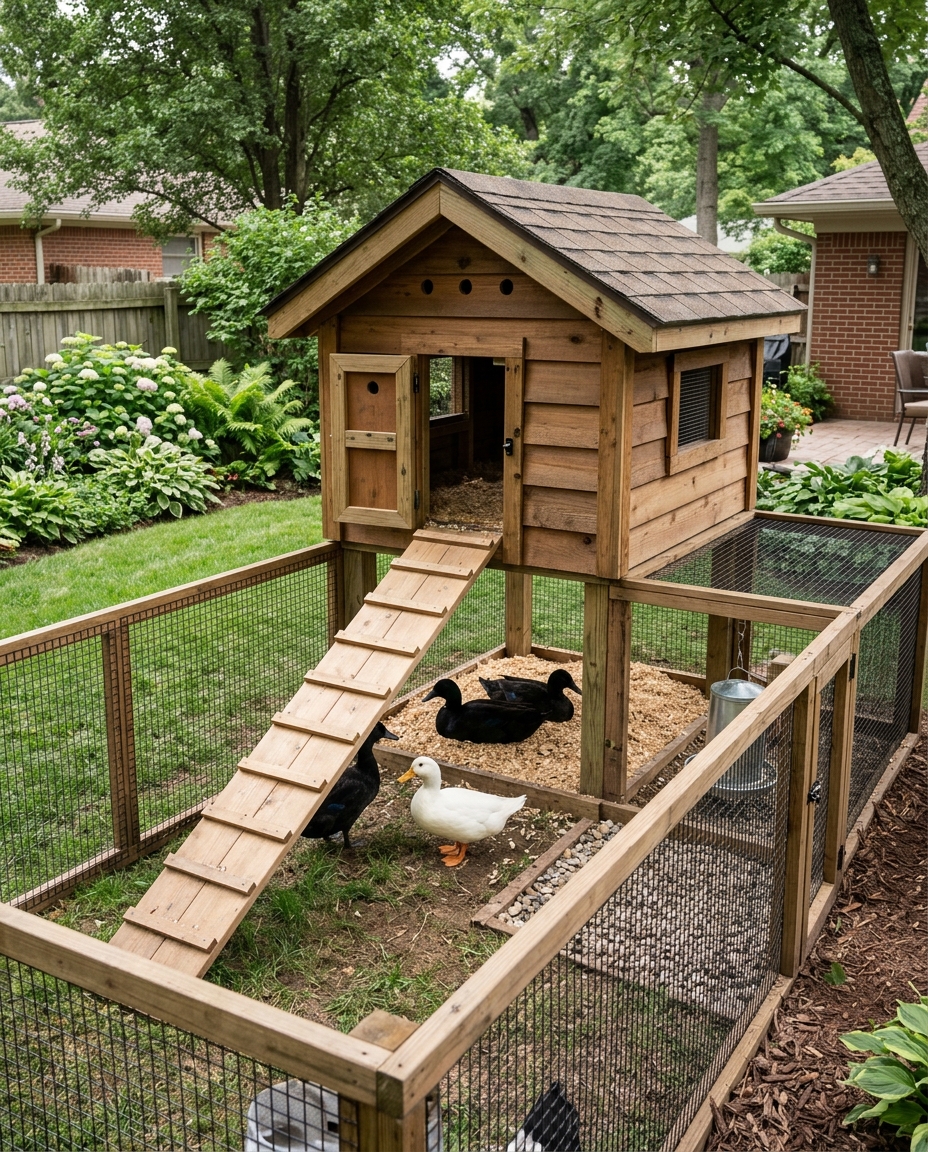
The house should not be raised so high that the ducks need a steep ramp. A low elevation is usually sufficient to create airflow beneath the floor and provide sheltered space while still allowing a broad, gentle entrance ramp.
The area under the house can become one of the driest sections of the run if roof runoff is directed away correctly. That makes it useful for resting, feeding, or simply escaping strong sun.
Predator resistance still depends on enclosing the entire ground-level run rather than assuming elevation protects the flock. Oregon State recommends secure flooring or elevation to discourage some rodents, snakes, raccoons, and skunks from entering poultry houses, but the surrounding run still requires its own mesh, roof, and anti-dig protection.
For daily care, add an exterior clean-out panel to the raised sleeping compartment. Opening one large wall is much easier than trying to crawl through the duck doorway every time bedding needs replacement.
7. The Paver-Perimeter Duck Enclosure
A paver perimeter combines a solid visual border with additional resistance to digging predators and can be especially practical around a compact backyard enclosure.
Heavy pavers or concrete edging blocks can be placed beneath and outside the fence line, creating a hard surface where a predator would normally begin digging. The wire wall should still be mechanically secured to the frame rather than relying on the pavers alone.
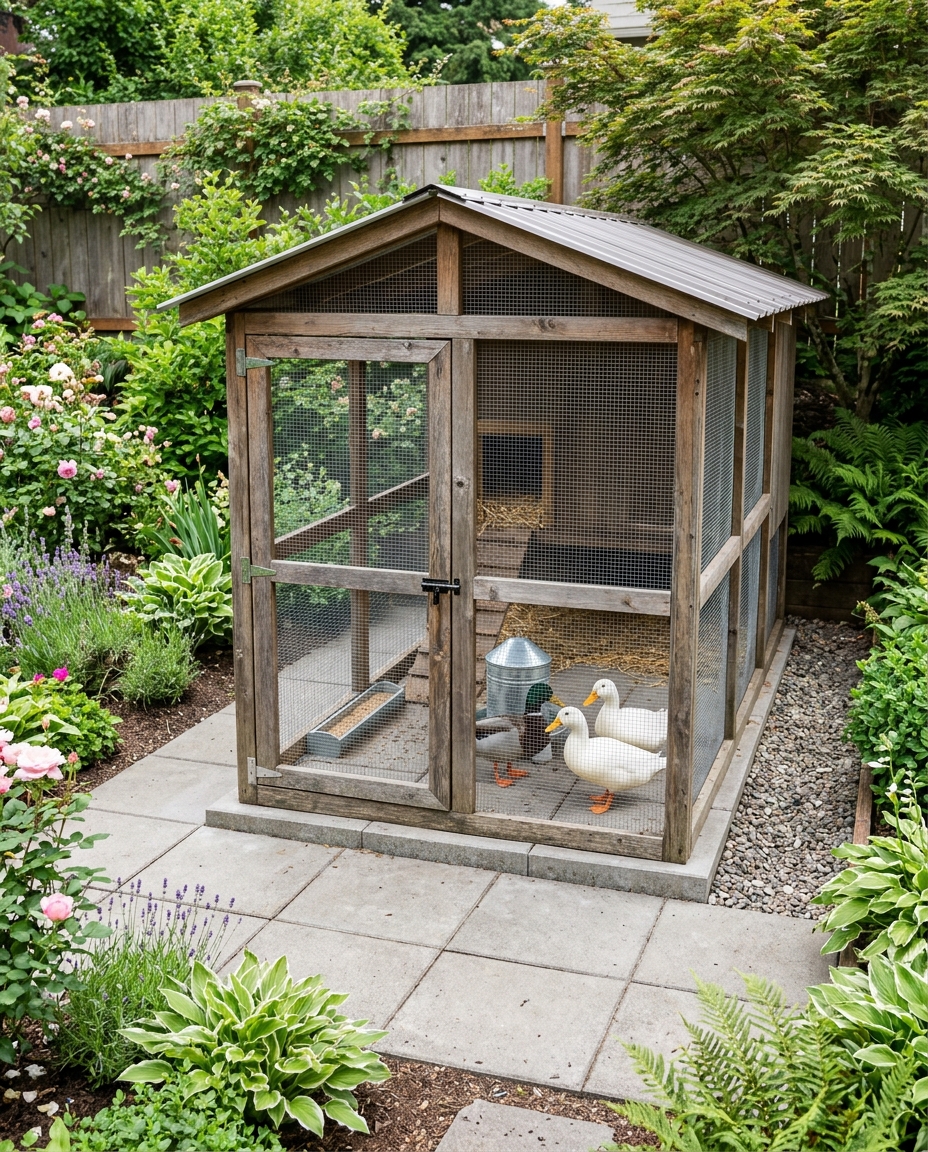
This design is particularly useful around water zones because pavers also reduce mud. Ducks can turn bare soil surrounding a tub or drinking station into slurry surprisingly quickly, so extending the hard surface into the wet section makes the area easier to rinse or scrape.
A layer of coarse gravel beyond the pavers can further improve drainage. Penn State stresses locating poultry housing on high, well-drained ground to avoid prolonged floor saturation, a recommendation that becomes especially relevant with waterfowl.
The enclosure still needs overhead protection and secure walls. Pavers solve one specific weakness—the ground edge—but should be part of a larger protection system rather than being treated as a substitute for strong fencing.
Best For
Small suburban yards, muddy sites, enclosures with permanent water stations, and owners who want an easy-to-clean perimeter.
8. The Lean-To Duck Run Against a Shed
If you already have a sturdy shed, barn wall, or other appropriate outbuilding, a lean-to enclosure can reduce material costs while creating a sheltered dry side for the ducks.
The existing wall becomes one side of the enclosure, while posts support the remaining mesh walls and a sloped roof. This makes it easy to add a weather-protected sleeping area against the building and leave the outer portion more open for daytime activity.
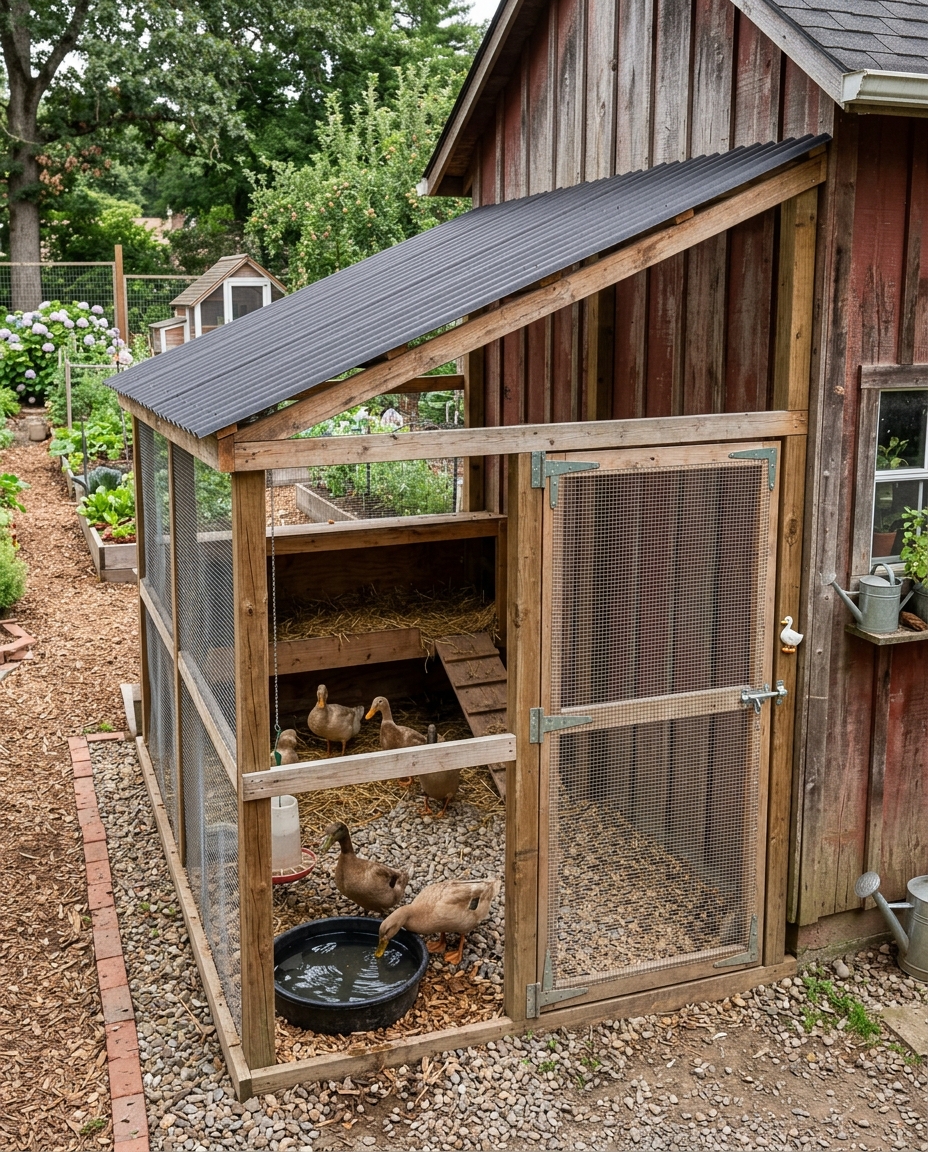
The junction between the new enclosure and existing structure requires careful inspection. Small gaps beside siding, roof edges, or foundations can become entry points for rodents or predators. Flashing, framing, and mesh should connect tightly enough that the old and new structures function as one enclosure rather than two loosely touching components.
A sloped roof is especially useful for ducks because it can direct rainfall away from the primary run and sleeping zone. Keep gutters or runoff channels away from the enclosure entrance so stormwater does not turn the floor into mud.
Ventilation should still be designed into the shelter. Penn State emphasizes ample airflow without drafts and notes that dampness and ammonia buildup indicate inadequate ventilation.
Best For
Backyards with an existing shed, narrow side yards, and DIY builders looking to reduce the amount of new framing required.
9. The Mobile Duck Tractor With Reinforced Lower Walls
A mobile duck enclosure allows the flock to spend time on fresh ground while limiting damage to any one section of the yard. The structure can be moved periodically so manure is distributed and vegetation has more opportunity to recover.
Mobility creates a challenge, however: permanent buried fencing is impossible. That makes the strength of the ground edge especially important.
University of Minnesota’s mobile poultry hut solves part of this problem by using ½-inch hardware cloth around the lower half and constructing the structure on heavy wooden runners with optional wheels. For ducks, the bottom frame should sit as close to the ground as practical without leaving gaps that a predator can exploit.
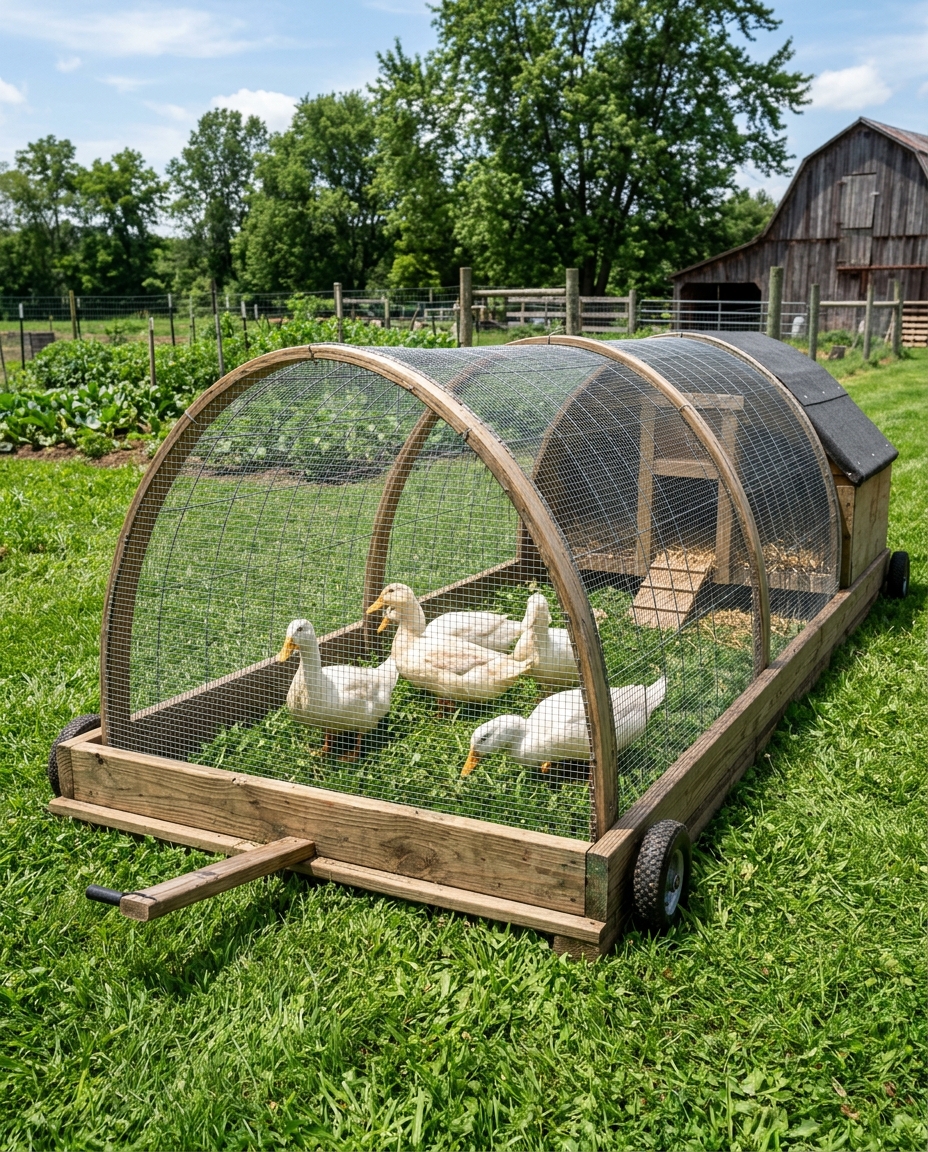
A mobile enclosure is best used as supervised or daytime housing unless its design truly provides strong nighttime security on every new patch of ground. Uneven soil can create gaps beneath the frame even when the tractor fit tightly in its previous position.
A lightweight enclosed sleeping box at one end provides shade and weather protection. Avoid making the overall structure so heavy that moving it becomes impossible, but do not sacrifice rigidity simply to save weight.
Best For
Small flocks, rotational grazing, gardens with several usable lawn areas, and keepers who want to move ducks regularly.
10. The Wet-Zone/Dry-Zone Duck Enclosure
One of the most practical duck enclosures is designed around the fact that water will create mess no matter how carefully you manage it. Instead of trying to keep the entire run dry, intentionally build one section to handle moisture and protect the rest.
Place drinking tubs, bathing water, and any shallow pool on a gravel bed, pavers, or another drainable surface near the outer edge of the run. The dry zone contains bedding, feed, and the sleeping shelter. A slight grade or physical border between the two areas helps stop water from constantly migrating toward the bedding.
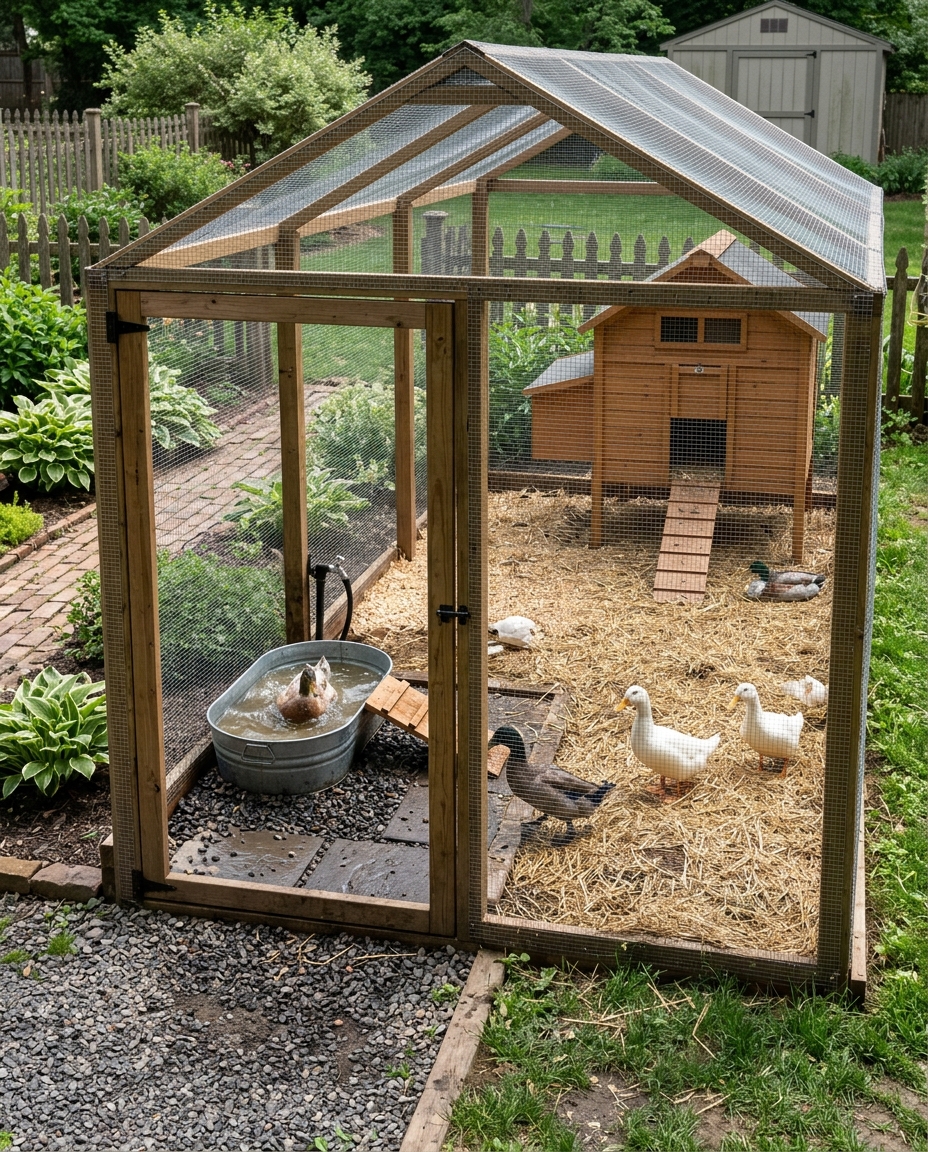
Penn State specifically recommends placing water outside the poultry house whenever possible for waterfowl because doing so lowers indoor humidity. It also stresses building poultry housing on well-drained ground to avoid persistent dampness.
This layout becomes much easier to maintain if the water zone sits near a gate. Heavy tubs can be emptied, scrubbed, and refilled without carrying them across clean bedding or dragging a hose through the sleeping area.
The enclosure itself should still use secure mesh, an anti-dig barrier, overhead protection, and a lockable nighttime shelter. The wet/dry layout does not replace predator resistance; it simply makes the protected enclosure much more manageable for a species that loves water.
Best For
Almost every backyard duck flock, particularly wet climates or enclosures where mud has already become difficult to control.
What Actually Makes a Duck Enclosure Predator-Resistant?
Predator resistance is rarely created by one material. The strongest enclosures use several defenses that address different methods of entry.
Ground predators may dig beneath the wall, which is why buried fencing or an outward apron matters. Raccoons and similar animals may reach through large openings, making finer mesh important near ground level. Hawks and owls attack from above, so uncovered runs remain vulnerable even if the side walls are strong. Doors and gates create another weakness because a perfectly built fence does little good when a latch does not hold securely.
Penn State describes complete confinement with fenced and covered runs as the strongest protection from predators and recommends buried fencing, while Mississippi State emphasizes small mesh openings, covered pens, and securely closing poultry into shelter at night.
Predator-Resistance Checklist
| Weak Point | Practical Defense |
|---|---|
| Digging beneath fence | Buried mesh or outward apron |
| Reaching through walls | Small-opening hardware cloth near ground |
| Aerial predators | Covered run |
| Gaps around doors | Tight framing and inspection |
| Loose gate | Strong secure latch |
| Night attacks | Lockable enclosed sleeping shelter |
| Rodents around feed | Secure feed storage and cleanup |
| Weak mesh connections | Screws/washers or secure heavy-duty fastening |
Think of the enclosure as a continuous shell. Predators do not care whether most of the structure is strong; they only need one usable opening.
Hardware Cloth vs. Chicken Wire
Chicken wire is excellent at keeping chickens or ducks inside an area, but containment and predator exclusion are not the same thing.
University of Minnesota’s mobile poultry-hut instructions specifically reserve ½-inch hardware cloth for the lower half of the structure because the openings in ordinary poultry wire are large enough for some ground predators to reach through. Mississippi State similarly recommends openings smaller than one inch where predator resistance is important because raccoons can reach through larger fencing.
This does not necessarily mean every square inch of a large run must use the most expensive hardware cloth available. A practical budget design may use stronger fine mesh around the lower walls, doors, vents, and vulnerable sleeping areas while using suitable welded wire elsewhere.
The key is understanding what each material is doing. If the wire’s main job is to stop a duck from leaving, lighter poultry mesh may accomplish that. If its job is to stop a determined predator from reaching or breaking through, stronger welded material deserves priority.
How Far Should You Bury the Fence?
Different Extension recommendations provide a useful range rather than one universal measurement. Oregon State recommends burying poultry fencing about six inches to one foot, while Penn State recommends at least 12 inches and an outward toe of approximately six inches.
Local predator pressure matters. A suburban enclosure mostly exposed to neighborhood dogs may face a different challenge from a rural flock visited by foxes, coyotes, raccoons, or other wildlife.
Soil matters too. Loose sandy soil is easier for animals to excavate than dense rocky ground. If deep burial is not practical, a broad surface apron can provide another layer of resistance.
Whichever method you choose, inspect the perimeter regularly. Animals often begin with small exploratory holes, and catching those attempts early is far easier than repairing major damage after something has learned where the enclosure is vulnerable.
Why the Roof Matters
A roof is useful for far more than keeping rain off the ducks.
Solid roofing provides shade, protects a dry section from bad weather, and reduces the amount of water entering the bedding. Mesh roofing protects against hawks and owls and can reduce contact with wild birds. Penn State and Mississippi State both recommend overhead protection where predation from above is a concern.
For many backyard setups, combining the two works well. Cover part of the enclosure with a solid waterproof roof for weather protection and use secure mesh over the remaining portion.
A completely solid roof may require more structural support, especially in areas exposed to heavy snow or strong wind. Any DIY roof should be designed for local weather conditions rather than copied purely from a photograph.
The most important point is that an enclosure with four secure walls but an entirely open top still has a major vulnerability.
Keep Duck Water Outside the Sleeping House
Ducks are extremely good at moving water from the drinker onto everything around it. Their water system therefore belongs in the run whenever the weather and enclosure design allow rather than beside the sleeping bedding.
Penn State specifically recommends placing waterers in outdoor runs where possible for waterfowl because this helps keep indoor humidity lower.
This also makes bedding last longer. Even a well-designed waterer can become messy when ducks wash their bills and splash, and a bathing tub creates much more moisture.
Positioning the water over gravel, pavers, or another drainable surface gives the wet area somewhere to discharge without turning the sleeping section into mud. A removable gravel layer or drainage bed can be refreshed much more easily than repeatedly replacing saturated straw across an entire enclosure.
Keep feed a short distance away from the bathing water as well. Constantly soaked feed spoils and attracts additional mess.
How Much Space Do Ducks Need?
Space recommendations vary according to breed, management system, climate, and how much time ducks spend outside. Penn State’s small-scale poultry housing guidance lists approximately 3 square feet of indoor space and 15 square feet of outside run space per duck as a minimum housing reference.
More room is often easier to manage than minimum dimensions, particularly because ducks create concentrated moisture and manure quickly. A larger run spreads traffic across a wider area, reduces crowding around water, and provides more flexibility for dividing the enclosure into dry and wet zones.
Think about usable space rather than only total measurements. A large run filled with a huge pool, storage bins, and narrow dead ends may provide less useful movement space than a smaller but better-organized layout.
Also plan for the flock you expect to keep, not merely the flock you currently own. If you are building a permanent enclosure and know that four ducks may eventually become six, adding capacity during construction is usually easier than extending the structure later.
Ventilation Matters Even in a Secure Duck House
Closing a shelter tightly can feel safer from predators, but a secure duck house still needs ventilation.
Poultry housing accumulates moisture, ammonia, and carbon dioxide, and Penn State emphasizes the importance of ample air exchange without direct drafts. Its guidance identifies dampness and ammonia odor as signs that ventilation is inadequate.
Duck housing can become humid particularly quickly because of the birds’ relationship with water and wet bedding. High vents protected by strong mesh allow stale air and moisture to leave while preventing predators from turning the opening into an entry point.
Ventilation should not mean leaving a large unprotected window open all night. Every opening that exchanges air should still function as part of the enclosure’s predator-resistant shell.
If condensation appears repeatedly or the bedding remains damp despite keeping water outside, improving airflow and cleaning frequency is more useful than simply adding more bedding on top.
Secure Doors Are Often the Weakest Part of the Enclosure
DIY builders naturally focus on walls and wire, but gates contain multiple potential weak points: hinges, gaps around the frame, the lower threshold, and the latch.
The gate should fit closely enough that a predator cannot force its head or paw into the space beside it. The lower edge deserves particular attention because uneven ground can create a gap that looks small to a person but large enough for an animal to investigate.
Use exterior-grade hinges sized for the door rather than lightweight decorative hardware. The latch should remain secure if pushed, pulled, bumped, or manipulated.
A second closure or locking mechanism adds another layer of security if raccoons or other dexterous predators are common locally.
Inspect doors frequently because repeated use naturally causes more movement and wear there than anywhere else in the enclosure.
Make the Enclosure Easy for Humans to Maintain
A technically secure enclosure can still be a poor design if daily care is unnecessarily difficult.
Give yourself a full-size door whenever possible. A narrow opening becomes particularly frustrating when carrying bedding, feed, a water tub, or an injured duck.
Put the water zone close to the gate so tubs are easy to clean. Add a large access panel to the sleeping house so bedding can be removed without crawling through the duck entrance.
Keep feed storage outside the bird area in a dry, rodent-resistant container. Penn State recommends managing food and housing in ways that discourage predators and rodents, which also means cleaning spilled feed rather than leaving it around the run overnight.
Practical design indirectly improves safety because enclosures that are easy to clean and inspect are more likely to receive consistent maintenance.
Common Duck-Enclosure Mistakes
One of the most common mistakes is treating ordinary chicken wire as a complete predator barrier. Lightweight wire may keep ducks inside, but stronger predators can exploit larger openings or weak construction, particularly around ground level.
Another problem is securing the walls while leaving the bottom edge exposed. Foxes, dogs, coyotes, and other animals often investigate the fence line directly, making the ground perimeter one of the first places to reinforce.
Open roofs create another obvious vulnerability. Even if aerial attacks are uncommon in your yard, overhead mesh also reduces contact with wild birds, which can be useful from a biosecurity perspective. University of Minnesota recommends enclosed shelters and fenced areas and notes that smaller mesh hardware cloth can help limit contact with wild birds.
Poor drainage is the major duck-specific mistake. Putting a large bathing tub on bare soil inside a compact run may create a mud pit surprisingly quickly. The enclosure should be designed around water management from the beginning rather than trying to solve it after the entire floor becomes saturated.
Finally, do not assume one successful year means the enclosure no longer needs inspection. Wire rusts, wood shifts, rodents chew, soil erodes, and predators learn. Regularly examine the entire perimeter, roof, doors, ventilation openings, and shelter floor.
10 DIY Duck Enclosure Ideas at a Glance
| Enclosure Idea | Main Advantage | Predator-Resistance Feature |
|---|---|---|
| Walk-in hardware-cloth run | Easy daily maintenance | Fine lower mesh + covered top |
| Duck house + attached run | Strong nighttime protection | Second secure barrier |
| Hardware-cloth apron | No deep trench required | Horizontal anti-dig barrier |
| Buried-fence pen | Permanent ground defense | Deep buried mesh |
| Cattle-panel hoop | Affordable large enclosure | Hardware-cloth lower section |
| Raised house + run | Keeps sleeping area drier | Secure raised flooring + enclosed run |
| Paver-perimeter run | Reduces mud and digging | Hard ground boundary |
| Lean-to enclosure | Uses existing structure | Fewer exposed walls |
| Mobile duck tractor | Rotational ground use | Reinforced lower walls |
| Wet-zone/dry-zone run | Easier duck-specific management | Secure shell + controlled drainage |
Final Thoughts
The best duck enclosure is not necessarily the most complicated one. It is the design that keeps the flock dry enough to stay comfortable, gives them enough room to behave naturally, and makes it difficult for predators to find an easy way inside.
Start with the outer shell. Use materials strong enough for the predator pressure in your area, reinforce the lower walls, secure the roof, and stop animals from simply digging underneath the perimeter. Penn State, Oregon State, Mississippi State, and University of Minnesota poultry guidance all emphasize some version of those same principles: secure confinement, protected openings, overhead barriers, and defenses against ground predators.
Then design around the fact that ducks are waterfowl. Put drinking and bathing areas where splashing can drain away, protect bedding from constant moisture, and maintain good ventilation in the sleeping shelter. A beautiful duck house that remains permanently wet is not a successful design.
Finally, build for yourself as well as the ducks. Give yourself a proper gate, easy access to water, removable bedding, and a clear view of the perimeter. An enclosure that takes five minutes to inspect is more likely to stay secure than one with hidden corners you rarely want to crawl into.
Predator resistance comes from layers, not one magic material.
A secure roof protects from above.
Strong mesh protects the walls.
An apron, trench, or solid perimeter protects below.
A well-built shelter adds nighttime security.
Good drainage keeps the structure healthier and easier to maintain.
When those pieces work together, a DIY duck enclosure can be practical, attractive, and far more difficult for predators to defeat.